

Achive your Success with Latest Fortinet FCP_FAZ_AD-7.4 Exam [Jun 29, 2026]
The FCP_FAZ_AD-7.4 Exam Test For Brief Preparation
NEW QUESTION # 57
Which two statements about deleting ADOMs are true? (Choose two.)
- A. Default ADOMs cannot be deleted.
- B. Logs must be purged or migrated before you can delete an ADOM.
- C. ADOMs with registered devices cannot be deleted.
- D. The status of the ADOMs must be unlocked.
Answer: A,C
Explanation:
DOMs with registered devices cannot be deleted.
An ADOM cannot be deleted if it has registered devices. You must first remove or deregister the devices before deleting the ADOM.
The status of the ADOMs must be unlocked.
An ADOM must be in an unlocked state before it can be deleted. If the ADOM is locked, it will not allow deletion.
NEW QUESTION # 58
A rogue administrator was accessing FortiAnalyzer without permission, and you are tasked to see what activity was performed by that rogue administrator on FortiAnalyzer.
What can you do on FortiAnalyzer to accomplish this?
- A. Click FortiView and generate a report for that administrator.
- B. Click Task Monitor and view the tasks performed by that administrator.
- C. View the tasks performed by the rogue administrator in Fabric View.
- D. Click Log View and generate a report for that administrator.
Answer: B
Explanation:
Reference: https://docs.fortinet.com/document/fortimanager/6.4.1/administration-guide/792943/task-monitor FortiAnalyzer_7.0_Study_Guide-Online.pdf page 54: View the tasks FortiAnalyzer administrators have performed, including progress and status.
NEW QUESTION # 59
What is the purpose of a predefined template on the FortiAnalyzer?
- A. It specifies report settings which contains time period, device selection, and schedule
- B. It contains predefined data to generate mock reports
- C. It can be edited and modified as required
- D. It specifies the report layout which contains predefined texts, charts, and macros
Answer: D
Explanation:
Reference: https://help.fortinet.com/fa/faz50hlp/56/5-6-2/FMGFAZ/
2300_Reports/0010_Predefined_reports.htm#:~:text=FortiAnalyzer%20includes%20a%20number%
20of,create%20and%2For%20build%20reports.&text=A%20template%20populates%20the%20Layout,that%
20is%20to%20be%20created.
https://help.fortinet.com/fa/faz50hlp/56/5-6-2/FMG-FAZ/2300_Reports/0010_Predefined_reports.htm Reference: https://docs2.fortinet.com/document/fortianalyzer/6.0.8/administration-guide/618245/predefined- reports-templates-charts-and-macros
NEW QUESTION # 60
Refer to the exhibit.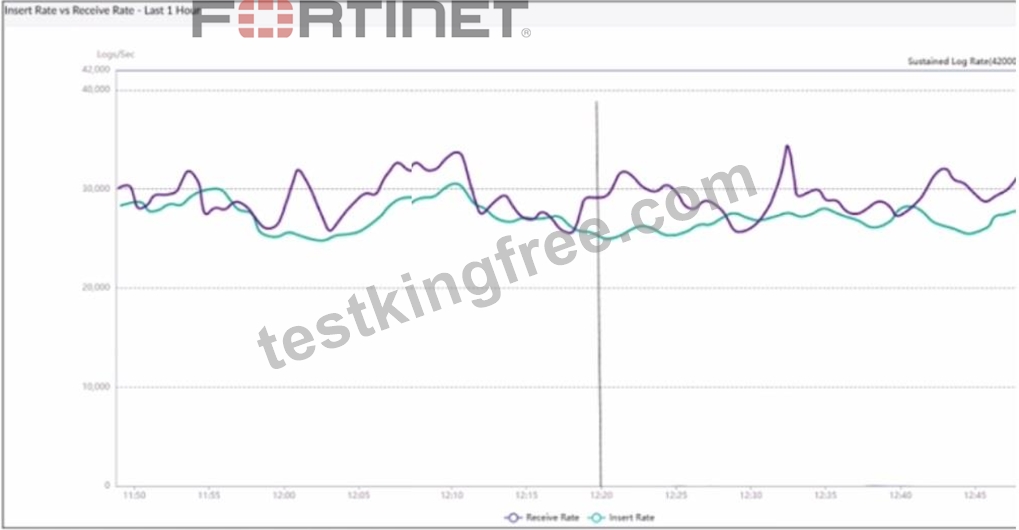
What does the data point at 12:20 indicate?
- A. The log insert lag time is increasing.
- B. FortiAnalyzer is using its cache to avoid dropping logs.
- C. The sqlplugind service is caught up with new logs.
- D. The performance of FortiAnalyzer is below the baseline.
Answer: C
NEW QUESTION # 61
What is the purpose of employing RAID with FortiAnalyzer?
- A. To introduce redundancy to your log data
- B. To back up your logs
- C. To provide data separation between ADOMs
- D. To separate analytical and archive data
Answer: A
Explanation:
https://en.wikipedia.org/wiki/RAID#:~:text=RAID%20(%22Redundant%20Array%20of%20Inexpensive,%
2C%20performance%20improvement%2C%20or%20both.
NEW QUESTION # 62
Which three RAID configurations provide fault tolerance on FortiAnalyzer? (Choose three.)
- A. RAID1
- B. RAID 5
- C. RAID 6+0
- D. RAIDO
- E. RAID 0+0
Answer: A,B,C
Explanation:
RAID 1 provides fault tolerance through disk mirroring.
RAID 5 provides fault tolerance by using distributed parity across multiple disks.
RAID 6+0 combines striping with double parity, offering enhanced fault tolerance.
RAID 0 and RAID 0+0 do not provide any fault tolerance, as they focus on performance through data striping but offer no redundancy.
NEW QUESTION # 63
Refer to the exhibit.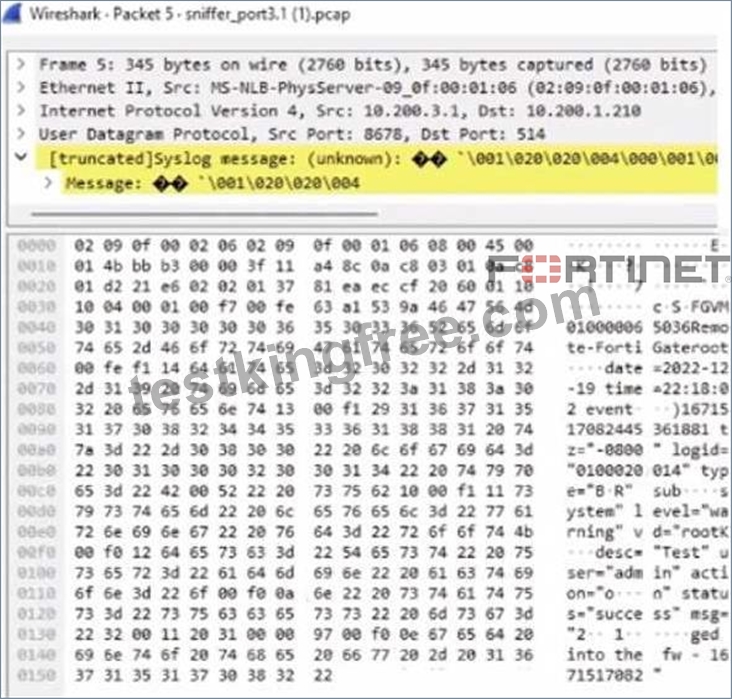
Which image corresponds to the packet capture shown in the exhibit?
- A.

- B.

- C.

Answer: C
Explanation:
The exhibit shows a packet capture with a syslog message containing a log event from a FortiGate device. This log event includes several details such as the date, time, and event message. The corresponding image that matches this packet capture would be the one which shows that the FortiGate device has logs being received in real-time, as indicated by the highlighted section in the packet capture where it mentions "real-time". Therefore, Option A is the correct answer because it shows logs with "Real Time" status for the FortiGate-VM64 device, indicating that this FortiAnalyzer is currently receiving real- time logs from the device, matching the activity in the packet capture.
Reference: Based on the provided exhibits and the real-time logging information, correlated with the knowledge from the FortiAnalyzer 7.2 Administrator documentation regarding log reception and device management.
NEW QUESTION # 64
What are offline logs on FortiAnalyzer?
- A. Real-time logs that are not yet indexed
- B. Any logs collected from offline devices after they boot up
- C. Compressed logs, also known as archive logs
- D. Logs that are indexed and stored in the SQL database
Answer: C
Explanation:
Archive logs: When a real-time log file in Archive has been completely inserted, that file is compressed and considered to be offline." https://docs.fortinet.com/document/fortianalyzer/7.4.3/administration-guide/381919/logs
NEW QUESTION # 65
Which two statements are true regarding the log synchronization states for HA on FortiAnalyzer?
(Choose two.)
- A. When Log Data Sync is turned on, the backup device reboots and then rebuilds the log database with the synchronized logs.
- B. By default. Log Data Sync is disabled on all backup devices.
- C. With Initial Logs Sync, when you add a unit to an HA cluster, the primary device synchronizes its logs with the backup device.
- D. Log Data Sync provides real-time log synchronization to all backup devices.
Answer: C,D
Explanation:
Log Data Sync provides real-time log synchronization to all backup devices. - Log Data Sync in FortiAnalyzer HA setups is designed to ensure that all backup devices in the cluster are kept up-to-date with real-time log data from the primary device. This synchronization helps maintain log integrity and availability even in the event of a primary device failure.
With Initial Logs Sync, when you add a unit to an HA cluster, the primary device synchronizes its logs with the backup device. - When a new unit is added to an HA cluster, Initial Logs Sync is crucial to ensure that the new unit starts with a complete set of logs. This process involves the primary device synchronizing its existing logs to the newly added backup unit, which ensures consistency across the cluster.
NEW QUESTION # 66
How are logs forwarded when FortiAnalyzer is using aggregation mode?
- A. Logs and content files are forwarded as they are received.
- B. Logs are forwarded as they are received and content files are uploaded at a scheduled time.
- C. Logs are forwarded as they are received.
- D. Logs and content files are stored and uploaded at a scheduled time.
Answer: D
Explanation:
https://www.fortinetguru.com/2020/07/log-forwarding-fortianalyzer-fortios-6-2-3/
https://docs.fortinet.com/document/fortianalyzer/6.2.0/administration-guide/420493/modes Reference: https://docs.fortinet.com/document/fortianalyzer/6.2.0/cookbook/63238/what-is-the-difference- between-log-forward-and-log-aggregation-modes
NEW QUESTION # 67
Refer to the exhibit.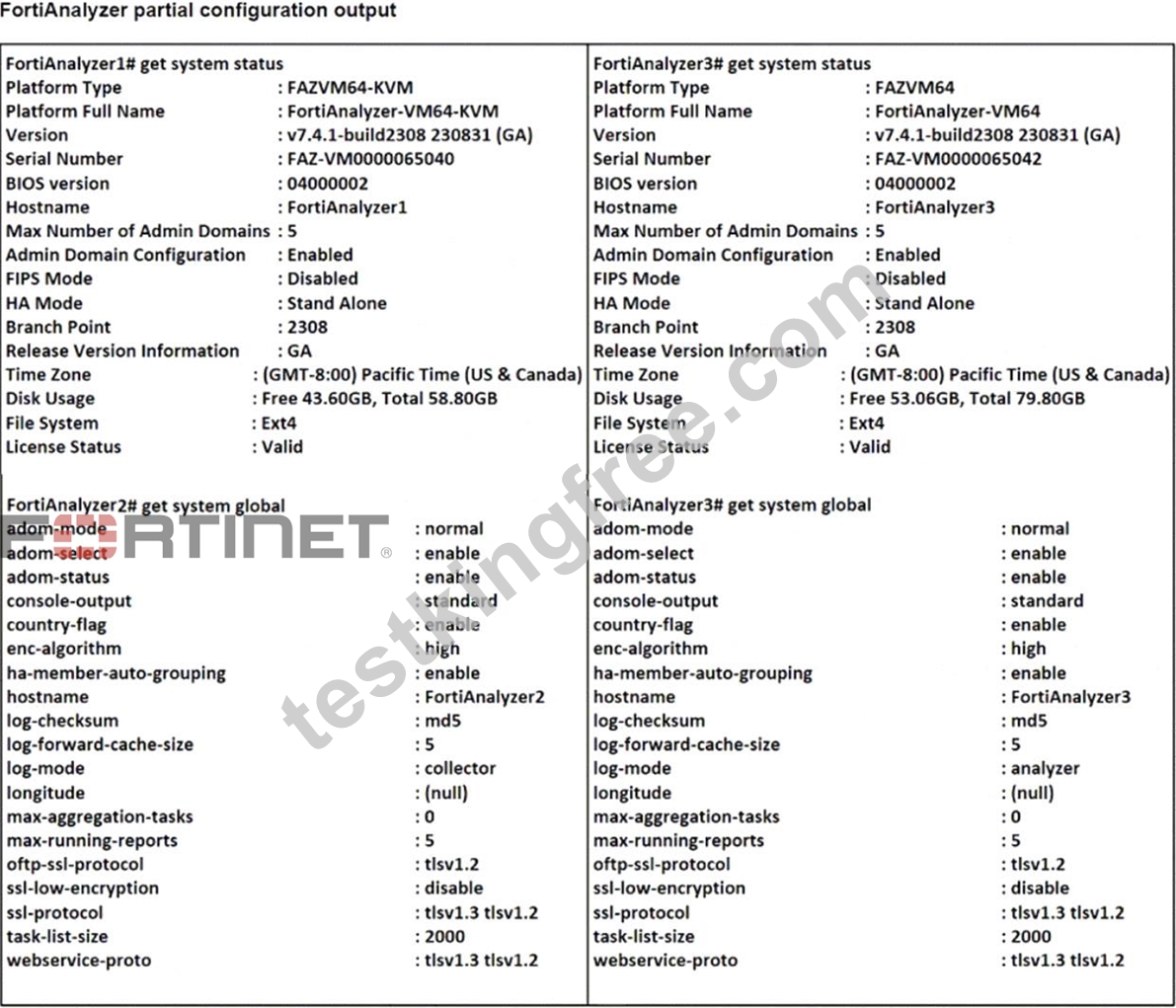
Based on the partial outputs displayed, which devices can be members of a FortiAnalyzer Fabric?
- A. All devices listed can be members.
- B. FortiAnalyzer1 and FortiAnalyzer2
- C. FortiAnalyzer1 and FortiAnalyzer3
- D. FortiAnalyzer2 and FortiAnalyzer3
Answer: B
Explanation:
Based on the partial configuration output, the primary factor for determining which devices can be members of a FortiAnalyzer Fabric is the log-mode setting. Devices with the same log mode can be part of the same FortiAnalyzer Fabric.
FortiAnalyzer1: Log mode is set to collector.
FortiAnalyzer2: Log mode is set to collector.
FortiAnalyzer3: Log mode is set to analyzer.
Devices with the same log mode can be part of the same fabric. Since FortiAnalyzer1 and FortiAnalyzer2 both have their log modes set to collector, they can be members of a FortiAnalyzer Fabric.
Therefore, the correct answer is FortiAnalyzer1 and FortiAnalyzer2.
NEW QUESTION # 68
What statements are true regarding FortiAnalyzer 's treatment of high availability (HA) dusters? (Choose two)
- A. FortiAnalyzer receives bgs only from the primary device in the cluster.
- B. FortiAnalyzer only needs to know (he serial number of the primary device in the cluster-it automaticaly discovers the other devices.
- C. FortiAnalyzer distinguishes different devices by their serial number.
- D. FortiAnalyzer receives logs from d devices in a duster.
Answer: C,D
NEW QUESTION # 69
You need to upgrade your FortiAnalyzer firmware.
What happens to the logs being sent to FortiAnalyzer from FortiGate during the time FortiAnalyzer is temporarily unavailable?
- A. FortiAnalyzer uses log fetching to retrieve the logs when back online
- B. The logfiled process stores logs in offline mode
- C. FortiGate uses the miglogd process to cache the logs
- D. Logs are dropped
Answer: C
NEW QUESTION # 70
Refer to the exhibit.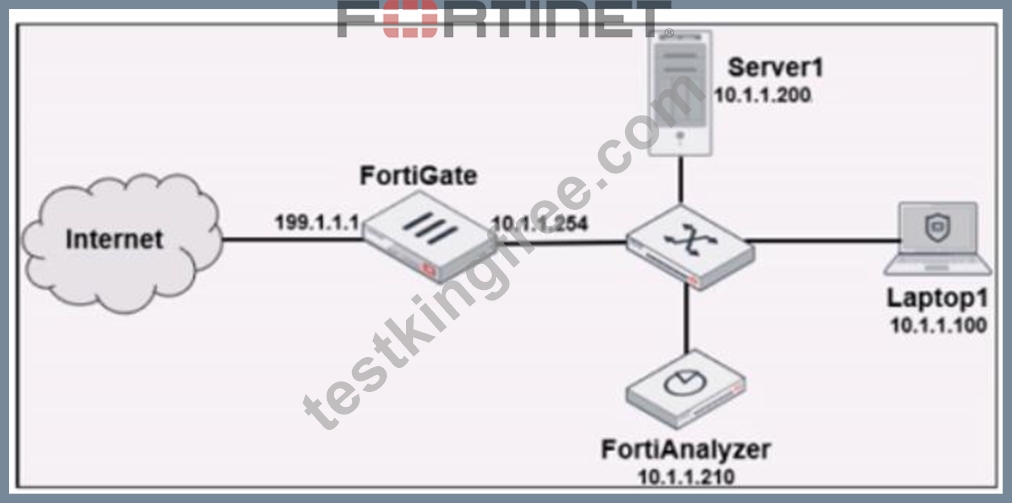
Laptop1 is used by several administrators to manage FortiAnalyzer. You want to configure a generic text filter that matches all login attempts to the web interface generated by any user other than "admin", and coming from Laptop1.
Which filter will achieve the desired result?
- A. operation-login & dstip==10.1.1.210 & user!-admin
- B. operation-login & performed_on=="GUI(10.1.1.210)" & user!=admin
- C. operation-login & srcip==10.1.1.100 & dstip==10.1.1.210 & user==admin
- D. operation-login & performed_on=="GUI(10.1.1.100)" & user!=admin
Answer: C
NEW QUESTION # 71
Which two statements are true regarding FortiAnalyzer log forwarding? (Choose two.)
- A. Forwarding mode forwards logs in real time only to other FortiAnalyzer devices.
- B. Both modes, forwarding and aggregation, support encryption of logs between devices.
- C. Aggregation mode stores logs and content files and uploads them to another FortiAnalyzer device at a scheduled time.
- D. In aggregation mode, you can forward logs to syslog and CEF servers as well.
Answer: B,C
Explanation:
A) FortiAnalyzer_7.0_Study_Guide-Online.pdf page 148: The log communication between devices can be protected by encryption, with the desired encryption level, using the commands shown on the slide. (You need to interpret this. "Real time" and "aggregation" is about the "moment" when Fortigate sends the logs.
However, no matter the moment, Fortigate will upload logs encrypted or unencrypted based on previous / differente config).
C) FortiAnalyzer_7.0_Study_Guide-Online.pdf page 147: Aggregation: Logs and content files stored and uploaded at scheduled time.
NEW QUESTION # 72
What is the purpose of employing RAID with FortiAnalyzer?
- A. To introduce redundancy to your log data
- B. To back up your logs
- C. To provide data separation between ADOMs
- D. To separate analytical and archive data
Answer: A
Explanation:
https://en.wikipedia.org/wiki/RAID#:~:text=RAID%20(%22Redundant%20Array%20of%20Inexpensive,%2C%20performance%20improvement%2C%20or%20both.
NEW QUESTION # 73
If you upgrade your FortiAnalyzer firmware, what report elements can be affected?
- A. Report scheduling
- B. Output profiles
- C. Custom datasets
- D. Report settings
Answer: C
NEW QUESTION # 74
Which two of the following must you configure on FortiAnalyzer to email a FortiAnalyzer report externally?
(Choose two.)
- A. Report scheduling
- B. Mail server
- C. SFTP server
- D. Output profile
Answer: B,D
Explanation:
Reference: https://docs.fortinet.com/document/fortianalyzer/6.0.2/administration-guide/598322/creating- output-profiles
NEW QUESTION # 75
Refer to the exhibit.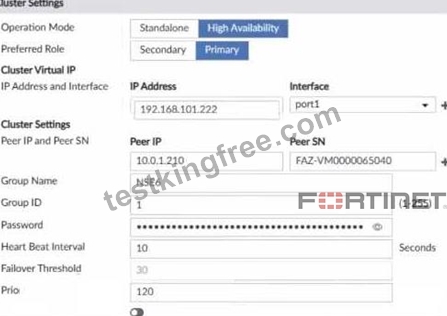
The image displays "he configuration of a FortiAnalyzer the administrator wants to join to an existing HA cluster.
What can you conclude from the configuration displayed?
- A. After joining to the cluster, this FortiAnalyzer will keep an updated log database.
- B. This FortiAnalyzer is configured to receive logs in its port1.
- C. This FortiAnalyzer will trigger a failover after losing communication with its peers for 10 seconds.
- D. This FortiAnalyzer will join to the existing HA cluster as the primary.
Answer: A
Explanation:
Operation Mode: The mode is set to "High Availability" which indicates that this FortiAnalyzer is intended to be part of an HA cluster.
Preferred Role: The "Primary" role is selected, meaning this device is configured to act as the primary unit in the HA cluster. This is a crucial setting as it determines the device's behavior and responsibilities within the cluster.
Cluster Virtual IP: A specific IP address (192.168.101.222) is assigned to be used by devices in the network to communicate with the cluster. This Virtual IP will be shared between the units in the cluster.
Cluster Settings: These include configurations for heartbeat interval, failover threshold, and priority which are crucial for maintaining cluster health and managing failover scenarios.
Given these points, the correct conclusion from the options provided is:
C: This FortiAnalyzer will join the existing HA cluster as the primary.
NEW QUESTION # 76
Which statement is true about sending notifications with incident updates?
- A. If you use multiple fabric connectors, all connectors must have the same notification settings
- B. Notifications can be sent only by email.
- C. Notifications can be sent only when an incident is updated or deleted.
- D. You can send notifications to multiple external platforms
Answer: D
Explanation:
You can add more than one fabric connector, each with the same or different notification settings. The receiving side of the connector must be configured for the notifications to be sent successfully.
FortiAnalyzer_7.0_Study_Guide-Online.pdf page 34: Fabric connectors also enable FortiAnalyzer to send notifications to ITSM platforms when a new incident is created or for any subsequent updates.
NEW QUESTION # 77
Which process is responsible for enforcing the archive file size?
- A. logfiled
- B. miglogd
- C. oftpd
- D. sqlplugind
Answer: C
NEW QUESTION # 78
......
Fortinet FCP_FAZ_AD-7.4 Exam Syllabus Topics:
| Topic | Details |
|---|---|
| Topic 1 |
|
| Topic 2 |
|
| Topic 3 |
|
| Topic 4 |
|
Revolutionary Guide To Exam Fortinet Dumps: https://www.testkingfree.com/Fortinet/FCP_FAZ_AD-7.4-practice-exam-dumps.html
Pass FCP_FAZ_AD-7.4 Exam Latest Practice Questions: https://drive.google.com/open?id=1Tr_-GmpyPweCBzkLJx3-ooXXIVfFOaLt