

View All MB-820 Actual Free Exam Questions Sep 29, 2025 Updated
Pass Authentic Microsoft MB-820 with Free Practice Tests and Exam Dumps
Microsoft MB-820 Exam Syllabus Topics:
| Topic | Details |
|---|---|
| Topic 1 |
|
| Topic 2 |
|
| Topic 3 |
|
| Topic 4 |
|
| Topic 5 |
|
NEW QUESTION # 43
You have an XMLport that exports items from a database to an XML file.
You need to change the export format from XML to CSV.
What should you do?
- A. Change the FormatEvaluate property to Legacy.
- B. Change the Direction property to Both
- C. Change the Format property to VariableText.
- D. Fill the FileName property with the Items.csv value.
- E. Change the XmlVeisionNo property to 1.1.
Answer: C
Explanation:
* XMLport Overview
In Microsoft Dynamics 365 Business Central, XMLports are used for importing and exporting data in XML, CSV, or other text formats. By default, XMLports are designed to work with XML data, but they can also handle delimited text formats like CSV (Comma-Separated Values).
* Requirement Clarification
The requirement is to change the export format from XML to CSV. CSV is a text-based format, not an XML format. To accommodate this, you need to change how the XMLport handles data during export.
* Properties of XMLport
The Format property in XMLports controls whether the output format is XML or a text-based format such as CSV.
The VariableText option of the Format property specifies that the data should be exported in a variable text format, like CSV.
The XMLports default to an XML format, but by setting the Format property to VariableText, you can change the export to CSV format or another text-delimited format.
* Explanation of Correct Answer (E)
To switch from XML to CSV export:
You need to change the Format property of the XMLport to VariableText.
The VariableText option allows for the export of data in a non-XML format, which is precisely what CSV represents (a comma-delimited text file).
* Why Other Options Are Incorrect
Option A (Change the Direction property to Both):
The Direction property controls whether the XMLport is used for Import, Export, or Both (import and export), but it does not affect the file format (XML vs. CSV). Hence, this is irrelevant to the file format change.
Option B (Change the FormatEvaluate property to Legacy):
The FormatEvaluate property is not related to changing the export format. It deals with the evaluation of the data format during the processing but doesn't change the format type (XML or CSV).
Option C (Change the XmlVeisionNo property to 1.1):
The XmlVersionNo property defines the XML version used for the export (such as 1.0 or 1.1). This only applies to XML exports and does not change the format to CSV.
Option D (Fill the FileName property with Items.csv):
While this option would specify the name of the file being exported (i.e., "Items.csv"), it doesn't control the format of the export itself. The actual format change is controlled by the Format property.
* Developer Reference from Microsoft Documentation
According to the official Microsoft documentation for XMLports in Business Central, the Format property is critical for determining how data is structured for export. To change the file format from XML to CSV, developers need to set the Format property to VariableText. This allows for export in a text-delimited format, which is ideal for CSV.
XMLport Properties - Format Property
How to: Export Data in Text Format Using XMLports
NEW QUESTION # 44
You need to use a query data type to retrieve required data.
How should you complete the code? To answer, select the appropriate options in the answer area.
NOTE: Each correct selection is worth one point.
For each of the following statements, select Yes if the statement is true Otherwise, select No.
NOTE: Each correct selection is worth one point.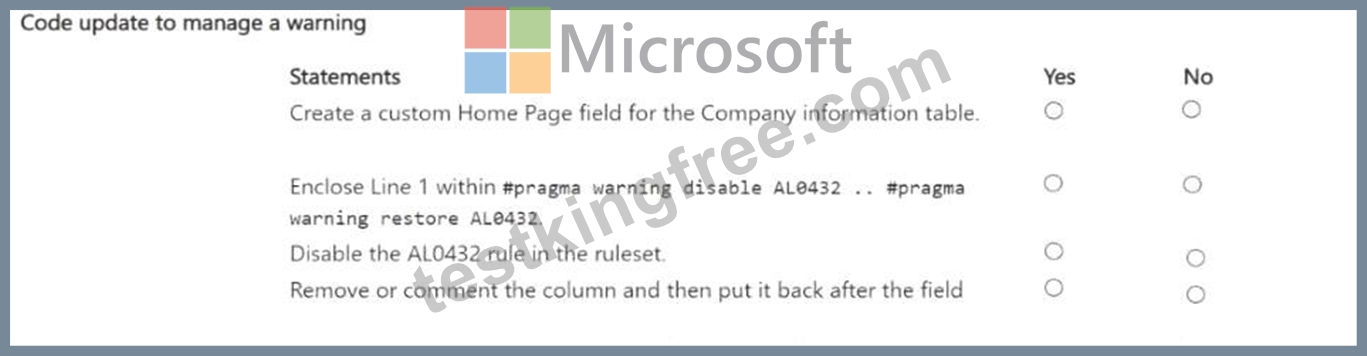
Answer:
Explanation: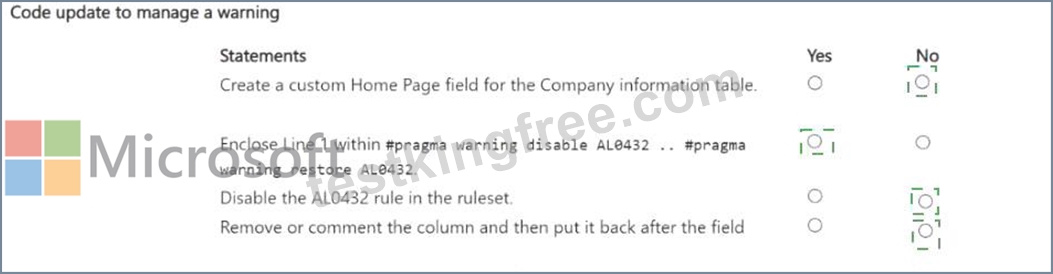
Explanation: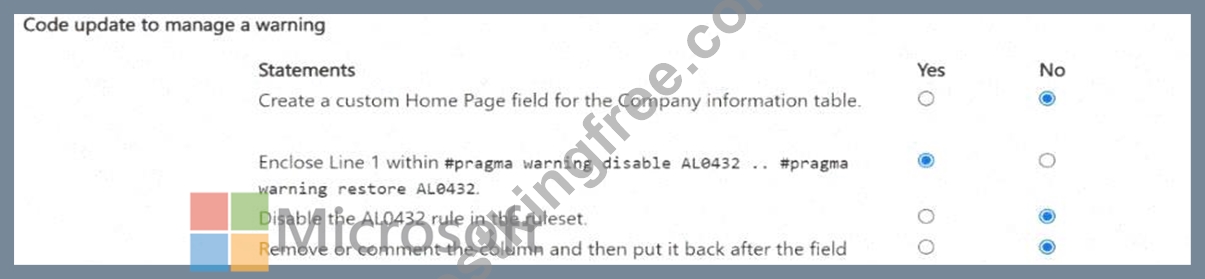
NEW QUESTION # 45
A company uses Business Central.
The company plans to use the AL object model in Business Central to extend the Base Application.
You need to extend the objects.
Which two objects can you extend? Each correct answer presents a complete solution.
NOTE: Each correct selection is worth one point.
- A. Codeunit
- B. API page
- C. Query
- D. Enum
- E. Report
Answer: A,E
Explanation:
* A: Codeunit
* Codeunits can be extended in AL to add or modify functionality in Business Central.
* B: Report
* Reports can also be extended to customize the format or data presented in the reports without modifying the base report.
Incorrect Options:
* C: Query: Queries cannot be extended. You would need to create new queries or modify the existing ones directly.
* D: API page: You cannot extend API pages, but you can create new API pages.
* E: Enum: You cannot extend Enums because they are predefined sets of values.
NEW QUESTION # 46
You create an 'AddltemsToJson" procedure and publish it.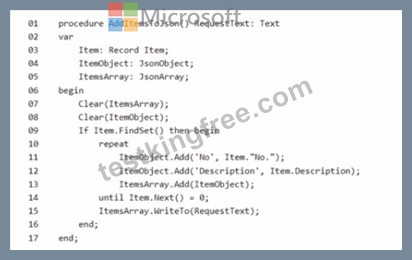
The procedure fails to run.
You need to fix the errors in the code.
For each of the following statements, select Yes if the statement is true. Otherwise, select No.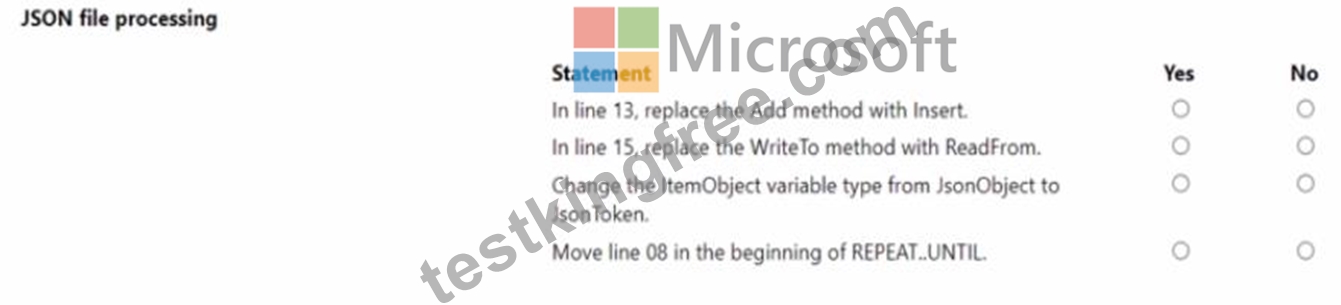
Answer:
Explanation: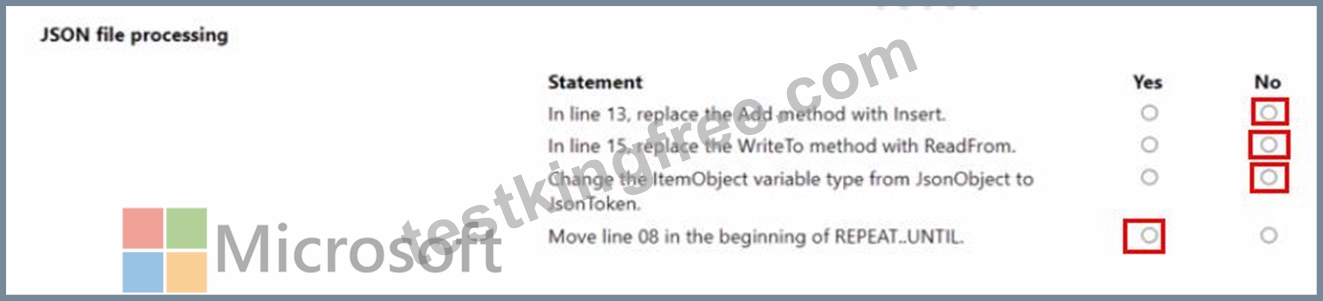
NEW QUESTION # 47
You create the following Vendor table and Item table in Business Central.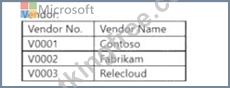
You require the following data set to assign vendors to items.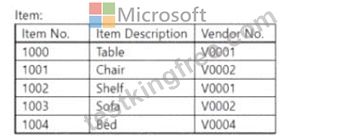
You need to create a query to assign the vendors.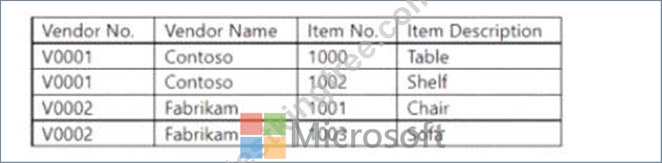
Which three code blocks should you use to develop the solution? To answer, move the appropriate code blocks from the list of code blocks to the answer area and arrange them in the correct order.
NOTE: More than one order of answer choices is correct. You will receive credit for any of the correct orders you select.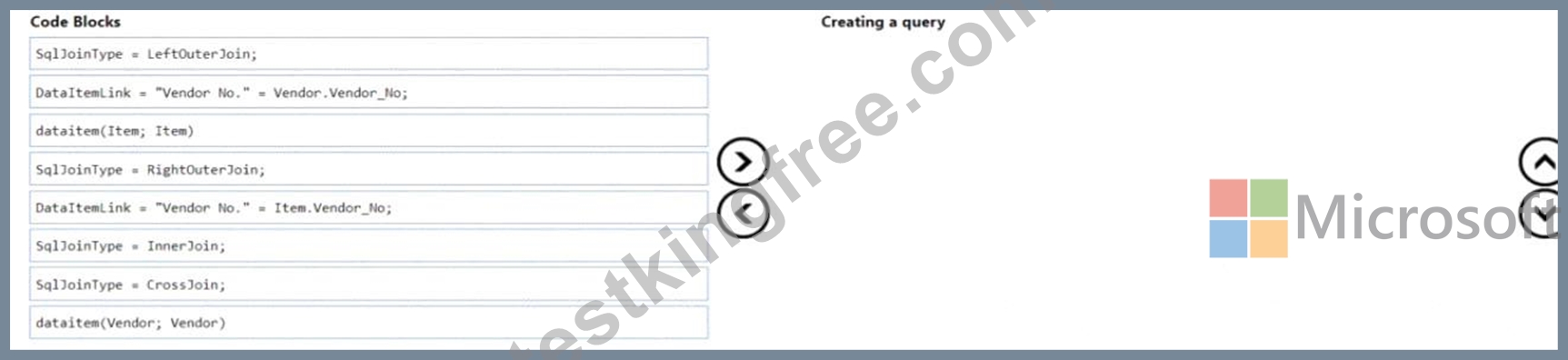
Answer:
Explanation: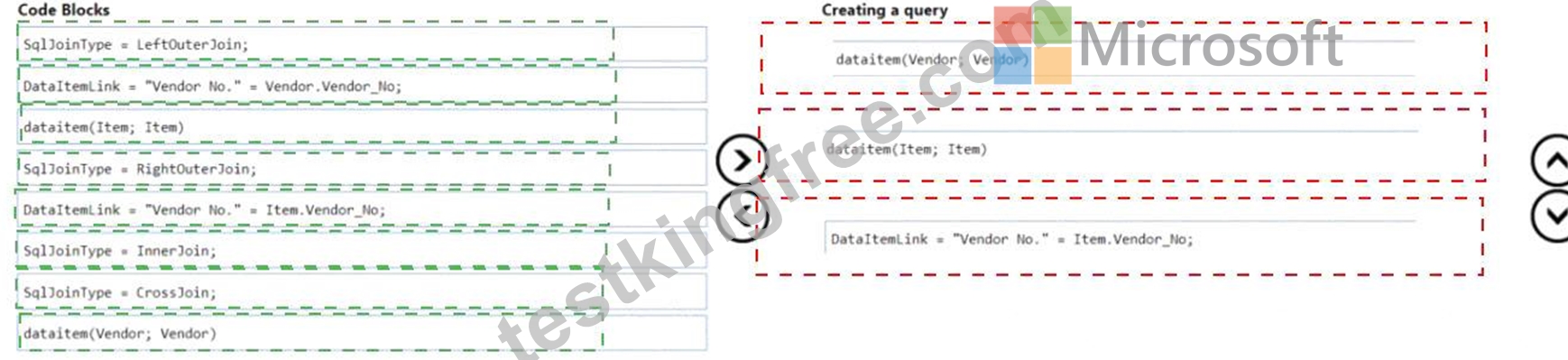
Explanation:
To create a query that assigns vendors to items in Business Central, use the following code blocks in sequence:
* dataitem(Vendor; Vendor)
* dataitem(Item; Item)
* DataItemLink = "Vendor No." = Item.Vendor_No;
Creating a query:In Business Central, a query object is used to combine data from multiple tables. You start by specifying each table as a data item. In this case, you would start with the Vendor table and then the Item table. After specifying the data items, you need to link them together. The DataItemLink property is used to establish a relationship between two data items based on a common field. Here, you are linking the Vendor and Item tables on the "Vendor No." field, which is present in both tables. This link ensures that the query will return a dataset that includes related records from both tables based on the vendor number. The order of the code blocks ensures the logical flow and relationships between tables as required for the query.
NEW QUESTION # 48
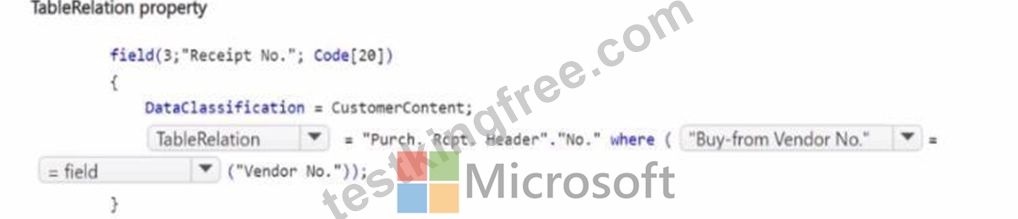
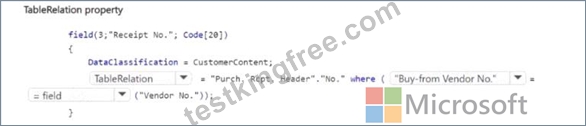
You need to define the properties for the Receipt No. field in the Non-conformity table when storing the information to the purchasing department How should you complete the code segment? To answer, select the appropriate options in the answer area.
NOTE; Each correct selection is worth one point.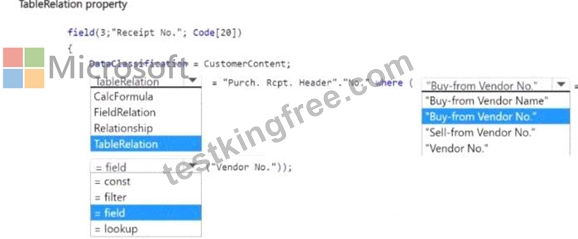
Answer:
Explanation: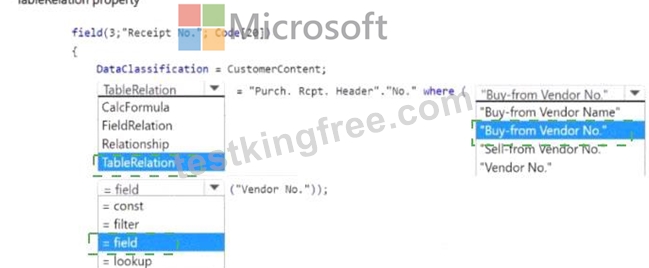
Explanation:
field(3; "Receipt No."; Code[20])
{
DataClassification = CustomerContent;
TableRelation = "Purch. Rcpt. Header"."No." where ("Buy-from Vendor No." = field("Vendor No."));
}
* Field Declaration:
* The field(3; "Receipt No."; Code[20]) part defines the field in the table with ID 3 and type Code with a length of 20. This field will hold the receipt number.
* DataClassification:
* CustomerContent is selected for the DataClassification property, which categorizes the data for privacy and compliance management. This aligns with Business Central's recommendations for handling sensitive data in customer-related tables.
* TableRelation Property:
* The TableRelation property links the "Receipt No." field to another table, which in this case is the "Purch. Rcpt. Header" table. This ensures that only valid receipt numbers from the Purchase Receipt Header table can be selected or entered in this field.
* Relation Filter:
* The filter condition is applied using the where clause. It ensures that the Receipt No. is only from the Purchase Receipt Header records where the "Buy-from Vendor No." matches the "Vendor No." of the current record.
* The condition field("Vendor No.") is selected from the drop-down as shown in the image. This links the vendor information in the non-conformity table to the receipt in the Purchase Receipt Header table.
* By linking the "Vendor No." fields, you ensure that only receipt numbers from the correct vendor are available, which improves data consistency and reduces errors during data entry.
* References to AL Language:
* The TableRelation property is frequently used to create references between tables in Business Central. In this case, the correct relationship between the "Purch. Rcpt. Header" and the Non- conformity table is established using the TableRelation and filter.
Reference Documentation:
* AL TableRelation Property
* AL Field Syntax
NEW QUESTION # 49
You need to define the properties for the Receipt No. field in the Non-conformity table when storing the information to the purchasing department How should you complete the code segment? To answer, select the appropriate options in the answer area.
NOTE; Each correct selection is worth one point.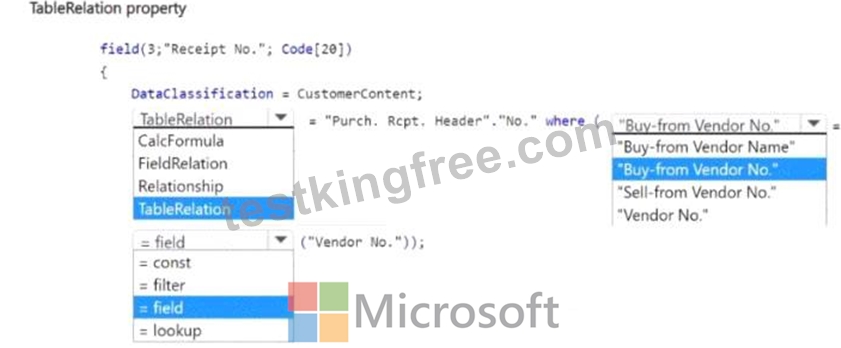
Answer:
Explanation: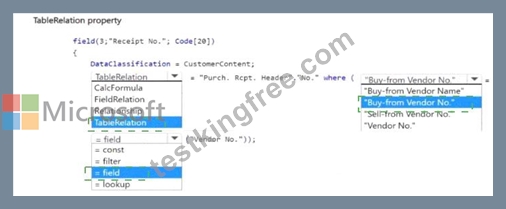
Explanation:
field(3; "Receipt No."; Code[20])
{
DataClassification = CustomerContent;
TableRelation = "Purch. Rcpt. Header"."No." where ("Buy-from Vendor No." = field("Vendor No."));
}
* Field Declaration:
* The field(3; "Receipt No."; Code[20]) part defines the field in the table with ID 3 and type Code with a length of 20. This field will hold the receipt number.
* DataClassification:
* CustomerContent is selected for the DataClassification property, which categorizes the data for privacy and compliance management. This aligns with Business Central's recommendations for handling sensitive data in customer-related tables.
* TableRelation Property:
* The TableRelation property links the "Receipt No." field to another table, which in this case is the "Purch. Rcpt. Header" table. This ensures that only valid receipt numbers from the Purchase Receipt Header table can be selected or entered in this field.
* Relation Filter:
* The filter condition is applied using the where clause. It ensures that the Receipt No. is only from the Purchase Receipt Header records where the "Buy-from Vendor No." matches the "Vendor No." of the current record.
* The condition field("Vendor No.") is selected from the drop-down as shown in the image. This links the vendor information in the non-conformity table to the receipt in the Purchase Receipt Header table.
* By linking the "Vendor No." fields, you ensure that only receipt numbers from the correct vendor are available, which improves data consistency and reduces errors during data entry.
* References to AL Language:
* The TableRelation property is frequently used to create references between tables in Business Central. In this case, the correct relationship between the "Purch. Rcpt. Header" and the Non- conformity table is established using the TableRelation and filter.
Reference Documentation:
* AL TableRelation Property
* AL Field Syntax
NEW QUESTION # 50
A company plans to change a field on the Resource Card page in a Base Application.
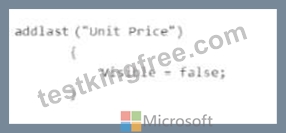
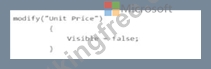
You need to hide the field "Unit Price" from the Resource Card page.
Which code snippet should you use?
- A.

- B.
- C.

- D.
Answer: D
Explanation:
To hide the field "Unit Price" from the Resource Card page in Microsoft Dynamics 365 Business Central, you need to modify the visibility property of the field using the modify keyword, which allows you to change the properties of an existing field on a page.
* modify("Unit Price") is the correct way to target an existing field on a page (like the Resource Card page).
* The line Visible = false; makes the field invisible on the page.
Here's a breakdown of why each option is right or wrong:
* Option A:
* Uses addlast("Unit Price"), which is incorrect because you are not adding a new field; you're modifying an existing one. Also, Visible = false is correct for hiding a field, but the wrong method (addlast) is used.
* Option B:
* Uses modify("Unit Price") with Enabled = false;. This would disable the field (make it non- editable), not hide it. The field would still be visible, so this does not meet the requirement.
* Option C:
* Uses addlast("Unit Price"), which is incorrect, and Enabled = false;, which would disable the field, not hide it.
* Option D:
* modify("Unit Price") { Visible = false; } is the correct syntax for hiding the field on the page.
Correct Code Snippet:
modify("Unit Price")
{
Visible = false;
}
This hides the "Unit Price" field from the Resource Card page.
NEW QUESTION # 51
You are customizing Business Central by using Visual Studio Code. You create a project that will extend Business Central. The AL extension contains JSON files, which are automatically generated and are used to store configuration data For testing purposes, you plan to add the following changes to the files:
* Specify that page 21 must be opened after publishing.
* Enable debugging
* Disable the capability to download the source code
You need to add the configurations to the JSON files.
Which two configurations should you add? Each correct answer presents a complete solution.
NOTE: Each correct selection is worth one point.
- A. Set "start upObjectld": 27 on appjson.
- B. In the "resourceExposurePolicy" tag, set "allowDebugging": true and "allowDown loading Source":
true on appjson. - C. In the "resourceExposurePolicy" tag, set "allowDebugging": true and "allowDownloadingSource": false on appjson.
- D. In the "resourceExposurePolicy" tag, set "at low Debugging". true and allowDownloadingSource": false on launchjson.
- E. Set "startupObjectld": 27 on launchjson.
Answer: A,C
Explanation:
You are customizing Business Central using Visual Studio Code and JSON files for configuration.
You plan to:
* Open page 21 after publishing.
* Enable debugging.
* Disable the capability to download the source code.
Which configurations should you add?
The options involve two primary JSON files: launch.json and app.json, and configuration tags like startupObjectId and resourceExposurePolicy.
NEW QUESTION # 52
Drag and Drop Question
A company plans to deploy Business Central.
The company has the following deployment requirements:
- Use the company hardware architecture to run the deployment.
- Use sandbox environments to develop extensions.
- Allow tenants to connect to Shopify with the standard connector.
- Use Microsoft Power Automate to create a workflow that calls a
business event.
You need to identify the deployment type for each requirement.
Which deployment types should you use? To answer, move the appropriate deployment types to the correct requirements. You may use each deployment type once, more than once, or not at all.
You may need to move the split bar between panes or scroll to view content.
NOTE: Each correct selection is worth one point.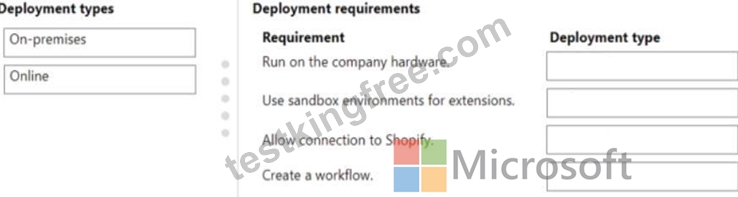
Answer:
Explanation: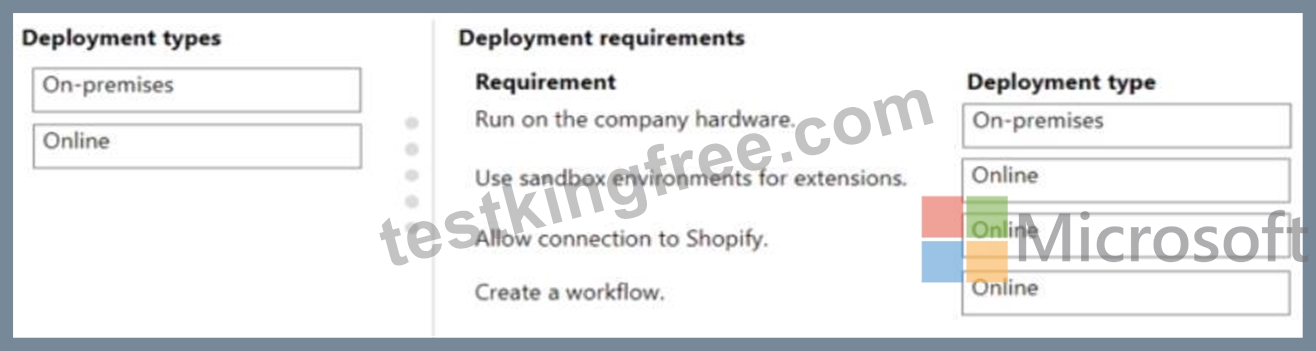
Explanation:
When deploying Microsoft Dynamics 365 Business Central, there are two main deployment types to consider: On-premises and Online.
On-premises Deployment:
The requirement to use the company's hardware architecture implies a need for an on-premises deployment. This is because on-premises deployment allows for the application to be installed and run directly from the company's in-house servers and computing infrastructure, giving full control over the environment and data.
Online Deployment:
The use of sandbox environments for developing extensions is a feature provided in the online version of Business Central. Sandbox environments are a part of the service offered in the cloud- based version, which allows developers to test and develop without affecting the live environment. Connection to Shopify with the standard connector implies an online deployment.
The standard connector is typically a cloud-based service that allows Business Central to connect with other cloud platforms like Shopify, which is more seamlessly integrated with the online version. Lastly, the use of Microsoft Power Automate to create a workflow that calls a business event suggests an online deployment. Power Automate is a cloud-based service designed to create automated workflows between applications and services - which aligns with the services provided by the online version of Business Central.
NEW QUESTION # 53
Note: This question is part of a series of questions that present the same scenario. Each question in the series contains a unique solution that might meet the stated goals. Some question sets might have more than one correct solution, while others might not have a correct solution.
After you answer a question in this section, you will NOT be able to return to it. As a result these questions will not appear in the review screen.
A company plans to optimize its permission sets.
The company has the following permission sets:
You need to provide the following implementation for a third permission set:
* Create a new Permission Set C that is a composite of Permission Set A and Permission Set B.
* Assign Permission Set C to a user.
You need to ensure that the user has only read access to the Job table.
Solution: Set the Included Permission Sets property to Permission Set B and the Excluded PermissionSets property to Permission Set A.
Does the solution meet the goal?
- A. Yes
- B. No
Answer: B
NEW QUESTION # 54
You need to define the tables used for the non-conformity entity.
What should you use?
- A. document table to introduce the non-conformity entities
- B. supplemental table to introduce the non-conformity lines
- C. document history table to introduce the non-conformity entities
Answer: A
Explanation:
Table Structure in Business Central: When creating entities such as "non-conformity" entities in Business Central, you use document tables to represent entities that have a header and line structure. In this case, the non-conformity entity has:
A header with common information (Non-conformity Number, Date, Vendor No., etc.).
One or more lines representing the detailed information for each non-conforming item.
Document Table Usage:
Document Table: A document table is the correct table type for scenarios where you have a header (with general information like vendor details) and lines (with detailed, item-specific information).
Document tables are typically used for entities such as Sales Orders, Purchase Orders, or any other transactional data where you have both header and line information.
Supplemental Table (Option C):
Supplemental tables are usually used to add supplementary information to existing data in Business Central. In this case, we need to store detailed line information, which is a core part of the entity rather than supplementary data, so a supplemental table would not be appropriate here.
Document History Table (Option A):
Document history tables are used to track changes and historical data for entities but are not suitable for the main introduction of the entity and its lines. This option is also not appropriate.
Reference Documentation:
Introduction to Business Central Tables
Document Tables in Business Central
Topic 2, Contoso, Ltd.
Overview
Contoso, Ltd. Is a sales company in the manufacturing industry. It has subsidiaries in multiple countries/regions, each with its own localization. The subsidiaries must be data-independent from each other. Contoso. Ltd. uses an external business partner to manage the subcontracting of some manufacturing items. Contoso. Ltd. has different sectors with data security between sectors required.
Contoso, Ltd. uses Business Central online as the main ERP for financial. sales, purchase, warehouse, and manufacturing processes. It has employees that use the Business Central web application and external applications. The company has a custom external mobile app under development The IT department and its partners installed custom extensions to satisfy the company's requirements where the functionality is not available natively.
Contoso. Ltd. interacts with external services provided by customers and partners. Different applications interact with SOAP and OData endpoints exposed from Business Central.
An external business partner of Contoso, Ltd exposed a REST API for receiving details about new subcontracting orders and for sending the planned release date of each subcontracting order received.
Contoso. Ltd. has not activated the monitoring of the tenant and has no internal telemetry for its apps.
Custom reporting must be created to meet the requirements of the different departments.
Contoso, Ltd. has the following tenant management considerations:
IT department
* The IT department requires the ability to monitor the tenant to prevent performance problems and detect possible anomalies.
* The IT department plans to use Azure Application Insights and Log Analytics to inspect the ingested telemetry signals.
* All tenant upgrades are automatically handled by Microsoft. The IT department does not check for update availability or for tenant-related notifications.
* The IT department has not configured the receipt of tenant-related notifications from the Business Central admin center.
External business partner
* The external business partner must add custom telemetry to an application created for Contoso. Ltd. to monitor a business process.
* Custom telemetry signals for the application must be visible only on the partner's telemetry.
SOAP
* Contoso, Ltd. plans to dismiss using the SOAP protocol for integrations.
* Contoso, Ltd. must be able to detect if external applications are using its Business Central SOAP endpoints.
Issue
The Business Central tenant is upgraded by Microsoft to a new major version during the night.
Users report that one of the Contoso. ltd. extensions disappeared from the tenant The IT department confirms that the extension is still published.
Contoso. Ltd. plans to create a custom mobile application that has the following requirements:
* The app must be used by employees to check item details from the ERP in real time and to report issues that occur during the manufacturing process.
* An AL extension must be created for handling archived issues.
* Business Central development guidelines must be followed when implementing modules.
* A module must be implemented for the reporting and tracking of issues information. You plan to call this module Issue Management The module must expose a method nan Postlude.
* Code modifications will be required over time.
* The Issue Management process must be split into two extensions:
o ISSUE BASE: main extension
o ISSUE EXT: second extension with dependency from ISSUE BASE
* In the version 1.0.0.0 of the ISSUE BASE extension, you plan to create an Issue table that contains a global Decimal variable named Issue Total.
* In the version 1.0.0.0 of the ISSUE BASE extension, you plan to define a table named Issue Category with a Description field defined as follows:
field (2; Description; Text[SG])
{
DataClassificstion * CustoaerContent;
>
* The Issue table defined in ISSUE BASE extension contains a Clone procedure defined as follows:
procedure Corte () begin end;
* In the ISSUE EXT extension, you create a table extension object of the Issue table.
* The table extension object of the Issue table must access the Issue Total: Decimal variable.
After weeks of usage, you discover that you must remove the Description field and the Clone procedure because they are no longer required.
In a new version of the ISSUE BASE extension, you create a new Issue Type table. You must move data row by row from a previously obsolete Issue Category table to the new Issue Type table. Because a large amount of data must be moved, you must write an Upgrade codeunit by using the DataTransfer object.
The IT department creates a custom API for exposing the custom Issue table. The API provides an action for copying an issue to a new table. The action is defined as follows:
(Service Enabled]
procedure Copy (vary action Context: WebServiceActionContext)
begin
end;
Contoso, Ltd. must create an API in Business Central to expose item details to the mobile application.
* The API must have the lowest possible impact on the production environment when used during working hours.
* The API must only support Get operations.
A user of the ISSUE BASE extension in Business Central reports a problem.
To debug the problem, snapshot debugging with the following configuration was activated: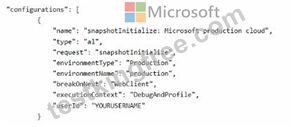
You discover that the debugging is not triggering.
Contoso, Ltd. must connect Business Central to the external API provided by the business partner. This will be used for the partner to send the details of new subcontracting orders to fulfill the sales demand, and for receiving the planned release date of each order sent. The integration requirements are as follows:
* The business partner will provide a REST API secured with basic authentication. Credentials to access the API will be shared with Contoso, ltd.
* The API for sending subcontracting orders must be called by sending an authenticated POST request to the given endpoint.
* The API for retrieving the order no. and planned release date of each subcontracting order responds with the following JSON: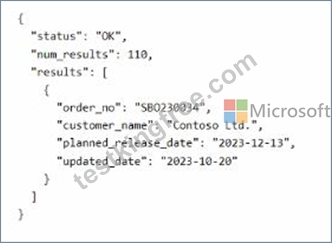
Each order no. must be retrieved.
NEW QUESTION # 55
A company uses four objects in development in Business Central.
The company plans to make changes to the objects.
You need to identify the application layer for each object in Visual Studio Code.
Which objects ate available in each application layer? To answer, move the appropriate application layer to the correct objects You may use each application layer once, more than once, or not at all. You may need to move the split bar between panes or scroll to view content.
NOTE: Each correct selection is worth one point.
Answer:
Explanation:
Explanation:
Language table # System layer
Activities Cue table # Base layer
Extension Management codeunit # System layer
Business Unit Card page # Base layer
Application Layers in Business Central:
In Business Central, there are different layers such as Base and System, which represent different levels of the application architecture. Here's a breakdown of where each object is likely to belong based on typical Business Central architecture:
* Language Table:This table typically belongs to the System layer, as language and localization features are often part of the foundational aspects of the system.
* Activities Cue Table:This would likely be found in the Base layer because it involves business logic that supports user interface elements (like activity cues) specific to the Business Central application.
* Extension Management Codeunit:The Extension Management Codeunit likely belongs to the System layer, as it deals with handling extensions, which is closely related to the core system functionality for managing and deploying changes.
* Business Unit Card Page:This object would typically be part of the Base layer, as it is a business- specific object that handles the user interface for business unit data, part of the core Business Central application.
NEW QUESTION # 56
A company is implementing Business Central.
The company has the following requirements for a report:
* The report must be loaded for users in a specific location only.
* Data entered in the request page must be validated before any further processing.
* A filter must be defined for users based on the Department field defined in user setup.
You need to implement the given requirements.
Which triggers should you use? To answer, move the appropriate triggers to the correct requirements. You may use each trigger once, more than once, or not at all. You may need to move the split bar between panes or scroll to view content.
NOTE: Each correct selection is worth one point.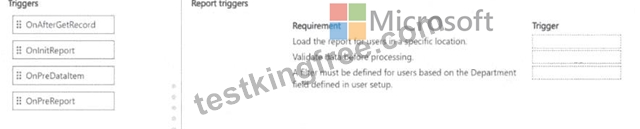
Answer:
Explanation: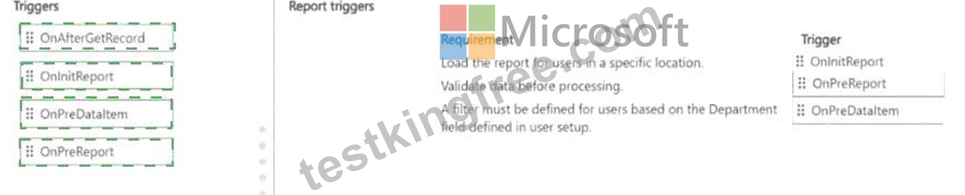
Explanation:
* Load the report for users in a specific location: OnInitReport
* Validate data before processing: OnPreReport
* Define filter based on Department field: OnPreDataItem
The requirements for the report are:
* The report must be loaded for users in a specific location only.
* Data entered in the request page must be validated before any further processing.
* A filter must be defined for users based on the Department field defined in user setup.
Trigger Matching:
* The report must be loaded for users in a specific location only.The correct trigger for loading the report is OnInitReport.
* This trigger runs when the report is initialized, and you can use it to define user-specific loading conditions, like location-based filtering.
* Data entered in the request page must be validated before any further processing.The correct trigger for validation before processing is OnPreReport.
* This trigger occurs before the report is run and can be used for data validation before further processing begins.
* A filter must be defined for users based on the Department field defined in user setup.The correct trigger to define filters is OnPreDataItem.
* This trigger occurs before data item processing begins and is used to apply filters such as those based on the Department field in the user setup.
NEW QUESTION # 57
A company plans to deploy Business Central.
The company has the following deployment requirements:
* Use the company hardware architecture to run the deployment.
* Use sandbox environments to develop extensions.
* Allow tenants to connect to Shopify with the standard connector.
* Use Microsoft Power Automate to create a workflow that calls a business event.
You need to identify the deployment type for each requirement.
Which deployment types should you use? To answer, move the appropriate deployment types to the correct requirements. You may use each deployment type once, more than once, or not at all.
Answer:
Explanation:
NEW QUESTION # 58
You need to create the configuration table and page for the non-conformity functionality.
Which table configurations should you use? To answer, select the appropriate options in the answer area.
NOTE: Each correct selection is worth one point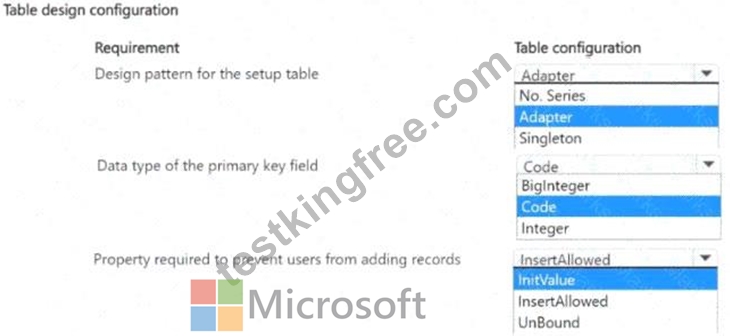
Answer:
Explanation: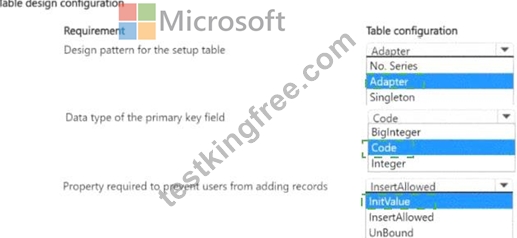
Explanation:
Design pattern for the setup table:
* The correct selection here is Adapter. The Adapter design pattern is commonly used when you need to handle integration points or create a setup table that acts as an intermediary for data manipulation, which fits the requirement for the configuration of the non-conformity functionality.
Data type of the primary key field:
* The correct data type is Code. In Business Central, when creating a table with a primary key field, the Code data type is typically used for fields such as document numbers, codes, and identifiers. For a setup table, a Code field is appropriate for keys like "No." series or setup identifiers.
Property required to prevent users from adding records:
* The correct property is InitValue. This property is used to set initial values for fields and can be configured in such a way that users are prevented from adding records directly, typically enforcing control over record creation and editing in configuration scenarios.
NEW QUESTION # 59
A company plans to optimize its permission sets.
The company has the following permission sets:
You need to provide the following implementation for a third permission set:
* Create a new Permission Set C that is a composite of Permission Set A and Permission Set B.
* Assign Permission Set C to a user.
You need to ensure that the user has only read access to the Job table.
Solution: Set the IncludedPermissionSets property to Permission Set A and the ExcludedPermissionSets property to Permission Set B.
Does the solution meet the goal?
- A. Yes
- B. No
Answer: A
NEW QUESTION # 60
You create a codeunit that works with a table named Boxes. You plan to filter the records and then modify them.
You get an error that you do not have permission to work with the Boxes table.
You need to assign the Indirect permissions for the Boxes table to the codeunit.
Which four code blocks should you use in sequence to assign the correct permission? To answer, move the appropriate code blocks from the list of code blocks to the answer area and arrange them in the correct order.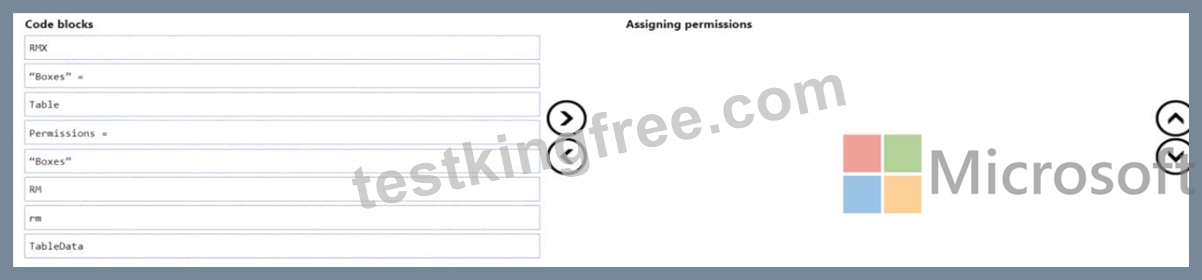
Answer:
Explanation: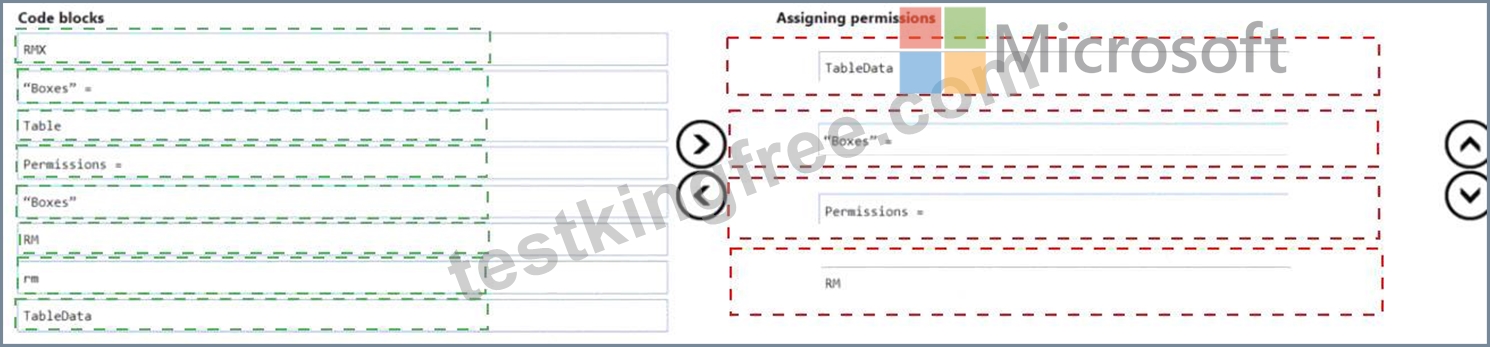
Explanation:
To assign the indirect permissions for the Boxes table to the codeunit, use the following code blocks in sequence:
* TableData
* "Boxes" =
* Permissions
* RIM
Assigning permissions:In Business Central, to assign permissions within a codeunit, you need to specify the table that the permissions apply to, followed by the type of permission. The sequence starts by indicating that we are defining table data permissions (TableData). Then, we specify the table in question ("Boxes" =).
After that, we state that we are setting permissions (Permissions). Finally, we assign the RIM permissions, which stands for Read, Insert, and Modify permissions. The Indirect permission allows the codeunit to read, insert, and modify records in the Boxes table indirectly, meaning these operations can be performed by the codeunit when it is called by a user who has direct permissions for these operations.
NEW QUESTION # 61
You are writing a procedure to block all inventory items with numbers that do not start with the letter S.
You need to complete the procedure.
How should you complete the code expressions? To answer, select the appropriate options in the answer area.
NOTE: Each correct selection is worth one point.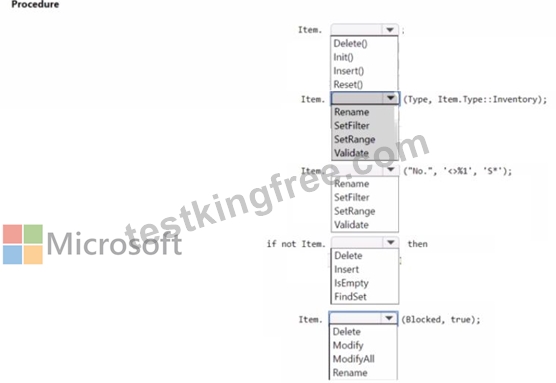
Answer:
Explanation: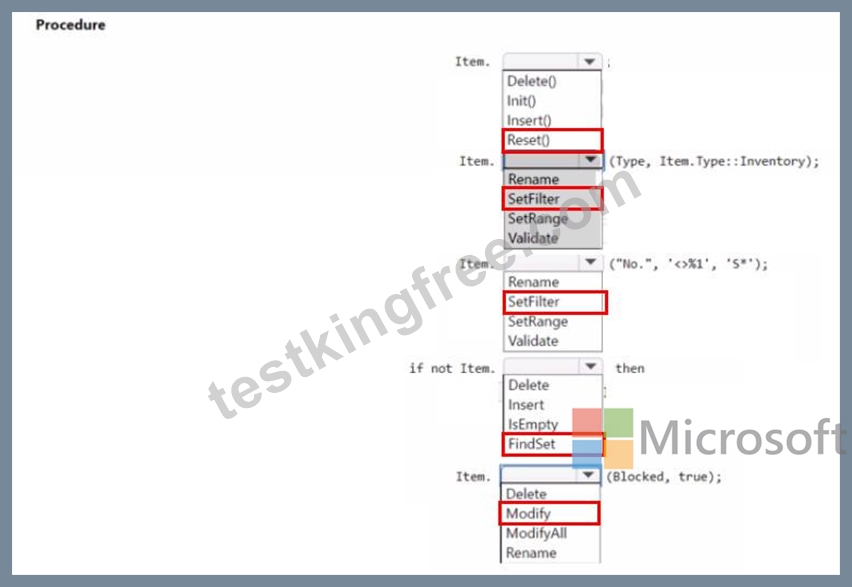
NEW QUESTION # 62
You plan to create a table to hold client data.
You have the following data integrity requirements:
* Lookups into other records must be established.
* Validate if a record exists in a destination record.
You need to select the table field property to use for each requirement.
Which table field property should you use? To answer, select the appropriate options in the answer area.
NOTE: Each correct selection is worth one point.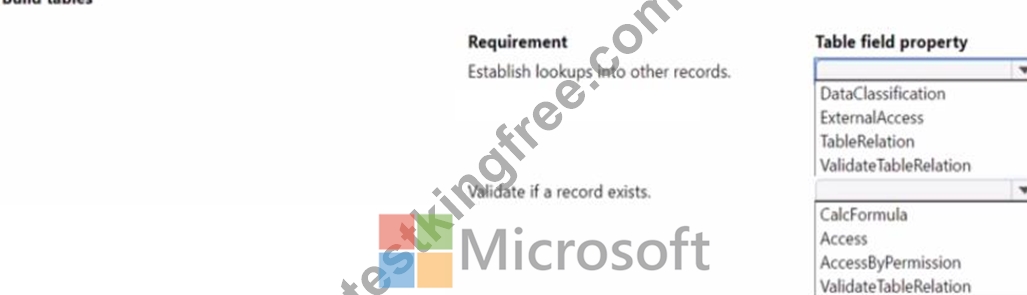
Answer:
Explanation: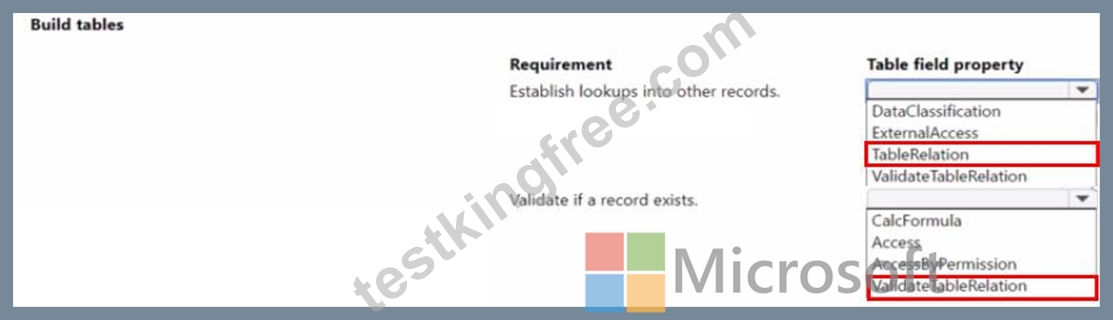
NEW QUESTION # 63
You create a query that contains a procedure to display the top customers.
The procedure breaks at runtime.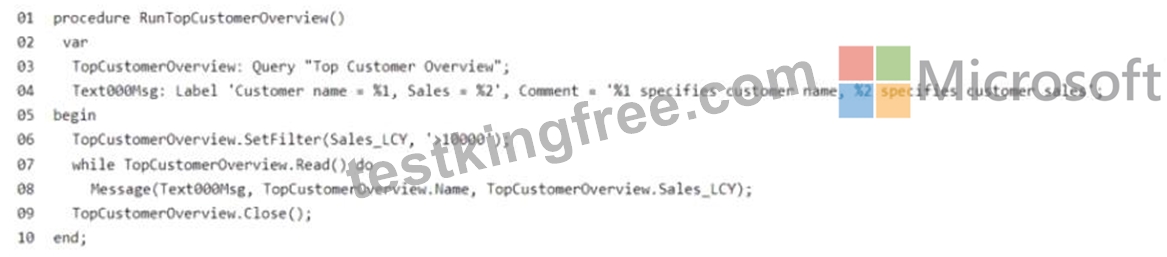
You need to fix the code.
For each of the following statements, select Yes if the statement is true. Otherwise, select No.
NOTE: Each correct selection is worth one point.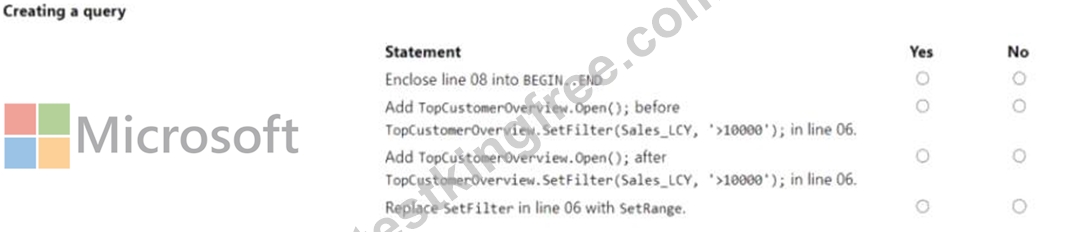
Answer:
Explanation: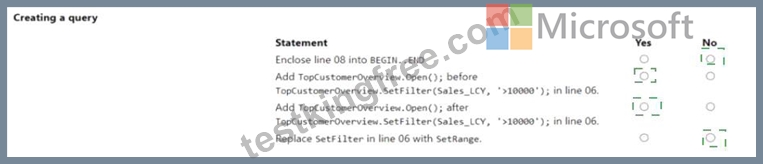
Explanation:
* Enclose line 08 into BEGIN .. END = NO
* Add TopCustomerOverview.Open(); before = YES
* TopCustomerOverview.SetFilter(Sales_LCY, '>10000'); in line 06.
* Add TopCustomerOverview.Open(); after TopCustomerOverview.SetFilter(Sales_LCY, '>10000'); in line 06. = YES
* Replace SetFilter in line 06 with SetRange. = NO
The code provided has a runtime error because the query TopCustomerOverview must be opened before it can be read from. Therefore, TopCustomerOverview.Open(); should be added before trying to read from the query, which is not present in the code.
Enclosing line 08 into a BEGIN .. END block is unnecessary because it is a single statement, and AL does not require a BEGIN .. END block for single statements within trigger or procedure bodies.
TopCustomerOverview.SetFilter(Sales_LCY, '>10000'); is a correct method to set a filter for the query, and using SetRange instead is not necessary unless the requirement is specifically to set a range of values, which is not indicated in the procedure's description.
In summary, for the procedure to run correctly, the query must be opened after setting the filter and before attempting to read from it. The SetFilter method is correct for the intended operation, and there's no requirement to use SetRange or to enclose the Message call in a BEGIN .. END block.
NEW QUESTION # 64
Hotspot Question
You have a per tenant extension that contains the following code.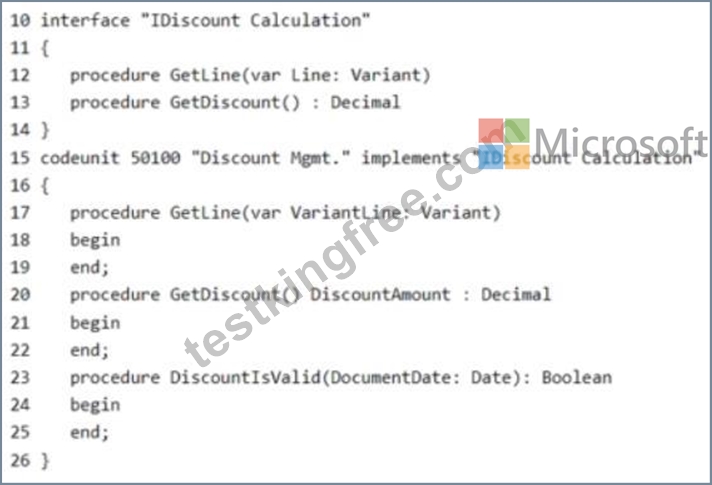
For each of the following statements, select Yes if the statement is true. Otherwise, select No.
NOTE: Each correct selection is worth one point.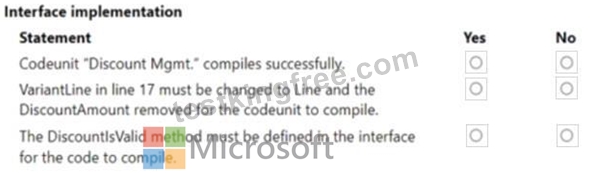
Answer:
Explanation: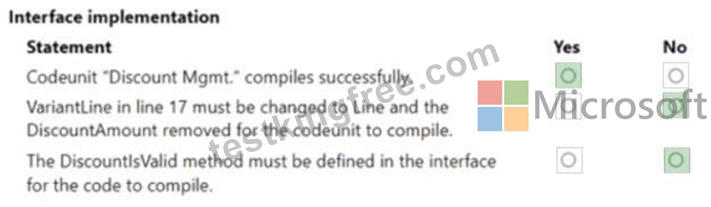
NEW QUESTION # 65
You need to access the RoomsAPI API from the canvas app.
What should you do?
- A. Use the default API configuration in Business Central
- B. Open the Web Services page and publish the RoomsAPI page as a web service.
- C. Include in the extension a codeunit of type Install that publishes RoomsAPI.
- D. Enable the APIs for the Business Central online environment.
Answer: C
Explanation:
* API Publishing for Extensions:
* In Business Central, when creating custom APIs like RoomsAPI, it is important to ensure that they are automatically published during the installation or upgrade of the extension.
* To achieve this, you can include a codeunit of type Install in the extension that explicitly publishes the custom API (RoomsAPI) as a web service. This ensures that it is available for use immediately after the extension is deployed without requiring manual intervention.
* Codeunit Type:
* A codeunit of type Install runs when the extension is installed or upgraded. This type of codeunit can be used to perform setup tasks such as publishing web services or APIs like RoomsAPI.
* Why Not Other Options?
* Option A (default API configuration): This would not automatically publish the RoomsAPI.
Default APIs do not cover custom APIs.
* Option B (enable APIs for the environment): Enabling APIs in Business Central allows the standard APIs to be used, but custom APIs still need to be manually published.
* Option C (publish via Web Services page): This would work but requires manual intervention to publish RoomsAPI, which does not fulfill the requirement of automatic publishing during installation.
Reference Documentation:
* Publishing APIs in Extensions
* Codeunit Types in Business Central
NEW QUESTION # 66
A company has the following custom permission set: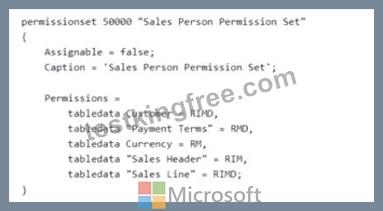
You need to make the permission set visible on the Permission Sets page.
Which three actions should you perform in sequence? To answer, move the appropriate actions from the list of actions to the answer area and arrange them in the correct order.
NOTE: More than one order of answer choices is correct. You will receive credit for any of the correct orders you select.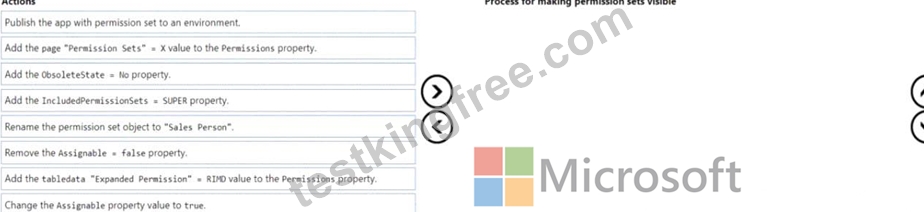
Answer:
Explanation: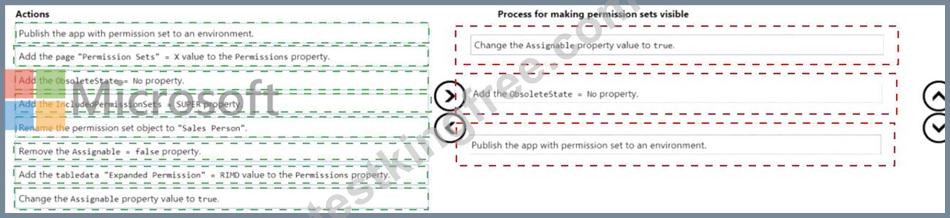
Explanation:
To make the permission set visible on the Permission Sets page, perform the following actions in sequence:
* Change the Assignable property value to true.
* Add the ObsoleteState = No property.
* Publish the app with the permission set to an environment.
Process for making permission sets visible:In Business Central, the Assignable property determines whether a permission set is shown in the user interface for assigning to users. By default, if Assignable is set to false, the permission set is hidden. Therefore, it should be set to true to make the permission set visible.
The ObsoleteState property indicates whether an object is outdated (Obsolete) or not (No). If an object is marked as obsolete, it is typically hidden from the user interface. Therefore, setting ObsoleteState = No ensures that the permission set is not treated as outdated and remains visible.
Finally, publishing the app with the permission set to an environment updates the environment with the new or modified objects, including permission sets, making them available for assignment to users.
NEW QUESTION # 67
......
New MB-820 Exam Questions Real Microsoft Dumps: https://www.testkingfree.com/Microsoft/MB-820-practice-exam-dumps.html
Course 2025 MB-820 Test Prep Training Practice Exam Download: https://drive.google.com/open?id=1hmsZdY4k8rMysv2u6BKOXJlHnEpWIIH4