

New (2024) Fortinet NSE7_ADA-6.3 Exam Dumps
Best Way To Study For Fortinet NSE7_ADA-6.3 Exam Brilliant NSE7_ADA-6.3 Exam Questions PDF
NEW QUESTION # 16
Refer to the exhibit.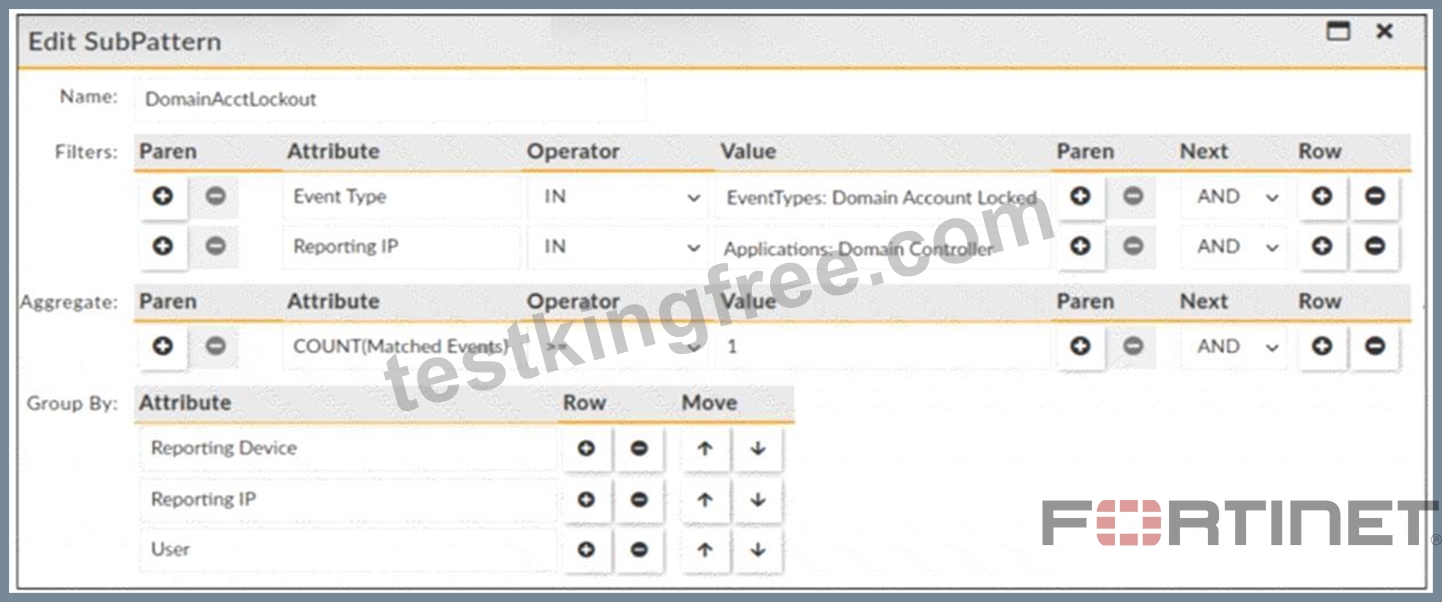
Which statement about the rule filters events shown in the exhibit is true?
- A. The rule filters events with an event type that belong to the Domain Account Locked CMDB group and a reporting |P that belong to the Domain Controller applications group.
- B. The rule filters events with an event type that belong to the Domain Account Locked CMDB group or a reporting IP that belong to the Domain Controller applications group.
- C. The rule filters events with an event type that belong to the Domain Account Locked CMDB group and a user that belongs to the Domain Controller applications group.
- D. The rule filters events with an event type that equals Domain Account Locked and a reporting IP that equals Domain Controller applications.
Answer: A
Explanation:
Explanation
The rule filters events with an event type that belong to the Domain Account Locked CMDB group and a reporting IP that belong to the Domain Controller applications group. This means that only events that have both criteria met will be processed by this rule. The event type and reporting IP are joined by an AND operator, which requires both conditions to be true.
NEW QUESTION # 17
Refer to the exhibit.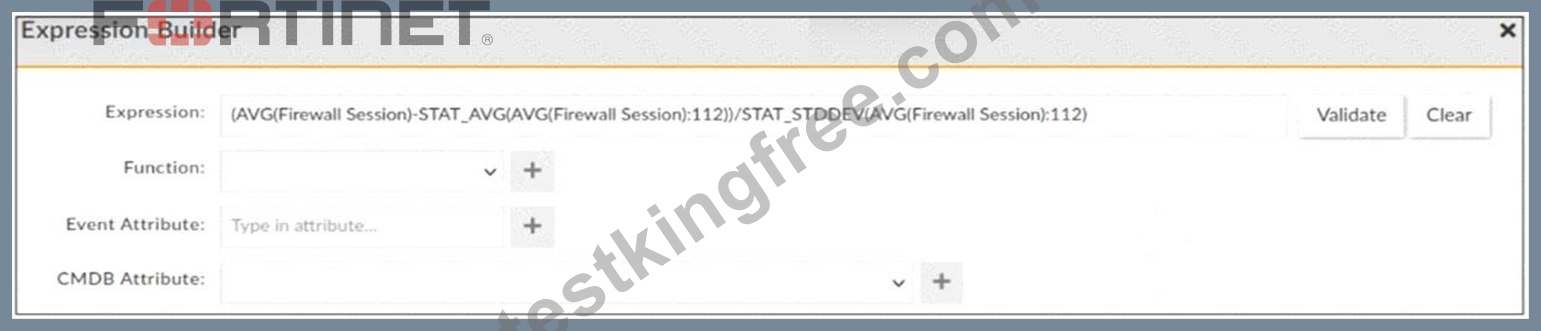
If the Z-score for this rule is greater than or equal to three, what does this mean?
- A. The rate of firewall connection is above the historical average value.
- B. The rate of firewall connection is optimum.
- C. The rate of firewall connection is below historical average value.
- D. The rate of firewall connection is above the current average value.
Answer: A
Explanation:
Explanation
If the Z-score for this rule is greater than or equal to three, it means that the rate of firewall connection is above the historical average value. The Z-score is a measure of how many standard deviations a value is away from the mean of a distribution. A Z-score of three or more indicates that the value is significantly higher than the mean, which implies an anomaly or deviation from normal behavior.
NEW QUESTION # 18
Which three statements about phRuleMaster are true? (Choose three.)
- A. phRuleMaster is present on the supervisor and workers.
- B. phRuleMaster wakes up to evaluate all the rule data in parallel, even/ 30 seconds
- C. phRuleMaster is present on the supervisor only
- D. phRuleMaster queues up the data being received from the phRuleWorkers into buckets.
- E. phRuleMaster wakes up to evaluate all the rule data in series, every 30 seconds.
Answer: A,B,D
Explanation:
Explanation
phRuleMaster is a process that performs rule evaluation and incident generation on FortiSIEM. phRuleMaster queues up the data being received from the phRuleWorkers into buckets based on time intervals, such as one minute, five minutes, or ten minutes. phRuleMaster is present on both the supervisor and workers nodes of a FortiSIEM cluster. phRuleMaster wakes up every 30 seconds to evaluate all the rule data in parallel using multiple threads.
NEW QUESTION # 19
Why can collectors not be defined before the worker upload address is set on the supervisor?
- A. To ensure that the service provider has deployed at least one worker along with a supervisor
- B. Collectors receive the worker upload address during the registration process
- C. To ensure that the service provider has deployed a NFS server
- D. Collectors can only upload data to a worker, and the supervisor is not a worker
Answer: B
Explanation:
Explanation
Collectors cannot be defined before the worker upload address is set on the supervisor because collectors receive the worker upload address during the registration process. The worker upload address is a list of IP addresses of worker nodes that can receive event data from collectors. The supervisor provides this list to collectors when they register with it, so that collectors can upload event data to any node in the list.
NEW QUESTION # 20
Refer to the exhibit.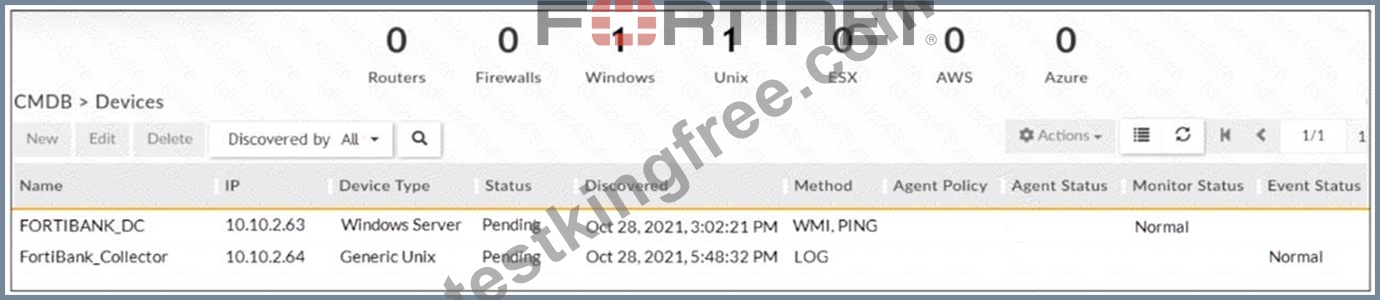
Why is the windows device still in the CMDB, even though the administrator uninstalled the windows agent?
- A. The device must be deleted manually from the CMDB
- B. The device has performance jobs assigned
- C. The device was not uninstalled properly
- D. The device must be deleted from backend of FortiSIEM
Answer: A
Explanation:
Explanation
The windows device is still in the CMDB, even though the administrator uninstalled the windows agent, because the device must be deleted manually from the CMDB. Uninstalling the windows agent does not automatically remove the device from the CMDB, as there may be other sources of data for the device, such as SNMP or syslog. To delete the device from the CMDB, the administrator must go to CMDB > Devices > All Devices, select the device, and click Delete.
NEW QUESTION # 21
How can you invoke an integration policy on FortiSIEM rules?
- A. Through Incident Notification settings
- B. Through Notification Policy settings
- C. Through External Authentication settings
- D. Through remediation scripts
Answer: B
Explanation:
Explanation
You can invoke an integration policy on FortiSIEM rules by configuring the Notification Policy settings. You can select an integration policy from the drop-down list and specify the conditions for triggering it. For example, you can invoke an integration policy when an incident is created, updated, or closed.
References: Fortinet NSE 7 - Advanced Analytics 6.3 Exam Description, page 9
NEW QUESTION # 22
Refer to the exhibit.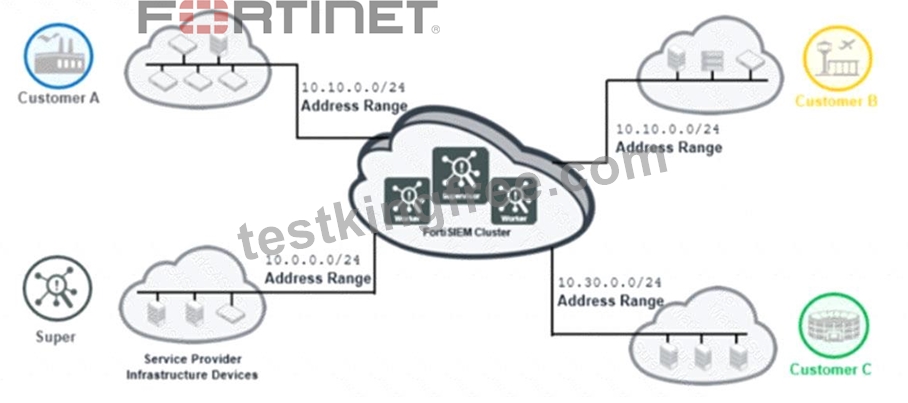
The service provider deployed FortiSIEM without a collector and added three customers on the supervisor.
What mistake did the administrator make?
- A. Collectors must be deployed on all customer premises before they are added to organizations on the supervisor.
- B. The number of workers on the FortiSIEM cluster must match the number of customers added.
- C. At least one collector must be deployed to collect logs from service provider infrastructure devices.
- D. Customer A and customer B have overlapping IP addresses.
Answer: D
Explanation:
Explanation
The mistake that the administrator made is that customer A and customer B have overlapping IP addresses.
This will cause confusion and errors in event collection and correlation, as well as CMDB discovery and classification. To avoid this problem, each customer should have a unique IP address range or use NAT to translate their IP addresses.
NEW QUESTION # 23
From where does the rule engine load the baseline data values?
- A. The memory
- B. The profile database
- C. The profile report
- D. The daily database
Answer: B
Explanation:
Explanation
The rule engine loads the baseline data values from the profile database. The profile database contains historical data that is used for baselining calculations, such as minimum, maximum, average, standard deviation, and percentile values for various metrics.
NEW QUESTION # 24
On which disk are the SQLite databases that are used for the baselining stored?
- A. Disk2
- B. Disk3
- C. Disk1
- D. Disk4
Answer: B
Explanation:
Explanation
The SQLite databases that are used for the baselining are stored on Disk3 of the FortiSIEM server. Disk3 is also used for storing raw event data and CMDB data.
NEW QUESTION # 25
How can you empower SOC by deploying FortiSOAR? (Choose three.)
- A. Address analyst skills gap
- B. Aggregate logs from distributed systems
- C. Baseline user and traffic behavior
- D. Reduce human error
- E. Collaborative knowledge sharing
Answer: A,D,E
Explanation:
Explanation
You can empower SOC by deploying FortiSOAR in the following ways:
* Collaborative knowledge sharing: FortiSOAR allows you to create and share playbooks, workflows, tasks, and notes among SOC analysts and teams. This enables faster and more consistent incident
* response and reduces duplication of efforts.
* Reduce human error: FortiSOAR automates repetitive and tedious tasks, such as data collection, enrichment, analysis, and remediation. This reduces the risk of human error and improves efficiency and accuracy.
* Address analyst skills gap: FortiSOAR provides a graphical user interface for creating and executing playbooks and workflows without requiring coding skills. This lowers the barrier for entry-level analysts and helps them learn from best practices and expert knowledge. References: Fortinet NSE 7 - Advanced Analytics 6.3 Exam Description, page 19
NEW QUESTION # 26
Which statement about EPS bursting is true?
- A. FortiSIEM must be provisioned with ten percent the licensed EPS to handle potential event surges.
- B. FortiSIEM will let you burst up to five times the licensed EPS at any given time, regardless of unused of EPS.
- C. FortiSIEM will let you burst up to five times the licensed EPS once during a 24-hour period.
- D. FortiSIEM will let you burst up to five times the licensed EPS at any given time, provided it has accumulated enough unused EPS.
Answer: D
Explanation:
Explanation
FortiSIEM allows EPS bursting to handle event spikes without dropping events or violating the license agreement. EPS bursting means that FortiSIEM will let you burst up to five times the licensed EPS at any given time, provided it has accumulated enough unused EPS from previous time intervals.
NEW QUESTION # 27
Refer to the exhibit. Click on the calculator button.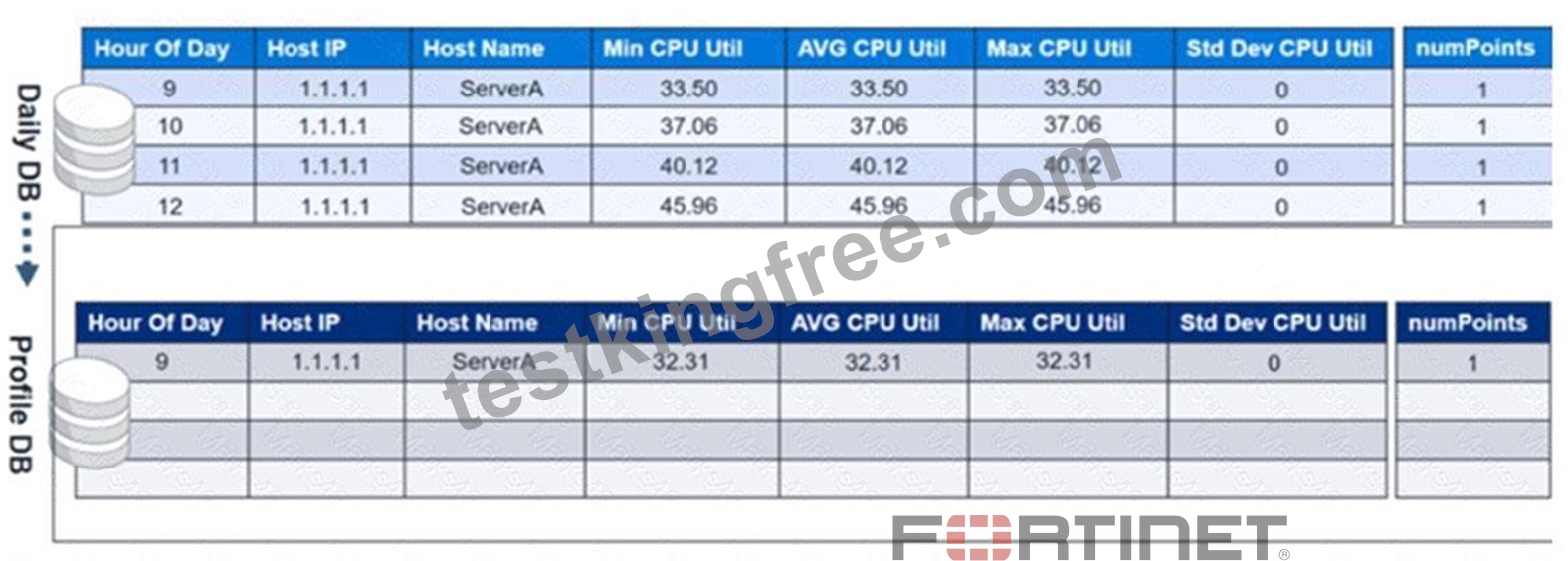
The profile database contains CPU utilization values from day one. At midnight on the second day, the CPU utilization values from the daily database will be merged with the profile database.
In the profile database, in the Hour of Day column where 9 is the value, what will be the updated minimum, maximum, and average CPU utilization values?
- A. Min CPU Util=32.31, Max CPU Ucil=32.31 and AVG CPU Util=32.31
- B. Min CPU Util=32.31, Max CPU Ucil=33.50 and AVG CPU Util=32.67
- C. Min CPU Util=33.50, Max CPU Ucil=33.50 and AVG CPU Util=33.50
- D. Min CPU Util=32.31, Max CPU Ucil=33.50 and AVG CPU Util=33.50
Answer: B
Explanation:
Explanation
The profile database contains CPU utilization values from day one. At midnight on the second day, the CPU utilization values from the daily database will be merged with the profile database using a weighted average formula:
New value = (Old value x Old weight) + (New value x New weight) / (Old weight + New weight) The weight is determined by the number of days in each database. In this case, the profile database has one day of data and the daily database has one day of data, so the weight is equal for both databases. Therefore, the formula simplifies to:
New value = (Old value + New value) / 2
In the profile database, in the Hour of Day column where 9 is the value, the updated minimum, maximum, and average CPU utilization values are:
Min CPU Util = (32.31 + 32.31) / 2 = 32.31 Max CPU Util = (33.50 + 33.50) / 2 = 33.50 AVG CPU Util = (32.67 + 32.67) / 2 = 32.67
NEW QUESTION # 28
In the event of a WAN link failure between the collector and the supervisor, by default, what is the maximum number of event files stored on the collector?
- A. 10.000
- B. 30.000
- C. 40.000
- D. 20.000
Answer: A
Explanation:
Explanation
By default, the maximum number of event files stored on the collector in the event of a WAN link failure between the collector and the supervisor is 10.000. This value can be changed in the collector.properties file by modifying the parameter max_event_files_to_store. References: Fortinet NSE 7 - Advanced Analytics 6.3 Exam Description, page 13
NEW QUESTION # 29
What is the disadvantage of automatic remediation?
- A. External threats or attacks detected by FortiSIEM will need user interaction to take action on an already overworked SOC team.
- B. It can make a disruptive change to a user, block access to an application, or disconnect critical systems from the network.
- C. Threat behaviors occurring during the night could take hours to respond to.
- D. It is equivalent to running an IPS in monitor-only mode - watches but does not block.
Answer: B
Explanation:
Explanation
The disadvantage of automatic remediation is that it can make a disruptive change to a user, block access to an application, or disconnect critical systems from the network. Automatic remediation can have unintended consequences if not carefully planned and tested. Therefore, it is recommended to use manual or semi-automatic remediation for sensitive or critical systems. References: Fortinet NSE 7 - Advanced Analytics
6.3 Exam Description, page 15
NEW QUESTION # 30
......
Updated Verified Pass NSE7_ADA-6.3 Exam - Real Questions and Answers: https://www.testkingfree.com/Fortinet/NSE7_ADA-6.3-practice-exam-dumps.html
Dumps Moneyack Guarantee - NSE7_ADA-6.3 Dumps Approved Dumps: https://drive.google.com/open?id=1h5gIBRo14D2-gj27BhUYjZSMcOUYV-xV