

May-2024 Pass Your JN0-682 Exam at the First Try with 100% Real Exam
Get Real Exam Questions for JN0-682 with New Questions
Juniper JN0-682 certification exam is a comprehensive and challenging exam that requires candidates to have a deep understanding of data center networking, as well as practical experience with Juniper Networks products. By passing the exam, candidates can demonstrate their skills and knowledge in data center networking, and can enhance their career opportunities in the IT industry. The Juniper JN0-682 certification is a valuable credential for IT professionals who want to advance their careers and become experts in data center networking.
Juniper JN0-682 exam is a challenging certification exam that requires candidates to have a deep understanding of data center technologies and protocols. JN0-682 exam covers a broad range of topics, including data center design, implementation, and support. Candidates who pass the JN0-682 exam can demonstrate their expertise in managing and troubleshooting Juniper Networks data center devices and technologies, which can help them advance their careers in the networking industry.
NEW QUESTION # 61
Referring to the exhibit, what would cause the problem on VCP 0/50?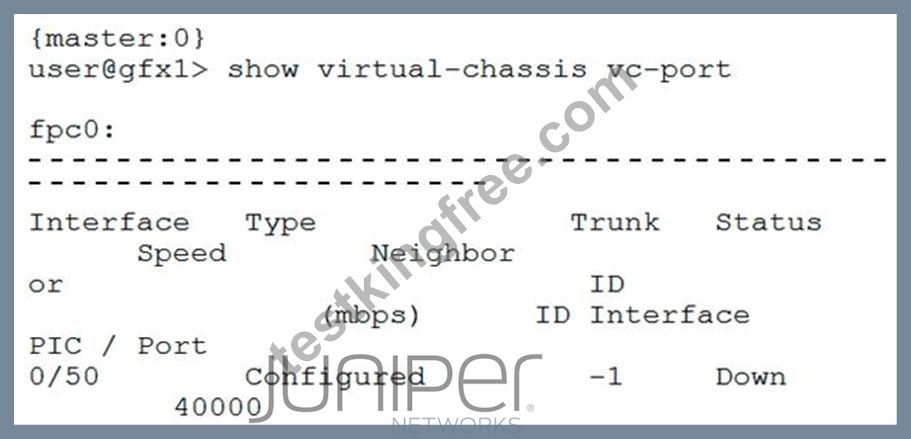
- A. The port is missing the interface hardware
- B. The VCP has been disabled through configuration
- C. VCP 0/50 is configured as a network port.
- D. The remote side is not configured as a VCP
Answer: D
Explanation:
Explanation
the status of this port can be "disabled" when it has been disabled through configuration or "down" when the
link is physically down or with the other end in network mode.
NEW QUESTION # 62
Which two statements about the seamless EVPN-VXLAN stitching data center interconnect architecture are correct? (Choose two.)
- A. VXLAN stitching is supported in 3-stage and 5-stage fabrics.
- B. IPIM is required in the underlay.
- C. VXLAN stitching is ideal for medium and large data center designs.
- D. For Layer 2 stretched between data centers, a full mesh of VXLAN tunnels between leaf switches is required.
Answer: A,C
NEW QUESTION # 63
You are asked to deploy an Ethernet bridging design in a data center with the criteria shown below.
- Routing must occur on the spine devices.
- VTEPs must terminate on the leaf devices.
- Facilitate inter-VLAN communication.
- Layer 2 gateways must be present on spine and leaf devices.
Which architecture should you use in this scenario?
- A. collapsed spine architecture
- B. edge-routed bridging architecture
- C. bridge overlay architecture
- D. centrally-routed bridging architecture
Answer: D
NEW QUESTION # 64
You are deploying a switch using ZTP.
Which two statements are true in this scenario? (Choose two.)
- A. If no configuration file is referenced in DHCP Options, the switch downloads a default configuration file from the storage server.
- B. Using DHCP Option 150. the DHCP server informs the switch of a software image name.
- C. If the switch is already running the referenced image, no action is performed and the switch moves to the next ZTP step in the ZTP process.
- D. Using DHCP Option 43 sub option 01, the DHCP server informs the switch of the configuration file name.
Answer: C,D
NEW QUESTION # 65
A company wants to expect their hosting business and is seeking solutions to supported multiple tenants. Each
tenant should be able to configure their own logical interfaces. Also, based on customer needs, all routing
features must be supported.
What will satisfy the customer's requirements?
- A. Tenant systems
- B. Logical systems
- C. Bridge domains
- D. Routing instances
Answer: B
Explanation:
Explanation
Logical systems support all routing protocols and the client will be able to configure all the attributes of the
logical interfaces
https://www.juniper.net/documentation/us/en/software/junos/logical-system-security/topics/topic-map/tenant-sys
NEW QUESTION # 66
Exhibit.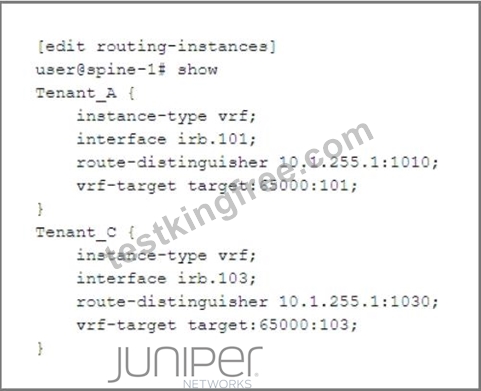
Referring to the exhibit, you want to advertise the IRB routes between both routing instances.
Which two statements are correct in this scenario? (Choose two.)
- A. Configure vrf-table-label under both routing instances.
- B. Configure a rib-group policy to advertise interface routes under both routing instances.
- C. Configure auto-export and an vrf-import policy under both routing instances.
- D. Configure a vrf-export policy to advertise interface routes under both routing instances.
Answer: C,D
NEW QUESTION # 67
Exhibit.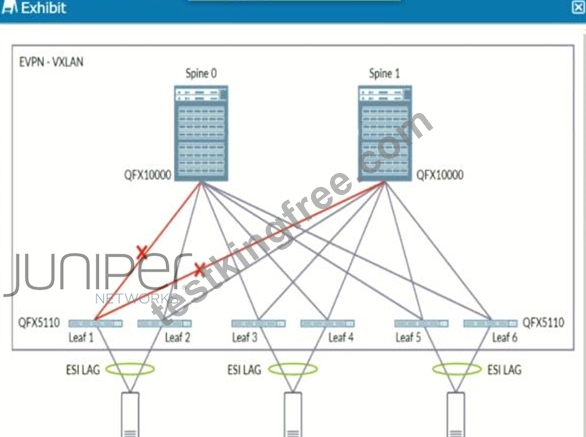
Referring to the exhibit, what effect does EVPN core isolation have?
- A. Leaf 1 will place the interfaces to connected hosts into LACP passive mode.
- B. Leaf 1 will take down all revenue interfaces.
- C. Spine 1 will block all traffic.
- D. Leaf 1 will send a pause frame to each connected host.
Answer: C
NEW QUESTION # 68
Which two statements describe EVPN based VXLAN implementations? (Choose two.)
- A. MAC addresses ate propagated using BGP updates
- B. The movement of a virtual host requires a manual reconfiguration of the VTEP
- C. The movement of a virtual host results in the dynamic remapping of the VTEP
- D. MAC addresses are learned using multicast flooding
Answer: A,C
Explanation:
A) In EVPN based VXLAN implementations, MAC addresses are propagated through BGP updates, which helps in efficient and scalable MAC address dissemination across the network.
C) The movement of a virtual host in an EVPN VXLAN environment triggers the dynamic remapping of the VTEP (VXLAN Tunnel Endpoint), ensuring that traffic is always routed to the current location of the host.
Reference:
Juniper Networks - EVPN VXLAN Configuration Guide
NEW QUESTION # 69
Which two statements are correct about a spine and leaf-based IP fabric? (Choose two.)
- A. Leaf switches broadcast frames to all other leaf devices.
- B. Traffic is diverted within the fabric when a device or link fails.
- C. There is no need for redundancy at the server level.
- D. Clos networks demonstrate good scaling features.
Answer: A,B
NEW QUESTION # 70
Exhibit.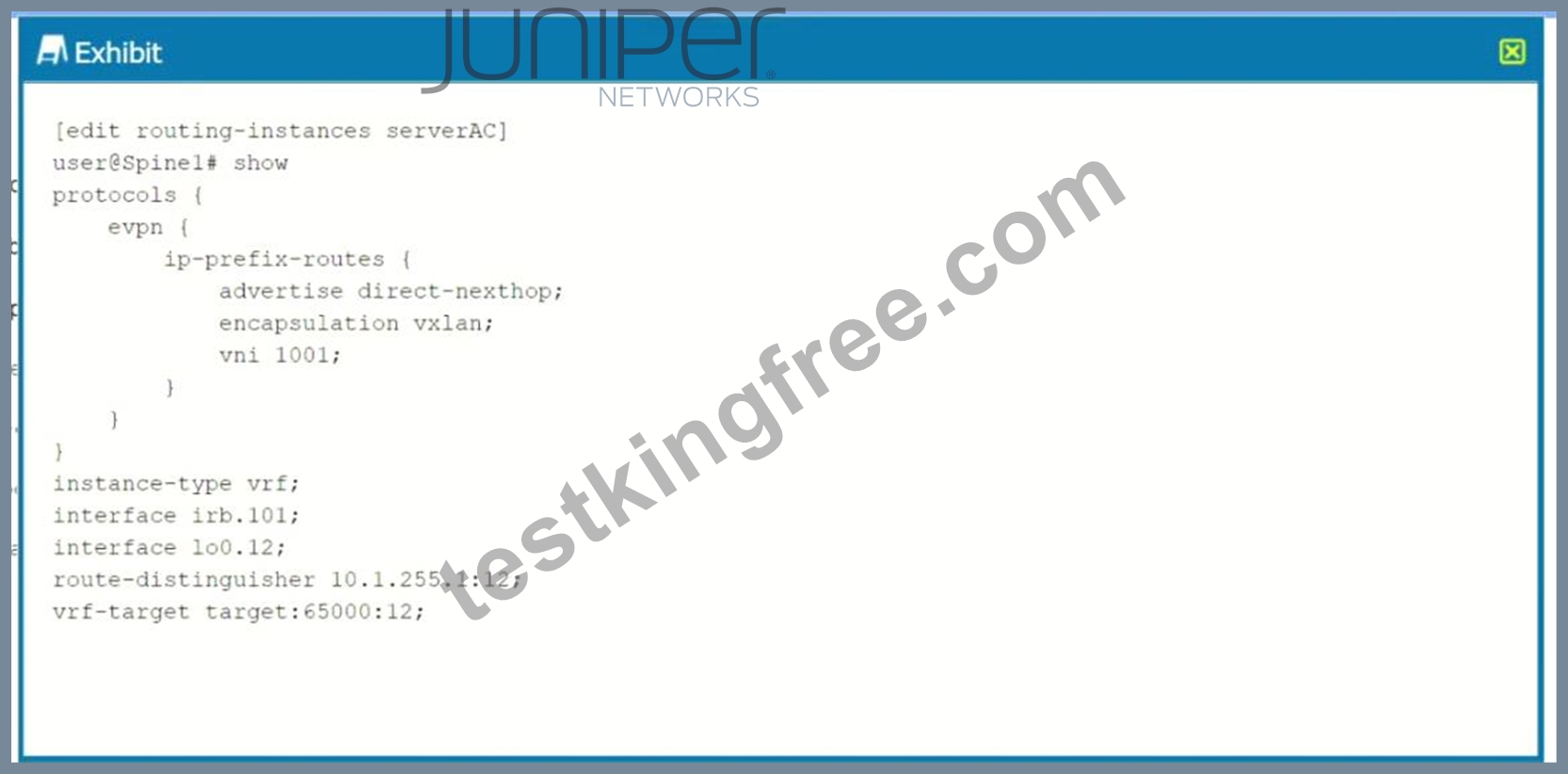
Referring to the exhibit, you must advertise the Io0.12 interface as a type-5 route.
Which configuration parameter would be used to accomplish this task?
- A. Configure a vrf-export policy to advertise the interface route under the routing instance.
- B. Configure vrf-table-label under the routing instance.
- C. Configure an export policy to advertise the interface route under protocols evpn.
- D. Configure auto-export under the routing instance.
Answer: D
NEW QUESTION # 71
You are building an IP fabric underlay network for your new data center. You must ensure that you have predictable load-balancing behavior throughout your network. According to Juniper Networks, what are two best practices that should be followed in this scenario? (Choose two.)
- A. All spine devices should be identical models including the same installed line cards.
- B. All leaf devices must be identical to the spine device models including the same installed line cards.
- C. Every leaf device should have an identical uplink to every spine device.
- D. Every leaf device should have an identical uplink to every other leaf device.
Answer: A,C
NEW QUESTION # 72
Referring to the exhibit, you must advertise the Io0.12 interface as a type-5 route.
Which configuration parameter would be used to accomplish this task?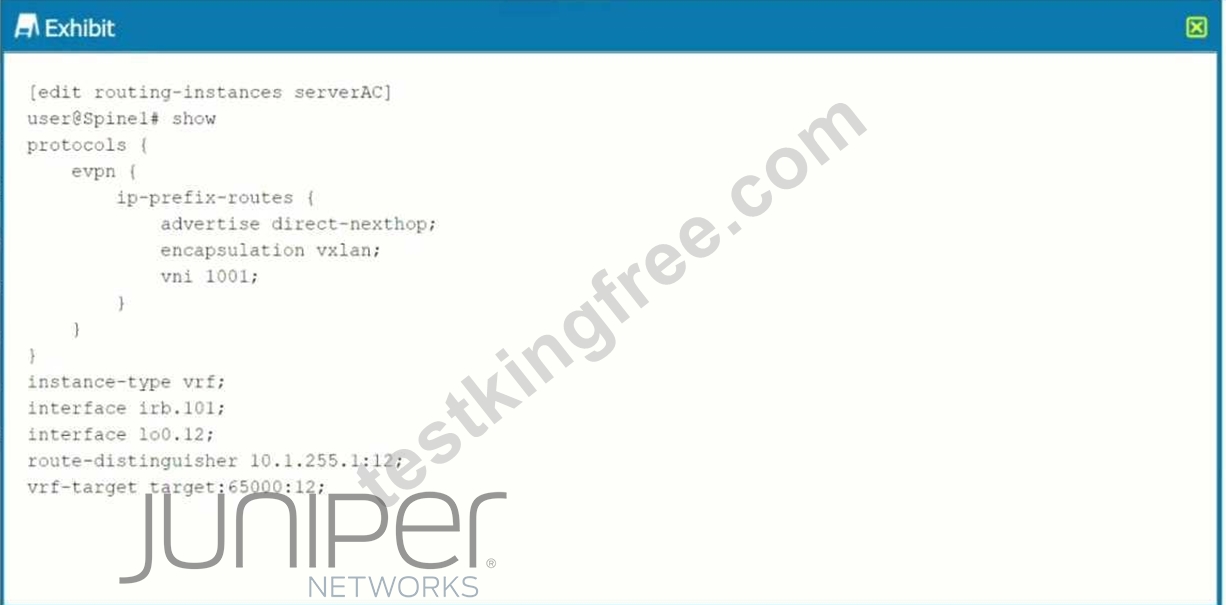
- A. Configure a vrf-export policy to advertise the interface route under the routing instance.
- B. Configure vrf-table-label under the routing instance.
- C. Configure auto-export under the routing instance.
- D. Configure an export policy to advertise the interface route under protocols evpn.
Answer: D
NEW QUESTION # 73
You are deploying an EBGP IP fabric. In this scenario, which statement is true?
- A. Each spine should peer with each leaf using loopback addresses.
- B. Each spine should peer with every other spine using loopback addresses.
- C. Each spine should peer with each leaf using physical addresses.
- D. Each spine should peer with every other spine using physical addresses.
Answer: C
NEW QUESTION # 74
Which event triggers the generation of a EVPN type-4 route?
- A. When known unicast traffic is received on an interface.
- B. When a new ESI is configured.
- C. When a new VNI is configured.
- D. When unknown unicast traffic is received on an interface.
Answer: B
Explanation:
An EVPN Type-4 route, also known as an Ethernet Segment (ES) route, is generated when a new Ethernet Segment Identifier (ESI) is configured. The ESI represents an Ethernet segment for multi-homing purposes in EVPN. When a new ESI is configured on an interface, it triggers the generation of an EVPN Type-4 route to advertise the Ethernet segment's existence and its multi-homed state to other VTEPs in the EVPN instance. This helps in providing redundancy and load balancing in a multi-homed EVPN environment.
Reference:
EVPN Type 4 Route (Ethernet Segment Route) Explanation
NEW QUESTION # 75
Referring to the VTEP output shown in the exhibit, which two statements are true? (Choose two.)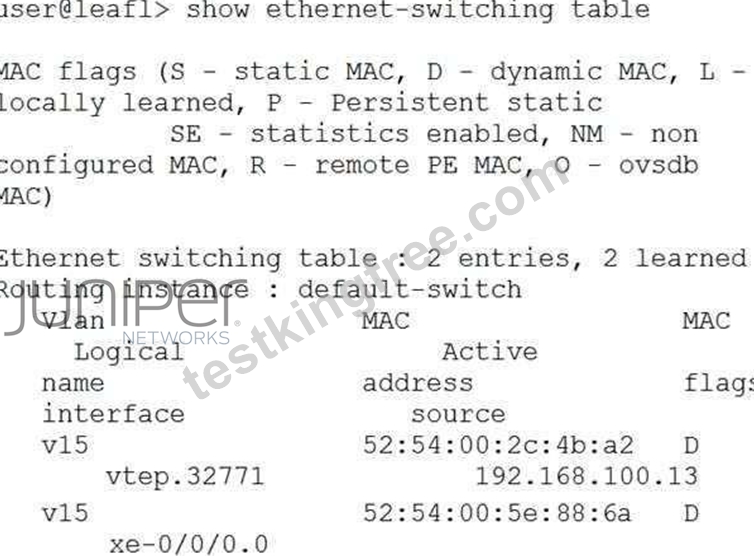
- A. The MAC address 52:54;00 5e 88 6a belongs to a local host.
- B. The MAC address 52:54:00 2c 4b:a2 belongs to a local host.
- C. The MAC address 52:54:00 2c 4b:a2 belongs to a remote host.
- D. The. MAC address 52:54:00 5e 88 6a belongs to a remote host.
Answer: C,D
NEW QUESTION # 76
The configuration shown in the exhibit is intended to set up assisted replication but will not commit. Which action will create a valid configuration in this situation?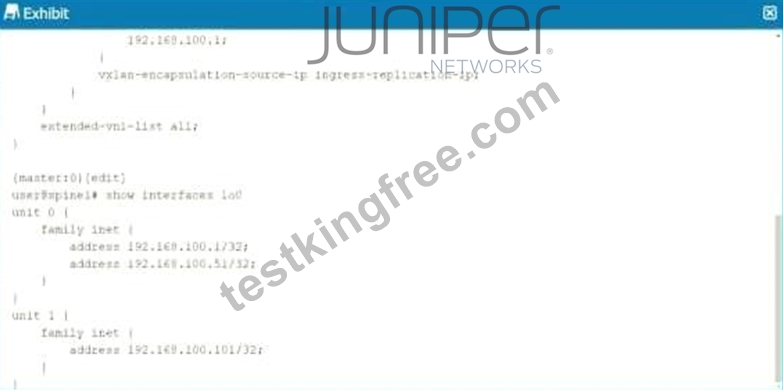
- A. Change the replicator inet address to 192.168.100. 51.
- B. Change the 10.0 address to 192.168.100.1 primary.
- C. Delete replicator inet 192.168.100.1.
- D. Change the replicator inet address to 192.168.100.101.
Answer: D
NEW QUESTION # 77
Exhibit.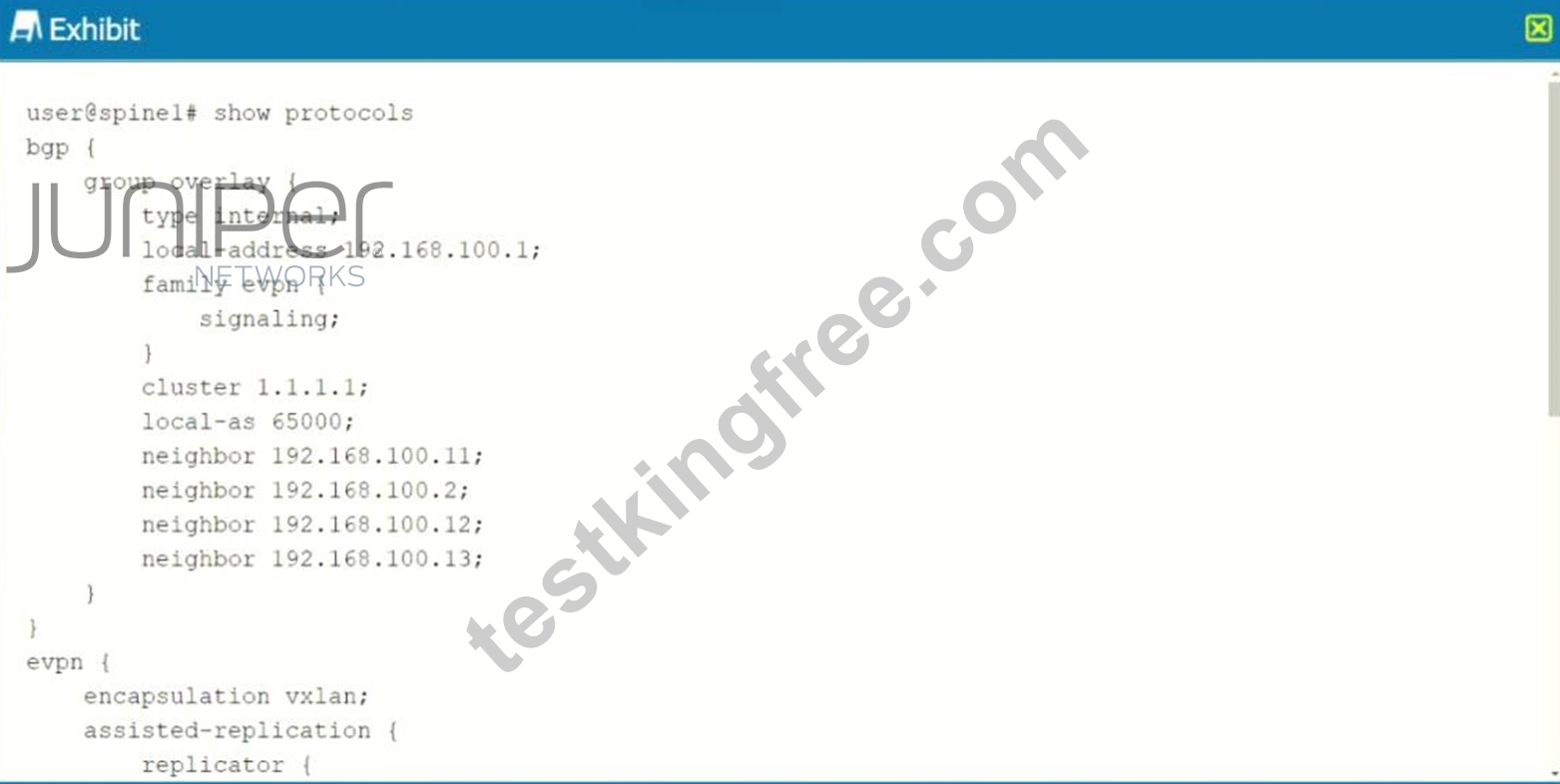
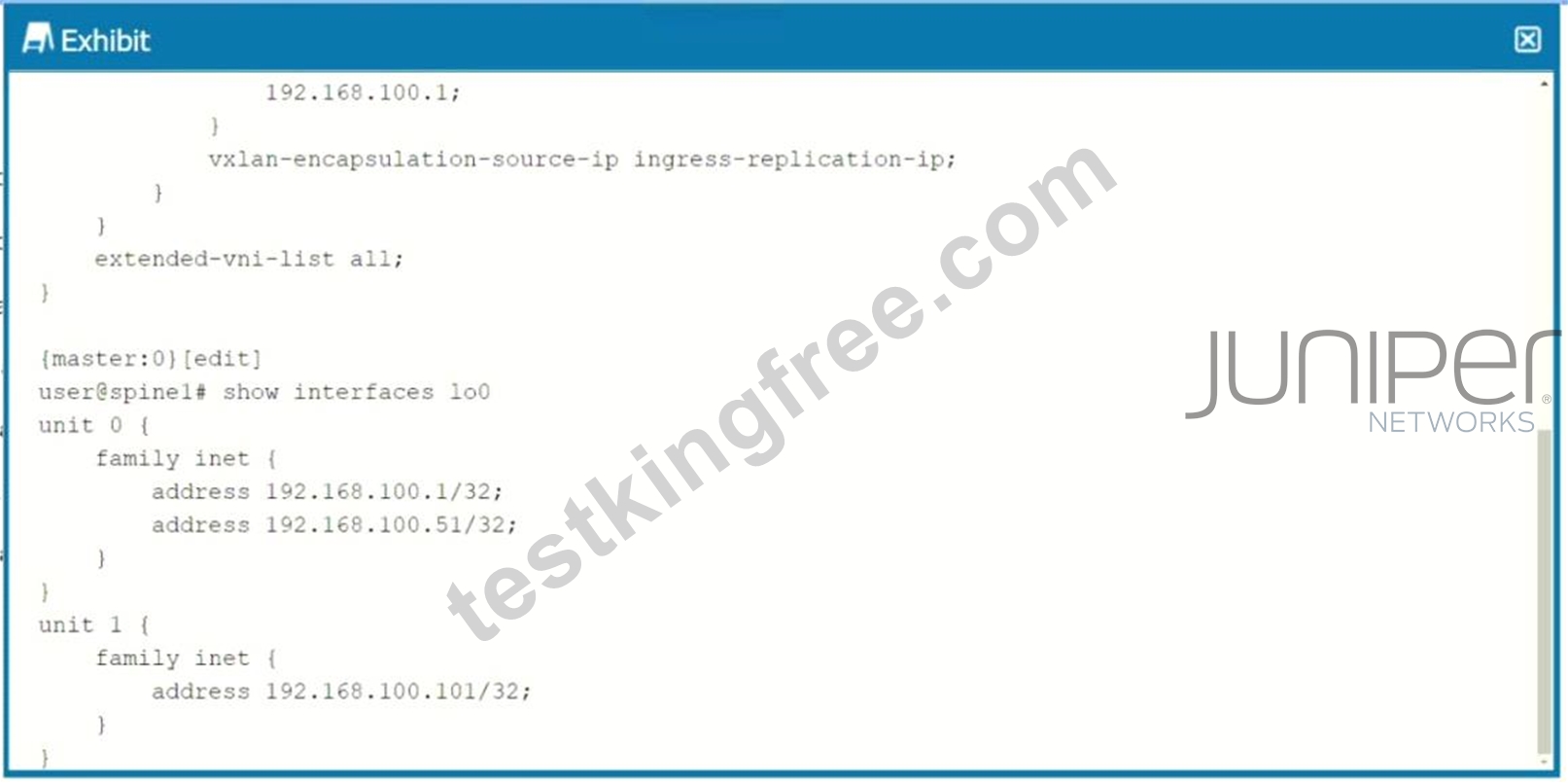
The configuration shown in the exhibit is intended to set up assisted replication but will not commit.
Which action will create a valid configuration in this situation?
- A. Change the replicator inet address to 192.168.100. 51.
- B. Change the 10.0 address to 192.168.100.1 primary.
- C. Delete replicator inet 192.168.100.1.
- D. Change the replicator inet address to 192.168.100.101.
Answer: D
NEW QUESTION # 78
You are implementing a Virtual Chassis using QFX5100s and EX4300s in your data center.
In this scenario, which two statements are correct? (Choose two.)
- A. Only 10GbE VCP connections can be used between the QFX5100s and the EX4300s.
- B. Some hardware capabilities are limited by the capabilities of the EX4300 switches.
- C. The EX4300 devices can only assume a line card role in the Virtual Chassis.
- D. The QFX5100 devices cannot assume the line card role in the Virtual Chassis.
Answer: B,C
NEW QUESTION # 79
Which device provides microsegmentation in a data center network?
- A. vMX
- B. vSRX
- C. EX4300
- D. QFX5100
Answer: B
Explanation:
In a data center network, the vSRX, which is a virtual firewall provided by Juniper, offers microsegmentation capabilities. Microsegmentation is a method of creating secure zones in data centers and cloud deployments to isolate workloads from one another and secure them individually. vSRX is capable of enforcing security policies at a granular level in virtualized environments, which is essential for effective microsegmentation. Reference: Juniper Networks vSRX Documentation.
NEW QUESTION # 80
You have deployed two data centers that require a Layer 2 stretch between host1 and host2.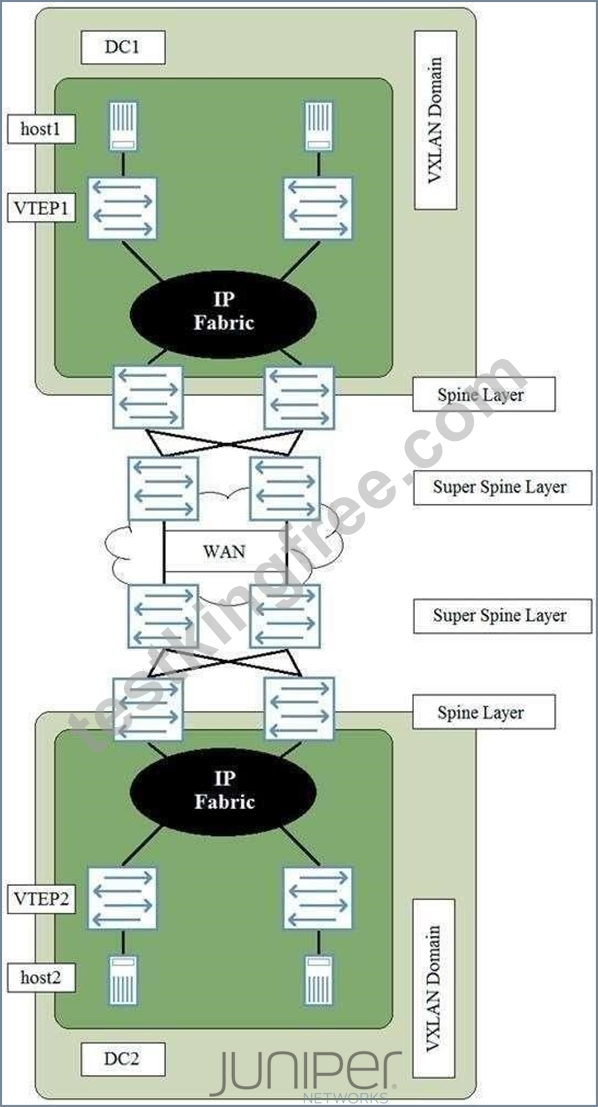
Referring to the exhibit, what does a Layer 2 stretch require?
- A. A VXLAN tunnel originating on the Spine Layer in DC1 to the Spine Layer in DC2.
- B. A VXLAN tunnel originating on the super Spine Layer in DC1 to the Super Spine Layer in DC2
- C. A VXLAN tunnel originating on VTEP1 to VTEP2
- D. A VPLS WAN connection data centers
Answer: C
NEW QUESTION # 81
You are troubleshooting an L3VPN that is part of an EVPN/MPLS DCI. You notice that the EVPN overlay
BGP session toward 10.29.50.4 is unable to establish.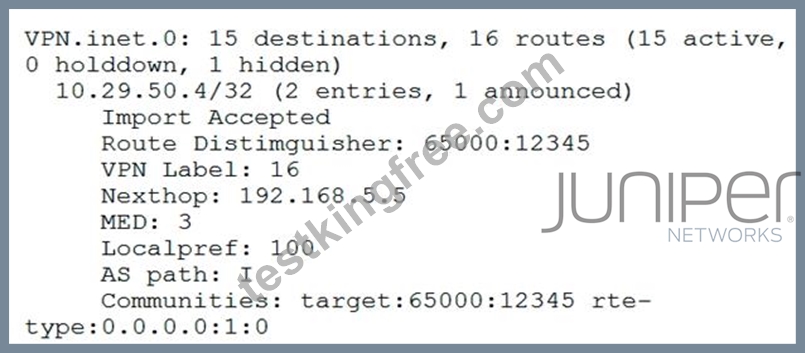
Why is the BGP session failing to establish?
- A. There is no route for 192.168.5.5. in inet 3.
- B. There is no route for 192.168.5.5 an VPN net 0.
- C. The route-distinguisher value on the local PE is incorrect
- D. The vrf-table -label value is not configured in the remote PE.
Answer: A
Explanation:
Explanation
https://www.networkfuntimes.com/junos-routers-what-does-the-inet-3-table-actually-do/
NEW QUESTION # 82
Which protocol replicates forwarding information between MC-LAG peers?
- A. LLDP
- B. ICCP
- C. VCCP
- D. VRRP
Answer: B
NEW QUESTION # 83
......
Updated JN0-682 Certification Exam Sample Questions: https://www.testkingfree.com/Juniper/JN0-682-practice-exam-dumps.html
Get Unlimited Access to JN0-682 Certification Exam Cert Guide: https://drive.google.com/open?id=1eH303BnHiCCv5zHaBPil4bWWwqdw2ZPU