

Clear your concepts with AZ-303 Questions Before Attempting Real exam
Get professional help from our AZ-303 Dumps PDF
Azure Infrastructure Implementation and Monitoring: 50-55%
- Storage Accounts Implementation – The potential candidates should have competence in managing access keys as well as implementing Azure storage replication and Azure storage account failover. The topic also covers Shared Access Signatures, access policies, and Azure Active Directory authentication for storage. You must also demonstrate the knowledge of how to configure blob storage, Azure Files, and network access for the storage account;
- Hybrid Identities Implementation and Management – This area requires the knowledge of using Azure Active Directory Connect Health as well as installing and configuring Azure AD Connect and single sign-on. It also covers the skills in identity synchronization alternatives and configuring and managing password writeback and password sync.
- Azure Active Directory Implementation – The applicants should demonstrate the skills in managing and implementing guest accounts, self-service password reset, multiple directories, and Conditional Access. They also need competence in adding custom domains and configuring Azure Active Directory Identity Protection. Additionally, they need the skills in configuring fraud alerts, bypass options, user accounts for MFA, verification methods, and Trusted IPs;
- Cloud Infrastructure Monitoring Implementation – This domain requires that you have the skills in monitoring security, cost, performance, and availability & health. It also covers your expertise in configuring advanced logging and logging for workloads. You should also know how to start automated responses with the use of Action Groups;
- Automation of Configuration and Deployment of Resources – This subsection requires competence in managing template libraries, creating and implementing automation run-books, and deploying from templates. The examinees also need the expertise in configuring virtual disk templates, measuring the location of the latest resources, and modifying the Azure Resource Manager template;
Key Points of Microsoft AZ-303 Exam
Getting ready for your Microsoft Certified Solutions Associate (MCSA) AZ-303 exam is easy if you only know the right preparation materials to choose from. Today, there are many options out there for you to study for your exam, but not all of them are the same. Diagnostics are extremely important in today's world. Networkingconfigure the deployment of resources across the network, browsing for solutions for common issues on DNS server, IPAM server, DHCP server, and WDS. Vmscreate virtual machines using Hyper-V technology, creating a virtual hard drives, and installing the operating system on a virtual hard drives. Microsoft AZ-303 exam dumps have been a great help. You can use them for preparation for the Microsoft Certified Solutions Associate (MCSA) AZ-303 exam. They have helped many students by providing them with an easy way to study without having to go through the books.
Connectivity and migrationsimplement multiple connectivity options such as IPv6, virtual private networks (VPNs), and branch office connectivity using DirectAccess. Factor in mobility and security by deploying and configuring Windows Azure Mobile Services, Microsoft Intune, and Enterprise Mobility Suite. Metrics and analyticsanalyze and monitor performance metrics and networks using the Windows monitoring tool to diagnose issues quickly. Metrics and analyticsanalyze and monitor performance metrics and networks using the Windows monitoring tool to diagnose issues quickly.
NEW QUESTION 69
DRAG DROP
You are designing a solution to secure a company's Azure resources. The environment hosts 10 teams. Each team manages a project and has a project manager, a virtual machine (VM) operator, developers, and contractors.
Project managers must be able to manage everything except access and authentication for users. VM operators must be able to manage VMs, but not the virtual network or storage account to which they are connected. Developers and contractors must be able to manage storage accounts.
You need to recommend roles for each member.
What should you recommend? To answer, drag the appropriate roles to the correct employee types. Each role may be used once, more than once, or not at all. You may need to drag the split bar between panes or scroll to view content.
NOTE: Each correct selection is worth one point.
Select and Place:
Answer:
Explanation:
Section: [none]
NEW QUESTION 70
You plan to automate the deployment of a virtual machine scale set that uses the Windows Server 2016 Datacenter image. You need to ensure that when the scale set virtual machines are provisioned, they have web server components installed. Which two actions should you perform? Each correct answer presents part of the solution. NOTE: Each correct selection is worth one point.
- A. Upload a configuration script.
- B. Create a new virtual machine scale set in the Azure portal.
- C. Create an automation account.
- D. Create an Azure policy.
- E. Modify the extensionProfile section of the Azure Resource Manager template.
Answer: B,E
Explanation:
Explanation
References:
https://docs.microsoft.com/en-us/azure/virtual-machine-scale-sets/tutorial-install-apps-template
NEW QUESTION 71
You have an Azure subscription that contains the resource groups shown in the following table.
You create an Azure Resource Manager template named Template1 as shown in the following exhibit.
From the Azure portal, you deploy Template1 four times by using the settings shown in the following table.
What is the result of the deployment? To answer, select the appropriate options in the answer area.
NOTE: Each correct selection is worth one point.
Answer:
Explanation:
NEW QUESTION 72
You have an Azure subscription.
You create a custom role in Azure by using the following Azure Resource Manager template.
You assign the role to a user named User1.
Which action can User1 perform?
- A. Create support requests
- B. Create resource groups.
- C. Create virtual machines.
- D. Delete virtual machines.
Answer: A
Explanation:
The "Microsoft.Support/*" operation will allow the user to create support tickets.
Reference:
https://docs.microsoft.com/en-us/azure/role-based-access-control/tutorial-custom-role-powershell
NEW QUESTION 73
You need to identify the storage requirements for Contoso.
For each of the following statements, select Yes if the statement is true. Otherwise, select No.
NOTE: Each correct selection is worth one point.
Answer:
Explanation:
Explanation:
Box 1: Yes
Contoso is moving the existing product blueprint files to Azure Blob storage.
Use unmanaged standard storage for the hard disks of the virtual machines. We use Page Blobs for these.
Box 2: No
NEW QUESTION 74
You have an Azure subscription that contains an Azure key vault named KeyVault1 and the virtual machines shown in the following table.
KeyVault1 has an access policy that provides several users with Create Key permissions.
You need to ensure that the users can only register secrets in KeyVault1 from VM1.
What should you do?
- A. Configure KeyVault1 to use a hardware security module (HSM).
- B. Modify the access policy for KeyVault1.
- C. Configure the Firewall and virtual networks settings for KeyVault1.
- D. Create a network security group (NSG) that is linked to Subnet1.
Answer: B
Explanation:
Explanation
You grant data plane access by setting Key Vault access policies for a key vault.
Note 1: Grant our VM's system-assigned managed identity access to the Key Vault.
* Select Access policies and click Add new.
* In Configure from template, select Secret Management.
* Choose Select Principal, and in the search field enter the name of the VM you created earlier. Select the VM in the result list and click Select.
* Click OK to finishing adding the new access policy, and OK to finish access policy selection.
Note 2: Access to a key vault is controlled through two interfaces: the management plane and the data plane.
The management plane is where you manage Key Vault itself. Operations in this plane include creating and deleting key vaults, retrieving Key Vault properties, and updating access policies. The data plane is where you work with the data stored in a key vault. You can add, delete, and modify keys, secrets, and certificates.
Reference:
https://docs.microsoft.com/en-us/azure/active-directory/managed-identities-azure-resources/tutorial-windows-vm
https://docs.microsoft.com/en-us/azure/key-vault/general/secure-your-key-vault2
NEW QUESTION 75
You have an Azure subscription that contains the resources shown in the following table.
Subnet1 is on VNET1. VM1 connects to Subnet1.
You plan to create a virtual network gateway on VNET1.
You need to prepare the environment for the planned virtual network gateway.
What are two ways to achieve this goal? Each correct answer presents a complete solution.
NOTE: Each correct selection is worth one point.
- A. Modify the address space used by Subnet1.
- B. Create a local network gateway.
- C. Delete Subnet1.
- D. Modify the address space used by VNET1
- E. Create a subnet named GatewaySubnet on VNET1.
Answer: C,D
NEW QUESTION 76
You have an Azure subscription that contains the Azure SQL Database servers shown in the following table.
The SQL Database servers have the elastic pools shown in the following table.
SQL1 has the SQL databases shown in the following table.
What will occur if you add DB1 to Pool1?
- A. The vCores on DB1 will decrease to two.
- B. The vCores on Pool1 will increase to four.
- C. The maximum data size of Pool1 will increase to 22 GB.
- D. The maximum data size of DB1 will decrease to 6 GB.
Answer: B
NEW QUESTION 77
You have virtual machines (VMs) that run a mission-critical application.
You need to minimize the possibility that the application will experience downtime.
What should you recommend? To answer, drag the appropriate solutions to the correct scenarios. Each solution may be used once, more than once, or not at all. You may need to drag the split bar between panes or scroll to view content.
NOTE: Each correct selection is worth one point.
Answer:
Explanation:
NEW QUESTION 78
Note: This question is part of series of questions that present the same scenario. Each question in the series contains a unique solution that might meet the stated goals. Some question sets might have more than one correct solution, while others might not have a correct solution.
After you answer a question in this section, you will NOT be able to return to it. As a result, these questions will not appear in the review screen.
Your network contains an Active Directory forest named fabrikam.com. The forest contains two child domains named corp.fabrikam.com and research.fabrikam.com.
You have an Azure subscription that contains an Azure Active Directory (Azure AD) tenant named contoso.com.
You install Azure AD Connect and sync all the on-premises user accounts to the Azure AD tenant. You implement seamless single sign-on (SSO).
You plan to change the source of authority for all the user accounts in research.fabrikam.com to Azure AD.
You need to prevent research.fabrikam.com from resyncing to Azure AD.
Solution: You use the Azure AD Connect wizard.
Does this meet the goal?
- A. No
- B. Yes
Answer: A
Explanation:
Section: [none]
Explanation:
Instead you should customize the default synchronization rule.
Note: The Synchronization Service Manager UI is used to configure more advanced aspects of the sync engine and to see the operational aspects of the service.
References:
https://docs.microsoft.com/en-us/azure/active-directory/hybrid/how-to-connect-create-custom-sync-rule
NEW QUESTION 79
You have a virtual network named VNet1 as shown in the exhibit.
No devices are connected to VNet1.
You plan to peer VNet1 to another virtual network named Vnet2 in the same region. VNet2 has an address space of 10.2.0.0/16.
You need to create the peering.
What should you do first?
- A. Modify the address space of VNet1.
- B. Configure a service endpoint on VNet2
- C. Create a subnet on VNet1 and VNet2.
- D. Add a gateway subnet to VNet1.
Answer: A
Explanation:
Explanation
The virtual networks you peer must have non-overlapping IP address spaces.
References:
https://docs.microsoft.com/en-us/azure/virtual-network/virtual-network-manage-peering#requirements-and-const
NEW QUESTION 80
You have an Azure Resource Manager template for a virtual machine named Template1. Template1 has the following parameters section.
For each of the following statements, select Yes if the statement is true. Otherwise, select No.
NOTE: Each correct selection is worth one point.
Answer:
Explanation:
Reference:
https://docs.microsoft.com/bs-latn-ba/azure/virtual-machines/windows/ps-template
NEW QUESTION 81
You have an Azure subscription that contains the resource groups shown in the following table.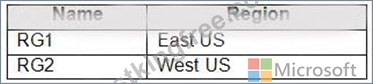
The subscription contains the storage accounts shown in the following table.
You create a Recovery Services vault named Vault1 in RG1 in the West US location.
You need to identify which storage accounts can be used to archive the diagnostics logs of Vault1.
Which storage accounts should you identify?
- A. storage1 or stoage3 only
- B. storage3 only
- C. storage1 or storage2 only
- D. storage2 only
- E. storage1 only
Answer: C
NEW QUESTION 82
You create a virtual machine scale set named Scale1. Scale1 is configured as shown in the following exhibit.
Use the drop-down menus to select the answer choice that completes each statement based on the information presented in the graphic.
Answer:
Explanation:
References: https://docs.microsoft.com/en-us/azure/virtual-machine-scale-sets/virtual-machine-scale-sets-autoscale-portal
NEW QUESTION 83
You have an Azure App Service app.
You need to implement tracing for the app. The tracing information must include the following:
* Usage trends
* AJAX call responses
* Page load speed by browser
* Server and browser exceptions
What should you do?
- A. Configure custom logs in Azure Log Analytics.
- B. Configure IIS logging in Azure Log Analytics.
- C. Configure a connection monitor in Azure Network Watcher.
- D. Enable the Azure Application Insights site extension.
Answer: D
Explanation:
Explanation
For web pages, Application Insights JavaScript SDK automatically collects AJAX calls as dependencies.
Note: Some of the things you can track or collect are:
What are the most popular webpages in your application, at what time of day and where is that traffic coming from?
Dependency rates or response times and failure rates to find out if there's an external service that's causing performance issues on your app, maybe a user is using a portal to get through to your application and there are response time issues going through there for instance.
Exceptions for both server and browser information, as well as page views and load performance from the end users' side.
Reference:
https://azure.microsoft.com/en-us/blog/ajax-collection-in-application-insights/
https://blog.pragmaticworks.com/what-is-application-insights
NEW QUESTION 84
Note: This question is part of series of questions that present the same scenario. Each question in the series contains a unique solution that might meet the stated goals. Some question sets might have more than one correct solution, while others might not have a correct solution.
After you answer a question in this section, you will NOT be able to return to it. As a result, these questions will not appear in the review screen.
You have an Azure Active Directory (Azure AD) tenant named contoso.com.
A user named Admin1 attempts to create an access review from the Azure Active Directory admin center and discovers that the Access reviews settings are unavailable. Admin1 discovers that all the other Identity Governance settings are available.
Admin1 is assigned the User administrator, Compliance administrator, and Security administrator roles.
You need to ensure that the Admin1 can create access reviews in contoso.com.
Solution: You assign the Global administrator role to Admin1.
Does this meet the goal?
- A. No
- B. Yes
Answer: A
Explanation:
Section: [none]
Explanation:
Instead use Azure AD Privileged Identity Management.
Note: PIM essentially helps you manage the who, what, when, where, and why for resources that you care about. Key features of PIM include:
* Conduct access reviews to ensure users still need roles
References:
https://docs.microsoft.com/en-us/azure/active-directory/privileged-identity-management/pim-configure
NEW QUESTION 85
You have several Azure virtual machines on a virtual network named VNet1.
You configure an Azure Storage account as shown in the following exhibit.
Use the drop-down menus to select the answer choice that completes each statement based on the information presented in the graphic.
NOTE: Each correct selection is worth one point.
Answer:
Explanation:
Explanation:
Box 1: Never
Box 2: Never
After you configure firewall and virtual network settings for your storage account, select Allow trusted Microsoft services to access this storage account as an exception to enable Azure Backup service to access the network restricted storage account.
Reference:
https://docs.microsoft.com/en-us/azure/storage/files/storage-how-to-use-files-windows
https://azure.microsoft.com/en-us/blog/azure-backup-now-supports-storage-accounts-secured-with-azure-storage-firewalls-and-virtual-networks/
NEW QUESTION 86
......
Achieve the AZ-303 Exam Best Results with Help from Microsoft Certified Experts: https://www.testkingfree.com/Microsoft/AZ-303-practice-exam-dumps.html