

Get up-to-date Real Exam Questions for NSE5_FSW_AD-7.6 UPDATED [2026]
Pass Fortinet NSE5_FSW_AD-7.6 Exam in First Attempt Guaranteed
NEW QUESTION # 59
On supported FortiSwitch models, which access control list (ACL) stage is recommended for applying actions before the switch performs any layer 2 or layer 3 processing? (Choose one answer)
- A. Egress
- B. Forwarding
- C. Prelookup
- D. Ingress
Answer: C
Explanation:
According to theFortiSwitchOS 7.6 Administration Guideand theNSE 5 FortiSwitch 7.6 Administrator Study Guide, FortiSwitch supports a multi-stage ACL pipeline that allows for granular traffic control at different points in a packet's journey through the switch.1The documentation identifies three primary stages for ACL application:Prelookup,Ingress, andEgress.
* Prelookup (Option D):This is the earliest stage in the switching pipeline. The documentation explicitly states thatPrelookup ACLsare processedbefore any Layer 2 or Layer 3 lookupsare performed by the switch hardware. This stage is highly recommended for high-performance security actions, such as dropping unwanted traffic immediately upon arrival, because it prevents the switch from wasting internal resources (CPU and ASIC lookup cycles) on frames that are destined to be discarded anyway.
* Ingress (Option A):This stage occursafterthe switch has completed its Layer 2 (MAC table) and Layer
3 (routing table) lookups butbeforethe packet is queued for the egress port. While powerful, actions here occur after initial processing has already taken place.
* Egress (Option C):This stage is processed just before the frame leaves the switch through the destination port. It is typically used for final modifications or filtering based on the outgoing interface context.
Therefore, to achieve the goal of applying actionsbeforeany Layer 2 or Layer 3 processing occurs, the Prelookupstage is the technically correct and recommended choice in FortiSwitchOS 7.6.Forwarding (Option B)is a general functional stage of a switch but is not a specific ACL stage type in the FortiSwitch configuration hierarchy.
NEW QUESTION # 60
Refer to the diagnostic output: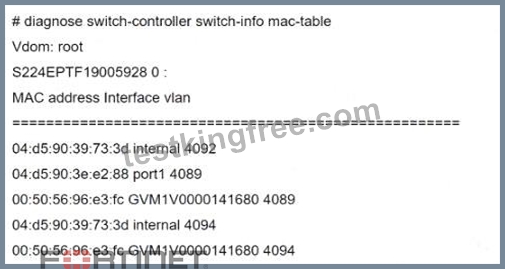
Two entries in the exhibit show that the same MAC address has been used in two different VLANs. Which MAC address is shown in the above output?
- A. It is a MAC address of FortiGate in HA configuration.
- B. It is a MAC address of an upstream FortiSwitch.
- C. It is a MAC address of a switch that accepts multiple VLANs.
- D. It is a MAC address of FortiLink interface on FortiGate.
Answer: C
Explanation:
The MAC address "00:50:56:96:e3:fc" appearing in two different VLANs (4089 and 4094) in the diagnostic output indicates it is a MAC address associated with a device that supports traffic from multiple VLANs.
Such a behavior is typical of network infrastructure devices like switches or routers, which are configured to allow traffic from various VLANs to pass through a single physical or logical interface. This is essential in network designs that utilize VLANs to segregate network traffic for different departments or use cases while using the same physical infrastructure.
References:
For more detailed information on MAC table diagnostics and VLAN configurations in FortiGate devices, refer to the official Fortinet documentation:Fortinet Product Documentation.
NEW QUESTION # 61
Refer to the diagnostic output:
What makes the use of the sniffer command on the FortiSwitch CLI unreliable on__port__23?
- A. Just the port egress payloads are printed on CLI.
- B. The switch port might be used as a trunk member
- C. The types of packets captured is limited.
- D. Only untagged VLAN traffic can be captured.
Answer: C
Explanation:
Page 452 of 7.2 study guide, specifically states "Although you can use the sniffer command to capture traffic on switch ports, the types of packets capture by the sniffer are very limited.
The use of the sniffer command on FortiSwitch CLI can be unreliable on port 23 for specific reasons related to the nature of traffic on the port:
D).The switch port might be used as a trunk member.When a switch port is configured as a trunk, it can carry traffic for multiple VLANs. If the sniffer is set up without specifying VLAN tags or a range of VLANs to capture, it may not accurately capture or display all the VLAN traffic due to the volume and variety of VLAN-tagged packets passing through the trunk port. This limitation makes using the sniffer on a trunk port unreliable for capturing specific VLAN traffic unless properly configured to handle tagged traffic.
References:
For guidelines on how to properly use sniffer commands on trunk ports and configure VLAN filtering, consult the FortiSwitch CLI reference available through Fortinet support channels, including theFortinet Knowledge Base.
NEW QUESTION # 62
Refer to the exhibit.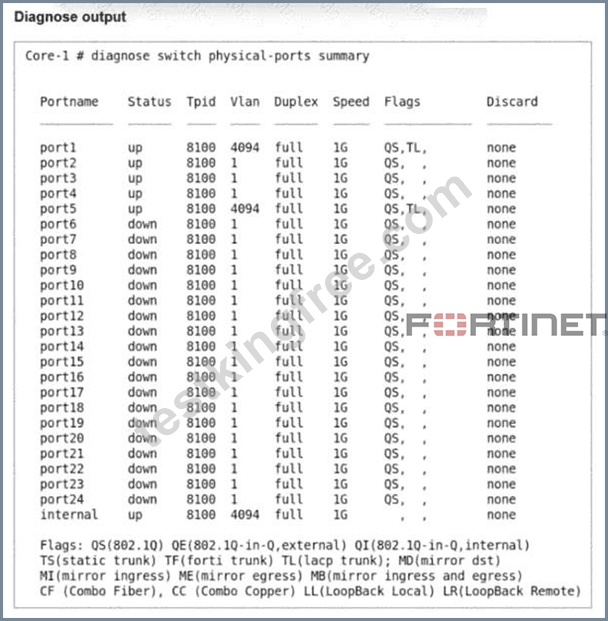
The command diagnose switch physical-ports summary is executed on FortiSwitch.
Based on the VLAN assignments shown in the output, what is the most likely management configuration of this FortiSwitch? (Choose one answer)
- A. FortiSwitch is managed by FortiSwitch Cloud.
- B. FortiSwitch is managed by FortiGate.
- C. FortiSwitch is operating in local mode.
- D. FortiSwitch is operating in standalone mode.
Answer: B
Explanation:
The output of the diagnose switch physical-ports summary command provides critical insight into how a FortiSwitch is being managed by examiningVLAN assignments,tag protocol identifiers (TPID), and internal port behavior. In the provided exhibit, several ports-includingport1,port5, and theinternalport- are assigned toVLAN 4094.
According to the FortiSwitchOS 7.6 Administrator Guide,VLAN 4094 is reserved for FortiLink management trafficwhen a FortiSwitch is managed by a FortiGate. FortiLink uses this dedicated VLAN to carry control-plane traffic such as configuration synchronization, monitoring data, LLDP-based discovery, and keepalive messages between the FortiGate and FortiSwitch. The presence of VLAN 4094 on physical interfaces is a strong and explicit indicator ofFortiGate-managed mode.
In standalone or local management mode, FortiSwitch ports typically default toVLAN 1or administrator- defined VLANs, andVLAN 4094 is not automatically assigned. Similarly, FortiSwitch Cloud-managed devices do not use VLAN 4094 in this manner, as cloud management relies on IP connectivity to FortiEdge Cloud rather than FortiLink encapsulation.
Additionally, the internal port showing VLAN 4094 further confirms FortiLink operation, as this internal interface is used by the switch ASIC to communicate with the FortiGate over the FortiLink tunnel. This behavior is documented in FortiOS 7.6 and FortiSwitchOS 7.6 design guides as characteristic of FortiGate- managed FortiSwitch deployments.
Therefore, based on the VLAN assignments shown-specifically the use ofVLAN 4094-the most accurate and fully verified conclusion is thatthe FortiSwitch is managed by FortiGate, makingOption Bthe correct answer.
NEW QUESTION # 63
(Full question statement start from here)
What is one key advantage of using a sniffer profile on FortiSwitch compared to using the sniffer command?
(Choose one answer)
- A. It eliminates the need to use access control lists (ACLs) or port mirroring for analysis.
- B. It automatically decrypts SSL/TLS traffic for full packet inspection.
- C. It automatically filters irrelevant traffic types.
- D. It allows packet capture on all switch ports without limitations.
Answer: D
Explanation:
FortiSwitchOS 7.6 provides two primary mechanisms for packet capture: thesniffer commandand thesniffer profile. While both are used for traffic analysis and troubleshooting, the FortiSwitchOS 7.6 Administrator Guide clearly identifies a key advantage of using asniffer profileover the CLI-based sniffer command.
According to the documentation (Page 438), a sniffer profile allows administrators tocapture packets from all switch ports simultaneously, without being constrained to a single interface or requiring repeated command execution. This capability makes sniffer profiles particularly effective for broad troubleshooting scenarios, such as identifying intermittent issues, unknown traffic sources, or network-wide anomalies across multiple ports and VLANs.
In contrast, the diagnose sniffer packet command is executed manually and typically focuses on a specific interface or traffic flow, requiring administrators to explicitly define capture parameters each time. This makes it less efficient when comprehensive visibility across the switch is required.
Sniffer profiles are also designed to bepersistent and reusable, meaning they can remain configured and enabled as needed without continuous CLI interaction. This is especially beneficial in production environments where consistent monitoring across all ports is necessary while minimizing administrative overhead.
The other answer choices are incorrect because sniffer profiles do not eliminate the need for ACLs or port mirroring, do not inherently filter traffic automatically, and do not provide SSL/TLS decryption, which is outside the functional scope of FortiSwitch.
Therefore, based on FortiSwitchOS 7.6 Administrator Guide (Page 438), the correct and fully verified answer isA. It allows packet capture on all switch ports without limitations.
NEW QUESTION # 64
Your team is deploying a single FortiGate and a single FortiSwitch across 100 branch offices. The goal is to expedite deployment while avoiding manual configuration errors. Which method would allow you to achieve this goal most efficiently? (Choose one answer)
- A. Ensure that devices engage FortiSwitch Manager to retrieve their configurations.
- B. Use the cloud Model-as-a-Service (MaaS) to push the configuration of both FortiGate and FortiSwitch.
- C. Push FortiGate and FortiSwitch configurations through FortiEdge Cloud.
- D. Use zero-touch provisioning (ZTP) through FortiManager.
Answer: D
Explanation:
According to theFortiOS 7.6 Administration Guideand theFortiManager 7.6 Study Guide, the most efficient and scalable method for deploying standardized configurations across a high volume of sites (such as
100 branch offices) isZero-Touch Provisioning (ZTP) through FortiManager.
ZTP allows administrators to createModel DevicesandProvisioning Templateswithin FortiManager before the physical hardware is even unboxed. When a factory-reset FortiGate at a branch office is connected to the internet, it automatically reaches out toFortiCloud(FortiDeploy) to discover its assigned management entity.
Once redirected to the centralFortiManager, the FortiGate retrieves its full configuration, including the FortiLinksettings required to manage the local FortiSwitch.
The 7.6 documentation highlights that because the FortiSwitch is managed via FortiLink, its configuration is technically part of the FortiGate's managed objects. Therefore, by using FortiManager to push a single template that includes both the FortiGate settings and theSwitch Controllerconfigurations, the team can ensure that every branch office is configured identically and without manual CLI intervention. This method significantly reduces the risk of human error and ensures rapid, consistent deployment across the entire fabric.
Options A and B refer to cloud management platforms that are effective but do not offer the same level of integrated, template-driven orchestration for large-scale enterprise ZTP as FortiManager. Option D is incorrect as "FortiSwitch Manager" is not the primary orchestration tool for branch-wide ZTP in a FortiLink- integrated environment.
NEW QUESTION # 65
Which statement best describes a benefit of using MAC, IP address, or protocol-based VLAN assignments on FortiSwitch? (Choose one answer)
- A. It requires devices to authenticate through a RADIUS server before VLAN tagging.
- B. It offers dynamic segmentation benefits similar to 802.1X authentication.2
- C. It assigns ports to VLANs regardless of device type or traffic.
- D. It disables 802.1X authentication while preserving user access control.1
Answer: B
Explanation:
According to theFortiSwitchOS 7.6 Administration Guideand theFortiSwitch 7.6 Study Guide, MAC- based, IP-based, and protocol-based VLAN assignments are methods ofdynamic VLAN assignment. These features allow the switch to categorize incoming traffic and assign it to a specific VLAN based on the packet's attributes rather than just the physical port it is connected to.3 The primary benefit of these methods is that theyoffer dynamic segmentation benefits similar to 802.1X authentication (Option D). In a modern network, devices with different security requirements (such as IoT devices, printers, and workstations) often connect to the same physical switch ports. 802.1X is the "gold standard" for dynamic segmentation but requires a supplicant on the client device.4For devices that do not support 802.1X, MAC or protocol-based assignments provide a similar result: they ensure the device is automatically placed into its designated secure segment (VLAN) the moment it is identified by the switch.
* MAC-based:Assigns a VLAN based on the source MAC address.
* IP-based:Assigns a VLAN based on the source IP address or subnet.
* Protocol-based:Assigns a VLAN based on the Ethernet type (e.g., IPv4, IPv6, or AppleTalk).
Option A is incorrect because these features complement rather than "disable" 802.1X. Option B is incorrect because these specific assignment types can be configured locally on the switch without a RADIUS server.
Option C is the opposite of how these features work, as they explicitly look at the device type or traffic to make an assignment.
NEW QUESTION # 66
Refer to the exhibits. An IP phone is connected to port1 of FortiSwitch Access-1. The IP phone tags its traffic with VLAN ID 20. On FortiGate, VLAN IP_Phone (VLAN ID 20) has been configured, and port1 of Access-
1 is set with VLAN 20 as the native VLAN. However, the IP phone cannot reach the network. The exhibit shows the partial VLAN configuration and the port1 configuration on Access-1.
Which configuration change must you make on FortiSwitch to allow ingress and egress traffic for the IP phone? (Choose one answer)
- A. On VLAN IP_Phone, enable l2forward
- B. On port1, add VLAN 20 to the allowed_vlans list
- C. On port1, disable the edge_port
- D. On VLAN IP_Phone, enable vlanforward
Answer: B
Explanation:
According to theFortiSwitchOS 7.6 Administration GuideandFortiOS 7.6 FortiLink Guide, the processing of Ethernet frames on a managed FortiSwitch port depends on whether the frame is tagged or untagged upon arrival (ingress) and how the port's VLAN membership is defined.
In the provided exhibit,port1is configured with set vlan "IP_Phone" (VLAN 20) as itsnative VLAN. By definition, the native VLAN handles untagged traffic; any untagged frame arriving at the port is assigned to VLAN 20, and any egress traffic from VLAN 20 is sent out of the port without a tag. However, the scenario specifically states that theIP phone tags its traffic with VLAN ID 20.
When a FortiSwitch receives atagged frame, it checks the VLAN ID against theallowed-vlanslist configured on that port. Although VLAN 20 is the native VLAN, the exhibit shows that the port has been explicitly configured with set allowed-vlans "quarantine". This creates a restrictive filter that permits only tagged frames belonging to the "quarantine" VLAN to enter or exit the port. Because VLAN 20 (IP_Phone) is not present in the allowed-vlans list, the switch drops the tagged frames from the IP phone during ingress processing.
To resolve this, the administrator must modify theFortiSwitch port configurationby adding VLAN 20 to the allowed_vlans list (e.g., set allowed-vlans "quarantine" "IP_Phone" or set allowed-vlans-all enable). This ensures that the switch recognizes and permits tagged traffic for VLAN 20 on that physical interface. Option B is incorrect because l2forward is a Layer 3 interface setting on the FortiGate and does not address the physical port's ingress filtering logic on the switch. Disabling the edge_port (Option D) relates to Spanning Tree Protocol (STP) convergence and would not impact VLAN tag filtering.
NEW QUESTION # 67
Which two statements about 802.1X authentication on FortiSwitch ports are true? (Choose two.)
- A. All hosts behind an authenticated port are allowed access after a successful authentication.
- B. A local user database must be used to authenticate devices using the 802.1X authentication protocol.
- C. All devices connecting to FortiSwitch must support 802.1X authentication.
- D. A security policy is used to apply 802.1 authentication on a port.
Answer: A,C
Explanation:
* All hosts behind an authenticated port are allowed access after a successful authentication (A): Once a device on a port successfully authenticates using 802.1X, all other devices connected behind that port also gain network access. This is typical in scenarios where a switch is behind an authenticated port and not each device individually authenticates.
* All devices connecting to FortiSwitch must support 802.1X authentication (D): For a network secured with 802.1X, all devices attempting to connect through the FortiSwitch must support and participate in
802.1X authentication to gain access. This ensures that all devices on the network are authenticated before they are allowed to communicate on the network.
NEW QUESTION # 68
Refer to the exhibits.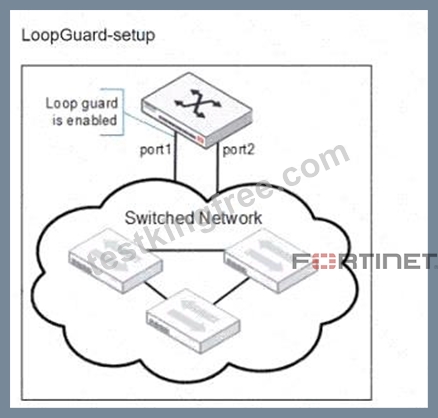
Port1 and port2 are the only ports configured with the same native VLAN 10.
What are two reasons that can trigger port1 to shut down? (Choose two.)
- A. STP triggered a loop and applied loop guard protection on port1.
- B. Loop guard frame sourced from port 1 was received on port 1.
- C. port1 was shut down by loop guard protection.
- D. An endpoint sent a BPDU on port1 that it received from another interface.
Answer: A,C
Explanation:
When loop guard is enabled on port1 and port2 configured with the same native VLAN (VLAN 10), there are specific scenarios under which port1 can be shut down due to loop guard operation:
A).port1 was shut down by loop guard protection.Loop guard is a specific feature used in network environments to prevent alternative or redundant loops. When loop guard is active, it can shut down a port if it stops receiving BPDU (Bridge Protocol Data Units) on a port that is expected to receive them, assuming a loop or link failure and putting the port into an inconsistent state to prevent potential loops.
B).STP triggered a loop and applied loop guard protection on port1.If the Spanning Tree Protocol (STP) detects a loop or loss of BPDU transmissions while loop guard is enabled, it will proactively shut down the port to prevent network instability or a broadcast storm. This is an essential function of loop guard within the context of STP, providing additional protection against topology changes that could introduce loops.
References:
Additional details about loop guard functionality and STP interaction can be found in the FortiSwitch administration guides, accessible viaFortinet Documentation.
NEW QUESTION # 69
An administrator needs to deploy managed FortiSwitch devices in a remote location where multiple VLANs must be utilized to segment devices. No Layer 3 switch or router is present. The the only WAN connectivity is the router provided by the ISP connected to the public internet.
Which two items will the administrator need to use? (Choose two.)
- A. FortiSwitch and FortiGate devices configured with IPsec interfaces.
- B. A FortiSwitch interface connected to the ISP router configured with fortilink-13-mode enabled.
- C. FortiSwitch devices that have the required internal hardware for this configuration.
- D. FortiSwitch and FortiGate devices configured with VXLAN interfaces.
- E. FortiSwitch devices configured with NAT disabled.
Answer: B,E
Explanation:
To deploy FortiSwitch in a remote location with multiple VLANs and no Layer 3 switch or router, you would need specific configurations:
* VXLAN Interfaces (B):
* Purpose:VXLAN (Virtual Extensible LAN) allows network segmentation without a Layer 3 device, extending VLAN capabilities across dispersed geographical locations over the WAN.
* Implementation:Configuring VXLAN on both FortiSwitch and FortiGate can encapsulate Layer
2 traffic over a Layer 3 network, making it ideal for scenarios lacking dedicated routing hardware.
* Appropriate Hardware (D):
* Requirement:Not all FortiSwitch models might support advanced features like VXLAN; hence, ensuring that the hardware can support such configurations is crucial.
References:For specific information on VXLAN configuration and hardware requirements, refer to the technical documentation provided by Fortinet:Fortinet Product Documentation
NEW QUESTION # 70
You are deploying a multitier FortiSwitch topology with redundant links between access and aggregation switches. The team is considering Multiple Spanning Tree Protocol (MSTP) to manage spanning tree across multiple VLANs. Which two Rapid STP (RSTP) features would be useful in this deployment to ensure fast convergence and predictable port roles? (Choose two answers)
- A. Automatic VLAN assignment
- B. Recalculating paths after a topology change
- C. The process for selecting the root bridge
- D. The rules for determining port roles
Answer: C,D
Explanation:
According to theFortiSwitchOS 7.6 Administration Guideand theFortiSwitch 7.6 Study Guide, Multiple Spanning Tree Protocol (MSTP) is built directly upon the foundations ofRapid Spanning Tree Protocol (RSTP), inheriting its mechanisms for fast convergence and fault recovery.12 In a multitier deployment (Access, Aggregation, and Core)3, theprocess for selecting the root bridge (Option A)is a fundamental RSTP feature that MSTP utilizes to create a stable and predictable logical topolog4y. By configuring the Bridge ID (priority and MAC address), administrators can manually ensure that the aggregation or core switches act as the Root Bridge for specific MST instances. This placement is critical for ensuring that traffic follows the most efficient physical paths and that high-bandwidth aggregation links are utilized effectively rather than blocked by suboptimal root selection.
Furthermore, therules for determining port roles (Option D)are essential for achieving the "Rapid" part of the protocol. RSTP/MSTP defines specific port roles such asRoot,Designated,Alternate, andBackup. Unlike legacy STP, which relies on slow listening and learning timers, RSTP uses the Alternate and Backup roles to identify secondary paths that are already in a "blocking" state but ready to transition to "forwarding" immediately through a proposal/agreement handshake if a primary link fails. This mechanism allows for sub- second convergence times in redundant multitier environments. While Option B (recalculating paths) occurs, it is the role-based synchronization process that characterizes the modern protocol's speed, making A and D the most relevant "useful features" for predictability and speed in this context.
NEW QUESTION # 71
Which is a requirement to enable SNMP v2c on a managed FortiSwitch?
- A. Configure SNMP agent and communities.
- B. Enable an SNMP v3 to handle traps messages with SNMP hosts.
- C. Create an SNMP user to use for authentication and encryption.
- D. Specify an SNMP host to send traps to.
Answer: A
Explanation:
To enable SNMP v2c on a managed FortiSwitch, the essential requirement involves configuring the SNMP agent and community strings:
* Configure SNMP Agent and Communities (D):
* SNMP Agent:Activating the SNMP agent on FortiSwitch allows it to respond to SNMP requests.
* Community Strings:SNMP v2c uses community strings for authentication. These strings function as passwords to grant read-only or read-write access to the SNMP data.
* Understanding Other Options:
* Create an SNMP user (A)is necessary for SNMP v3, not v2c, as it involves user-based authentication and encryption.
* Specify an SNMP host (B)is typically a part of SNMP configuration but not a requirement just to enable SNMP.
* Enable SNMP v3 (C)is not related to enabling SNMP v2c.
References:For detailed instructions on configuring SNMP on FortiSwitch, you can refer to the SNMP configuration section in the FortiSwitch administration guide available on:Fortinet Product Documentation
NEW QUESTION # 72
You are deploying a small office network with a single FortiGate and a single FortiSwitch. The office currently has moderate traffic, but the IT team expects the network to grow in the near future, adding more FortiSwitch devices and endpoints. Which FortiLink configuration should you deploy to provide the best combination of current performance and scalability for future growth? (Choose one answer)
- A. Configure FortiLink using software-based switch interfaces.
- B. Configure FortiLink as a multichassis LAG (MCLAG) interface.2
- C. Configure FortiLink as a link aggregation group (LAG) interface.
- D. Configure FortiLink using hardware-based switch interfaces.1
Answer: C
Explanation:
According to theFortiGate Switch Best Practicesand theFortiSwitch 7.6 FortiLink Guide, the recommended best practice for a scalable and high-performance FortiLink deployment is to use alink aggregation group (LAG)interface, also known as an802.3ad aggregate.3 While ahardware-based switch interface (Option A)offers low latency by switching traffic directly in the ASIC, it has significant limitations regardingscalability and redundancy. Hardware switches are restricted by the number of physical ports on the Integrated Switch Fabric (ISF) and cannot be easily expanded to include additional redundant links as the network grows. Conversely,software-based switch interfaces (Option B)are processed by the system CPU, leading to higher utilization and a lack ofNPU hardware acceleration, which makes them unsuitable for high-performance or growing environments.4 By configuring FortiLink as aLAG (Option C), the administrator ensures that the network can support future growth seamlessly. A LAG interface allows for the addition of multiple physical ports to increase bandwidth between the FortiGate and the switch fabric while providing link-level redundancy.5This configuration is the default for modern FortiOS versions because it supports NPU offloading and serves as the technical prerequisite for more advanced topologies, such asMCLAG (Option D). While MCLAG is an excellent solution for high availability in multi-switch environments, it is a topology feature rather than the primary interface type used to define the FortiLink connection on the FortiGate unit itself. Therefore, starting with an aggregate (LAG) interface provides the most flexible foundation for migrating to more complex infrastructures as additional switches are added.
NEW QUESTION # 73
Which interfaces on FortiSwitch send out FortiLink discovery frames by default in order to detect a FortiGate with an enabled FortiLink interface?
- A. The last four switch ports on FortiSwitch have auto-discovery enabled by default.
- B. No ports are enabled by default for auto-discovery. This must be configured under config switch interface.
- C. All ports have auto-discovery enabled by default.
- D. The ports with auto-discovery enabled by default are dependent upon the FortiSwitch model.
Answer: C
Explanation:
* Fortinet FortiLink Protocol:The FortiLink protocol is Fortinet's proprietary mechanism for managing FortiSwitch units from a FortiGate firewall. It simplifies configuration and security policy enforcement across the connected network devices.
* Auto-Discovery:FortiLink's auto-discovery feature means that by default, all ports on a FortiSwitch will actively send out discovery frames. This allows them to locate a FortiGate device that has a FortiLink interface enabled, streamlining the device management process.
* No Configuration Needed:You don't have to manually configure individual ports for FortiLink discovery on FortiSwitch devices.
References
* FortiSwitchOS FortiLink Guide (FortiSwitch Devices Managed by FortiOS 7.2):Refer to pages 13 and 14 for details on zero-touch management and FortiLink configuration. [https://fortinetweb.s3.
amazonaws.com/docs.fortinet.com/v2/attachments/27f63c72-b083-11ec-9fd1-fa163e15d75b
/FortiSwitchOS-7.2.0-FortiLink_Guide%E2%80%94FortiSwitch_Devices_Managed_by_FortiOS_7.2.
pdf]
NEW QUESTION # 74
Refer to the exhibit.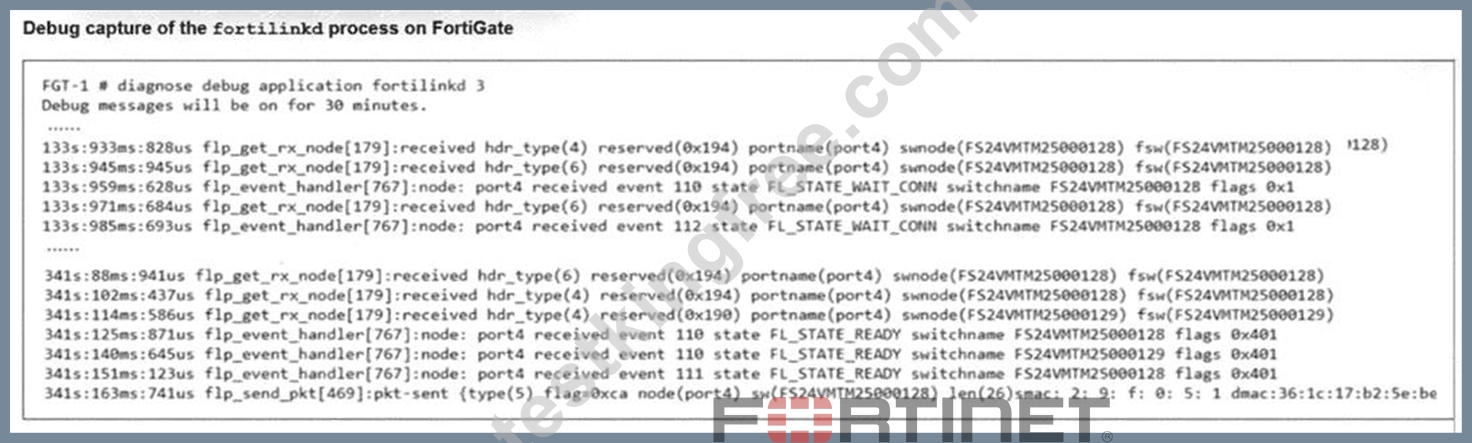
A periodic heartbeat message sent from a managed FortiSwitch and corresponding acknowledgments from FortiGate is shown. What does this behavior indicate? (Choose one answer)
- A. The FortiLink connection between FortiGate and FortiSwitch is healthy and active.
- B. FortiGate is unable to establish a FortiLink session with FortiSwitch.
- C. FortiSwitch has not been authorized yet.
- D. FortiSwitch is expecting an authorization from FortiGate.
Answer: A
Explanation:
According to theFortiOS 7.6 Study Guideand theFortiSwitch 7.6 FortiLink Guide, the health of the Control and Provisioning of Wireless Access Points (CAPWAP) based management tunnel between a FortiGate and a FortiSwitch is maintained through a continuous keepalive mechanism. The provided exhibit captures the fortilinkd process logs, which are essential for verifying the operational status of the FortiLink control plane.
The debug output reveals two critical indicators of a successful connection:
* State Transitions:The lines at timestamp 341s show the managed switch (FS24VMTM25000128) has reached theFL_STATE_READYstate. This state indicates that the discovery, authorization, and configuration synchronization phases are complete, and the switch is now fully operational under the FortiGate's management.
* Heartbeat Mechanism:The entry flp_send_pkt[469]:pkt-sent {type(5)} represents the transmission of a FortiLink heartbeat. TheseType 5 packetsare sent every few seconds to verify that the peer device is still reachable and responsive. In a healthy environment, the FortiGate sends these heartbeats, and the FortiSwitch responds (or vice versa depending on the specific sub-protocol phase), ensuring the management tunnel remains active.
The regular exchange of these messages as shown in the exhibit confirms that the FortiLink connection is healthy and active. If the switch were unauthorized or stuck in a negotiation phase, the state would be shown as FL_STATE_WAIT_AUTH or FL_STATE_DISCOVERY, and the periodic type(5) heartbeats would either be absent or not acknowledged.
NEW QUESTION # 75
An administrator must deploy managed FortiSwitch devices in a remote location where multiple VLANs must be used to segment devices. No layer 3 switch or router is present at the site, and the only WAN connectivity is an ISP-provided router connected to the public internet. Which two components are required to enable VLAN segmentation across this remote site? (Choose two answers)
- A. FortiGate and FortiSwitch configured with VXLAN to tunnel VLANs over the WAN
- B. A FortiSwitch model that supports VXLAN hardware acceleration
- C. A layer 3 router at the remote location to handle inter-VLAN routing
- D. FortiGate with a layer 3 interface to terminate the VXLAN overlay
- E. FortiSwitch and FortiGate devices configured with IPsec interfaces
Answer: A,D
Explanation:
According to theFortiOS 7.6 Administration Guideand theFortiSwitch 7.6 FortiLink Guide, deploying managed switches over a Layer 3 underlay-such as the public internet-requires a specific tunneling mechanism to bridge Layer 2 broadcast domains. Traditional FortiLink relies on a direct Layer 2 connection; however, for remote sites,FortiLink over VXLANis the standard solution.
* FortiLink over VXLAN (Option A):Virtual Extensible LAN (VXLAN) is used to encapsulate Layer 2 Ethernet frames into Layer 3 UDP packets, allowing VLAN-tagged traffic to traverse an ISP's routable network. This enables the FortiGate to manage remote FortiSwitch "islands" as if they were locally connected, maintaining full VLAN segmentation across the WAN.
* Layer 3 Termination (Option E):The FortiGate acts as theVirtual Tunnel Endpoint (VTEP). It must have a reachable Layer 3 interface (such as a WAN port with a public IP or an IPsec tunnel interface) to terminate the VXLAN overlay. Once the VXLAN tunnel is terminated at the FortiGate, the encapsulated VLAN traffic is extracted, and the FortiGate can perform inter-VLAN routing and security inspection.
Regarding the incorrect options:Option Bis incorrect because the FortiGate at the central site handles the routing, eliminating the need for a local L3 device.Option Cis a performance consideration but not a functional requirement for basic connectivity.Option Dis often used for security to encrypt the underlay, but IPsec alone does not provide the Layer 2 extension capabilities required for VLAN segmentation; VXLAN is the specific component that handles the MAC-in-UDP encapsulation.
NEW QUESTION # 76
Which statement about using MAC, IP, and protocol-based VLANs on FortiSwitch is true?
- A. It provides benefits that can be obtained when using 802.1X authentication.
- B. Endpoints are required to use the same FortiSwitch port to remain members of the VLAN.
- C. FortiSwitch uses only the Ethernet type to assign traffic to VLANs.
- D. lt is a scalable and secure solution in comparison to other Layer 2 security measures.
Answer: A
Explanation:
It provides benefits that can be obtained when using 802.1X authentication (C): MAC, IP, and protocol-based VLANs on FortiSwitch are beneficial in network environments where additional granularity is needed in traffic segmentation and security, similar to what can be achieved through 802.1X authentication. These VLAN types allow for dynamic assignment of ports to VLANs based on the characteristics of the incoming traffic, enhancing both security and network efficiency.
NEW QUESTION # 77
What type of multimode transceiver can be used to split a 40G port?
- A. QSFP+ transceiver
- B. SFP transceiver
- C. SFP+ transceiver
- D. QSFP transceiver
Answer: A
Explanation:
QSFP+ transceiver (A): The QSFP+ (Quad Small Form-factor Pluggable Plus) transceiver is designed to handle 40G data rates and can be used to split a 40G port into multiple 10G connections. This type of transceiver supports such configurations, making it suitable for high-density applications where multiple 10G connections are derived from a single 40G port, thereby maximizing the utilization of the port and the fiber infrastructure.
NEW QUESTION # 78
Exhibit.
port1 and port2 are the only ports configured with the same native VLAN 10.
What are two reasons that can trigger port1 to shut down? (Choose two.)
- A. Loop guard frame sourced from port1 was received on port1.
- B. STP triggered a loop and applied loop guard protection on port1.
- C. port1 was shut down by loop guard protection.
- D. An endpoint sent a BPDU on port1 that it received from another interface.
Answer: A,C
NEW QUESTION # 79
Which packet capture method allows FortiSwitch to capture traffic on trunks and management interfaces?
- A. Sniffer profile
- B. sFlow
- C. SPAN
- D. TCP dump
Answer: A
Explanation:
FortiSwitch supports packet capture through various methods, but the Sniffer profile is specifically capable of capturing traffic on both trunks and management interfaces.Here's why:
* Sniffer Profile (B):
* Versatile Capture:The sniffer profile in FortiSwitch is designed to capture traffic across different types of interfaces, including trunks (where multiple VLANs are present) and management interfaces (used for controlling and monitoring the switch).
* Configuration Flexibility:You can configure sniffer profiles to target specific traffic, offering flexibility in monitoring and troubleshooting network issues on both data and management planes.
* Other Options:
* SPAN (A)is used mainly for mirroring traffic to another port for analysis but is typically limited in its ability to capture management interface traffic.
* sFlow (C)andTCP dump (D)are useful tools but do not specifically align with the capability to universally capture traffic across trunks and management interfaces in the context described.
References:For further details on configuring and utilizing sniffer profiles on FortiSwitch, refer to the FortiSwitch management documentation:Fortinet Product Documentation
NEW QUESTION # 80
Which Ethernet frame can create Layer 2 flooding due to all bytes on the destination MAC address being set to all FF?
- A. The broadcast Ethernet frame
- B. The unicast Ethernet frame
- C. The multicast Ethernet frame
- D. The anycast Ethernet frame
Answer: A
Explanation:
Layer 2 flooding caused by Ethernet frames with all bytes in the destination MAC address set to FF refers to broadcast frames.Here's why:
* Broadcast Ethernet Frame (A):
* Address Specification:In Ethernet networking, a broadcast frame has a destination MAC address ofFF:FF:FF:FF:FF:FF, which instructs network devices to forward the frame to all devices within the broadcast domain.
* Network Behavior:This causes Layer 2 flooding as the frame is sent to all ports in the VLAN, except the originating port, ensuring that the broadcast reaches all network segments.
* Other Frame Types:
* Unicast (B)targets a single device.
* Multicast (C)targets a group of devices.
* Anycast (D)is not used in Ethernet but rather in IP-based routing to route to the nearest of multiple destinations, typically in internet addressing.
References:You can find more information about Ethernet frame types in networking textbooks or documentation that discusses network layer interaction:Network Theory Books
NEW QUESTION # 81
(Full question statement start from here)
You are deploying a FortiSwitch virtual stack in a network that contains Cisco devices. You want the Cisco devices toautomatically discover the FortiSwitch devices and exchange device information. Which two protocols must be enabled on the FortiSwitch devices to achieve this? (Choose two answers)
- A. LLDP - Media Endpoint Discovery
- B. Cisco Discovery Protocol
- C. Link Layer Discovery Protocol
- D. Unidirectional Link Detection
Answer: B,C
Explanation:
In mixed-vendor network environments, such as deployments that include bothFortiSwitchandCiscodevices, properLayer 2 discovery protocolsmust be enabled to allow devices to automatically discover neighbors and exchange essential device and interface information. FortiSwitchOS 7.6 supports bothCisco Discovery Protocol (CDP)andLink Layer Discovery Protocol (LLDP)to ensure interoperability.
Cisco Discovery Protocol (CDP)is a Cisco-proprietary Layer 2 discovery protocol widely used by Cisco switches, routers, and IP phones. When CDP is enabled on FortiSwitch interfaces, Cisco devices can discover FortiSwitch neighbors and receive information such as device ID, port ID, platform, and capabilities. This is particularly important in Cisco-centric networks where CDP is the primary discovery mechanism.
Link Layer Discovery Protocol (LLDP), defined by IEEE 802.1AB, is a vendor-neutral discovery protocol supported by both Fortinet and Cisco devices. Enabling LLDP allows FortiSwitch and Cisco devices to exchange standardized information including system name, port description, VLAN information, and management address. LLDP is essential for cross-vendor compatibility and is commonly enabled by default in modern enterprise networks.
The remaining options are incorrect.Unidirectional Link Detection (UDLD)is used to detect unidirectional fiber or copper link failures and does not provide device discovery or information exchange.LLDP-MEDis an extension of LLDP specifically designed for media endpoints such as IP phones and is not required for general switch-to-switch discovery.
Therefore, to ensure automatic discovery and information exchange between FortiSwitch and Cisco devices, both CDP and LLDP must be enabled, makingOptions B and Cthe correct and fully verified answers based on FortiSwitchOS 7.6 documentation.
NEW QUESTION # 82
Which QoS mechanism maps packets with specific CoS or DSCP markings to an egress queue?
- A. Queuing for egress traffic
- B. Classification for ingress traffic
- C. Rate limiting for egress traffic
- D. Marking for ingress traffic
Answer: B
Explanation:
"Classification: FortiSwitch maps packets with a given CoS or DSCP marking to an egress queue. There are eight egress queues on each port: queues 0 to 7." In Quality of Service (QoS) mechanisms, the process of mapping packets with specific CoS (Class of Service) or DSCP (Differentiated Services Code Point) markings to an egress queue involves two key steps:
classificationandqueuing.
* Classification: This occurs on the ingress side (incoming traffic). The switch examines the packet headers (e.g., CoS or DSCP values) to determine how the traffic should be treated. Based on this classification, the switch assigns the packet to a specific priority level or queue.
* Queuing: Once the packet is classified, it is mapped to an egress queue based on its priority level. The egress queues are used to manage how traffic is transmitted out of the switch.
* Option A (Queuing for egress traffic)refers to managing how packets leave the switch, but it does not involve the initial mapping of CoS/DSCP values to a queue.
* Option C (Rate limiting for egress traffic)is about controlling the rate of outgoing traffic, which is unrelated to CoS/DSCP mapping.
* Option D (Marking for ingress traffic)involves modifying the CoS or DSCP values of packets as they enter the switch, but it does not map them to an egress queue.
Thus,classification for ingress trafficis the mechanism that identifies and maps packets with specific CoS or DSCP markings to an appropriate egress queue.
NEW QUESTION # 83
Refer to the exhibits.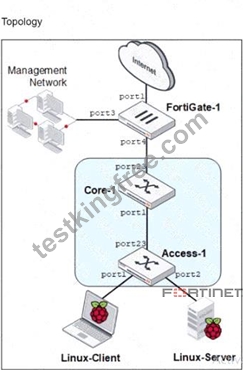
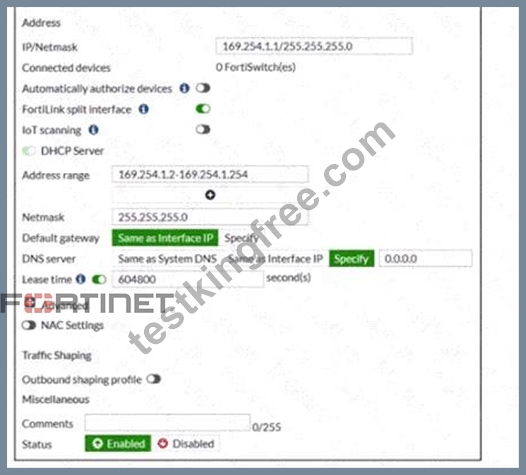
You are asked to ensure that managed FortiSwitch devices are reachable by other devices, such as SNMP and other management tools across your network.
Which setting must you configure to ensure traffic from other devices in the network reaches FortiSwitch?
- A. Change the FortiLink interface IP address and DHCP server address range.
- B. Recreate the FortiLink interface with a nonaggregate setting.
- C. Enable NAC settings to select the onboarding VLAN.
- D. Select a specific default gateway provided to FortiSwitch as an upstream device.
Answer: A
NEW QUESTION # 84
......
Fortinet NSE5_FSW_AD-7.6 Study Guide Archives : https://www.testkingfree.com/Fortinet/NSE5_FSW_AD-7.6-practice-exam-dumps.html
Pass NSE5_FSW_AD-7.6 Exam Latest Practice Questions: https://drive.google.com/open?id=1vKV0MpuX1FTNJhr176qlW2kUzMADtct3