

(May-2026) 3V0-24.25 Exam Dumps Contains FREE Real Quesions from the Actual Exam
Free Test Engine Verified By Professional Level Exams Certified Experts
NEW QUESTION # 80
An administrator is configuring the Supervisor Service in vCenter.
Click the option an administrator uses to begin creating a vSphere Supervisor Zone.
Answer:
Explanation:
Explanation:
Hosts and Clusters
To create avSphere Zone(used as a Supervisor Management Zone and/or Workload Zone), the administrator must start from the vSphere Client inventory wherevCenterand its clusters are managed. That's why the correct starting point in the "Inventories" toolbar isHosts and Clusters-it is the entry point used to select the vCenter object and the target clusters.
VCF 9.0 documents the zone-creation workflow as:navigate to vCenter, thenSelect Configure, thenselect vSphere Zones, and finally clickAdd New vSphere Zone. After naming the zone, youselect a vSphere cluster to add to the zoneand finish the wizard.
This sequence matches the intent of the hotspot: you must first open the inventory view that exposes vCenter and clusters (Hosts and Clusters), then perform the configuration steps under vCenter to define vSphere Zones. Once created, these zones can later be selected during Supervisor deployment (for multi-zone placement) or assigned to namespaces for workload placement.
NEW QUESTION # 81
A Developer is using Helm to upgrade an application my-app. The upgrade fails, leaving the release in a failed state.
How can the developer recover the application to the previous working version using Helm?
- A. kubectl apply -f previous-manifest.yaml
- B. helm rollback my-app
- C. kubectl rollout undo deployment my-app
- D. helm delete my-app and re-install.
Answer: B
NEW QUESTION # 82
A Platform Engineer is deploying a StatefulSet in a vSphere Namespace. The application requires
"Gold" tier storage which is backed by an All-Flash vSAN cluster. The vSphere Administrator has already created the "Gold-Storage-Policy" in vCenter.
Review the Namespace configuration:
Namespace: app-prod
Storage Policies:
- Silver-Storage-Policy (Default)
- Gold-Storage-Policy
What must the engineer specify in the PersistentVolumeClaim (PVC) manifest to ensure the volume is provisioned on the All-Flash vSAN using the correct policy?
- A. accessModes: ReadWriteMany
- B. storageClassName: vsan-default
- C. storageClassName: Gold-Storage-Policy
- D. volumeMode: Block
Answer: C
NEW QUESTION # 83
A developer is unable to log in to a specific TKG cluster using the command kubectl vsphere login.
They receive an "Unauthorized" error.
The Security Analyst reviews the role bindings in the target namespace dev-team-1:
apiVersion: rbac.authorization.k8s.io/v1
kind: RoleBinding
metadata:
name: dev-read-access
namespace: dev-team-1
subjects:
- kind: User
name: sso:[email protected]
apiGroup: rbac.authorization.k8s.io
roleRef:
kind: ClusterRole
name: psp:vmware-system-privileged
apiGroup: rbac.authorization.k8s.io
The analyst confirms the user is valid in Active Directory.
What is the misconfiguration in the RoleBinding preventing successful interaction/authorization?
- A. The binding is in the wrong namespace.
- B. The name field in subjects is using the prefix sso:, but for vCenter SSO backed users, the Supervisor typically expects the format [email protected] (UPN) without a manual prefix, or the prefix depends on the specific claim mapping, but sso: is generally incorrect for standard AD integration.
- C. The kind must be Group, not User.
- D. The roleRef is pointing to a Pod Security Policy (PSP) role, which grants pod execution permissions but does not grant the basic get, list, or watch permissions required to view resources or authenticate successfully to the API context.
- E. kubectl vsphere login does not support Active Directory users.
Answer: D
NEW QUESTION # 84
A Platform Engineer is troubleshooting a failed installation of the external-dns Supervisor Service.
The service status in the vSphere Client is "Error".
The engineer retrieves the logs from the service's pod and sees the following:
time="2023-11-22T10:00:00Z" level=error msg="rfc2136: failed to send TSIG authenticated message:
dns: failed to pack message: dns: bad secret"
time="2023-11-22T10:00:05Z" level=error msg="source: failed to list vSphere resources: Unauthorized" The configuration YAML provided during installation included the following snippet for the DNS provider:
spec:
provider: rfc2136
rfc2136:
host: 192.168.10.5
zone: corp.local
tsigSecretName: external-dns-tsig-secret
What is the most likely cause of the failure? (Choose 2.)
- A. The Kubernetes Secret external-dns-tsig-secret referenced in the config does not exist in the namespace where the service is being deployed, or it contains an incorrect TSIG key.
- B. The external-dns service account does not have the necessary RBAC permissions on the Supervisor to watch/list Service and Ingress resources.
- C. The storage policy for the service is full.
- D. The rfc2136 provider is not supported by vSphere with Tanzu.
- E. The Supervisor Cluster does not have a route to the DNS server 192.168.10.5.
Answer: A,B
NEW QUESTION # 85
When diagnosing a "connectivity error" between a DevOps engineer's workstation and the Supervisor Control Plane, which architectural component is the primary entry point that must be validated first?
- A. The Virtual IP (VIP) assigned to the Supervisor Control Plane Service on the Load Balancer.
- B. The Management Network IP address of the first Supervisor Control Plane VM.
- C. The Spherelet agent running on the ESXi host where the Control Plane VM resides.
- D. The Distributed Port Group associated with the Namespace's Tier-1 Gateway.
Answer: A
NEW QUESTION # 86
What open-source project enables automated lifecycle management of VMware vSphere Kubernetes Service (VKS) clusters?
- A. kubeadm
- B. Grafana
- C. Contour
- D. Cluster API
Answer: D
Explanation:
VCF 9.0 describes VKS as providing self-service, declarative lifecycle management for Kubernetes clusters and explicitly identifiesCluster APIas the mechanism that enables Kubernetes-style lifecycle automation. The documentation states that "The Cluster API provides declarative, Kubernetes-style APIs for cluster creation, configuration, and management," and that its inputs include resources describing "the virtual machines that make up the cluster" plus "cluster add-ons." This directly maps to automated lifecycle management: a desired- state YAML is reconciled by controllers that create, update, and maintain the control plane and worker node resources without manual, imperative procedures.
The same VCF 9.0 content also notes VKS exposes "three layers of controllers" for lifecycle management and lists Cluster API as one of those layers, reinforcing that Cluster API is foundational for ongoing cluster operations (create, scale, upgrade, reconcile). Contour is an ingress controller (traffic routing), kubeadm is a Kubernetes bootstrap tool (not the VKS lifecycle controller framework), and Grafana is observability
/visualization (not cluster lifecycle).
NEW QUESTION # 87
Which object type does the Kubernetes RBAC API declare?
- A. Container and Deployment
- B. ValidatingAdmissionPolicy and ResourceQuotas
- C. ClusterObject and ClusterNode
- D. ClusterRole and ClusterRoleBinding
Answer: D
Explanation:
Kubernetes Role-Based Access Control (RBAC) is implemented through theRBAC API group(rbac.authorization.k8s.io) and defines the core authorization primitives used to grant permissions to users, groups, and service accounts. The cluster-scoped objects declared by the RBAC API areClusterRoleandClusterRoleBinding. AClusterRoledefines a set of permissions (verbs such as get/list/watch/create/update/delete) over resources at thecluster scope(including cluster-wide resources and optionally namespaced resources across namespaces). AClusterRoleBindingthenbindsthat ClusterRole to a subject (user/group/serviceaccount), making those permissions effective cluster-wide.
This differs from namespace-scoped RBAC objects (RoleandRoleBinding) which apply only within a single namespace. The other options are incorrect becauseClusterObject/ClusterNodeare not RBAC API objects, ValidatingAdmissionPolicybelongs to the admission control API surface (policy enforcement), ResourceQuotais a namespace resource governance object, andContainer/Deploymentare workload/runtime concepts defined in the core/apps APIs rather than authorization primitives.
NEW QUESTION # 88
A Security Architect is designing a vSphere with Tanzu environment using NSX Networking. The requirement is to implement NSX VPCs (Virtual Private Clouds) to provide hard multi-tenancy and self- service networking for development teams.
Context:
The "Finance" team needs a dedicated network space where they can create their own subnets, ACLs, and load balancers without impacting the "HR" team.
Which configuration steps are required to enable this NSX VPC capability for the Finance team? (Select all that apply.)
- A. The developers use kubectl to create NetworkPolicy resources, which NSX automatically converts into VPC segments.
- B. Create an NSX Project in NSX Manager and associate it with the Finance team's vSphere Namespace.
- C. The Finance team's Namespace must be configured to use a specific Tier-0 Gateway that supports VPCs.
- D. The Supervisor Cluster must be configured with NSX Networking (not VDS).
- E. The administrator must pre-create logical switches in vCenter and assign them to the Namespace.
Answer: B,D
NEW QUESTION # 89
A Security Architect is configuring the External DNS Supervisor Service to automatically manage DNS records for TKG workloads.
The environment uses Infoblox.
Which piece of information is critical to provide in the external-dns configuration (Values YAML) to allow it to securely update the DNS server?
- A. The vCenter SSO administrator account.
- B. The SSH key of the DNS server.
- C. The root password of the Supervisor.
- D. A Kubernetes Secret name containing the Infoblox credentials (Username/Password) and the WAPI endpoint URL.
Answer: D
NEW QUESTION # 90
A DevOps Engineer attempts to deploy a database VM using the following YAML manifest, but the kubectl apply command results in the object staying in a pending state, and kubectl get virtualmachine shows a failure condition.
# postgres-vm.yaml
apiVersion: vmoperator.vmware.com/v1alpha1
kind: VirtualMachine
metadata:
name: pg-db-01
namespace: dev-playground
spec:
className: guaranteed-xlarge
imageName: centos-8-stream-v10.ova
powerState: poweredOn
The VI Administrator checks the dev-playground namespace status:
nsx-cli> get namespace dev-playground
...
VM Service: Enabled
Assigned VM Classes:
- best-effort-small
- guaranteed-medium
Assigned Content Libraries:
- K8s-Images (Contains: centos-8-stream-v10.ova)
...
What is the root cause of the provisioning failure?
- A. The VM Service is not compatible with CentOS 8 Stream images.
- B. The imageName must include the full Content Library path (e.g., lib/K8s-Images/centos-8-stream- v10.ova).
- C. The VM Class guaranteed-xlarge requested in the YAML is not assigned to the dev-playground namespace.
- D. The powerState field is invalid; VMs are powered on by default.
Answer: C
NEW QUESTION # 91
A Cloud Administrator is evaluating the use of Custom Ingress Controllers (e.g., Contour, Nginx) versus the Native NSX Load Balancer for handling Layer 7 traffic in a vSphere with Tanzu environment.
The goal is to support advanced traffic shaping, such as header-based routing and TLS termination at the ingress layer, while minimizing the consumption of Load Balancer VIPs (Virtual IPs) from the limited pool.
Why would deploying a Custom Ingress Controller (like Contour) via a TKG Extension be architecturally preferable to using type: LoadBalancer for every service? (Select all that apply.)
- A. The Native NSX Load Balancer (in the context of type: LoadBalancer) primarily operates at Layer 4 (TCP/UDP); advanced L7 features often require an Ingress Controller layer on top.
- B. Custom Ingress Controllers automatically bypass the SNAT rules of the namespace.
- C. A Custom Ingress Controller consumes only one Load Balancer VIP (L4) to expose itself, and then routes traffic to multiple internal services based on Host/Path rules (L7), significantly conserving VIPs.
- D. Custom Ingress Controllers run as Pods inside the cluster, allowing developers to define routing rules via Ingress or HTTPProxy resources without requiring vSphere Administrator intervention for every rule change.
- E. Using a Custom Ingress Controller removes the need for NSX entirely.
Answer: A,C,D
NEW QUESTION # 92
A Platform Engineer needs to deploy the Contour Ingress Controller on a TKG cluster to manage Layer 7 routing for multiple microservices. The engineer wants to manage this installation as a standard Tanzu Package.
Review the following command sequence intended for the installation:
tanzu package available list standard.tanzu.vmware.com
tanzu package install contour \
--package-name contour.tanzu.vmware.com \
--version 1.20.2+vmware.1-tkg.1 \
--values-file contour-values.yaml
What is the primary role of the --values-file (contour-values.yaml) in this deployment model?
- A. It defines the list of Ingress resources (routes) that Contour should create immediately upon installation.
- B. It customizes the default configuration of the Contour package, allowing the engineer to specify settings like the LoadBalancer service type (e.g., NodePort vs LoadBalancer), Envoy replica counts, and internal/external visibility.
- C. It contains the TLS certificates for the applications that will be exposed by Contour.
- D. It provides the credentials for the private registry where the Contour images are stored.
Answer: B
NEW QUESTION # 93
A VMware vSphere Kubernetes Service (VKS) cluster exposes three layers of controllers to manage its lifecycle. Which set identifies these layers?
- A. API Gateway, StatefulSet Controller, Ingress Controller.
- B. Cluster API, Node Problem Detector, CNI Plug-in.
- C. Virtual Machine Service, vCenter Server Appliance, Supervisor Service.
- D. Virtual Machine Service, Cluster API, and Cloud Provider Plug-in.
Answer: D
Explanation:
VCF 9.0 explicitly states: "The VKS exposes three layers of controllers to manage the lifecycle of a VKS cluster," and then enumerates those layers. The first layer is the set of components that integrate the workload cluster with Supervisor-backed resources, including aCloud Provider Plug-inthat integrates with the Supervisor and enables infrastructure integrations such as persistent volume requests being passed to the Supervisor (which is integrated with Cloud Native Storage). The second layer isCluster API, described as providing "declarative, Kubernetes-style APIs for cluster creation, configuration, and management," driven by resources that represent the cluster, the VMs making up the cluster, and cluster add-ons. The third layer is theVirtual Machine Service, which provides a declarative API for managing VMs and associated vSphere resources and is used to manage the lifecycle of the control plane and worker node VMs hosting a VKS cluster.
Therefore, optionAis the only answer that matches the three lifecycle controller layers defined in the VCF 9.0 documentation.
NEW QUESTION # 94
A DevOps Engineer is planning the deployment of a new microservices application. One specific service, Service-A, has a strict requirement to load a custom, proprietary Linux kernel module (.ko) to function correctly.
Which compute model must the engineer select for Service-A within vSphere with Tanzu?
- A. vSphere Pods
- B. Tanzu Kubernetes Grid (TKG) Cluster Nodes
- C. Supervisor Control Plane VMs
- D. Static Pods on the ESXi host
Answer: B
NEW QUESTION # 95
A Cloud Administrator is troubleshooting a failed Tanzu Kubernetes Grid (TKG) cluster provisioning.
The cluster creation task in the vSphere Client indicates a failure, but the error message is generic. The administrator decides to investigate the specific controller logs on the Supervisor.
Which specific Kubernetes object events should the administrator inspect using kubectl to find the most detailed error messages regarding the infrastructure provisioning (VM cloning, networking) of the TKG cluster nodes?
- A. kubectl logs deployment/wcp-auth-proxy
- B. kubectl get events --namespace kube-system
- C. kubectl describe virtualmachine
- D. kubectl describe tanzukubernetescluster
Answer: C
NEW QUESTION # 96
An administrator had deployed a Supervisor cluster on vSphere in a mult?-zone-enabled environment and now wants to create a zonal vSphere Namespace so that workloads can be scheduled across zones.
Drag and drop the six actions into the correct order from Configuration Option list on the left and place them Into the Configuration Sequence on the right.
(Choose six.)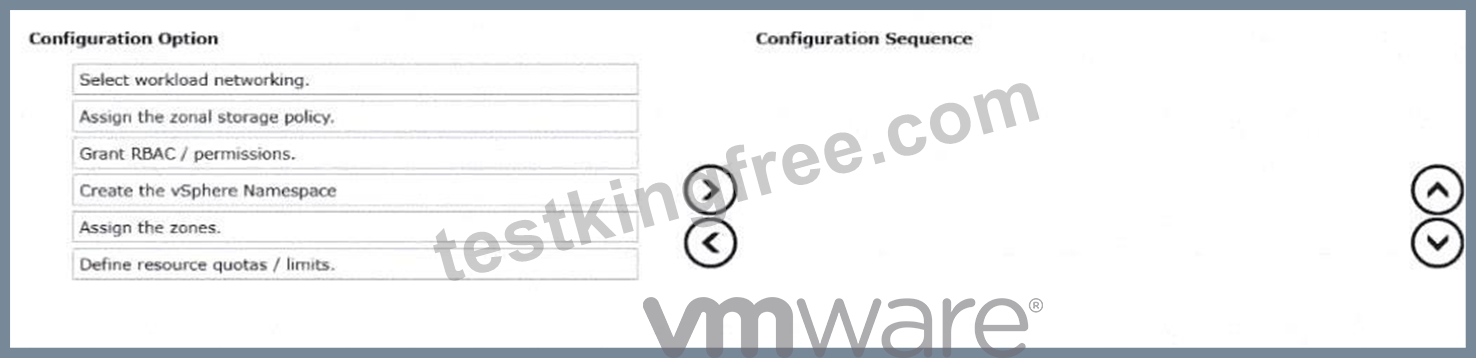
Answer:
Explanation: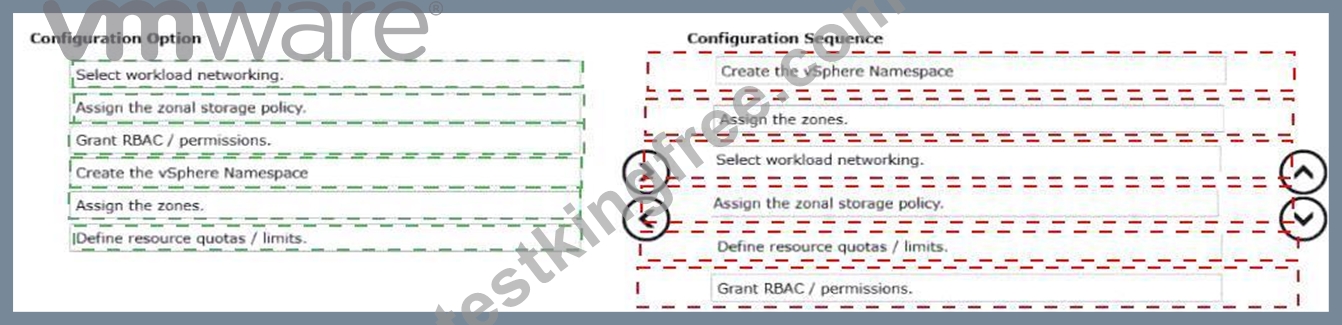
Explanation:
Configuration Sequence (in order):
* Create the vSphere Namespace
* Assign the zones
* Select workload networking
* Assign the zonal storage policy
* Define resource quotas / limits
* Grant RBAC / permissions
A zonal vSphere Namespace is created as a standard namespace first, then "zonalized" by associating it with one or morevSphere Zonesso workloads can be scheduled according to zone placement rules. You start bycreating the namespacebecause it is the tenancy and governance container where networking, storage access, quotas, and permissions are applied. Next, youassign the zones, since zone association is what makes the namespace "zonal" and determines where Kubernetes workloads (and their node pools) are allowed to land.
With zones set, you configureworkload networking, because namespaces must have the correct network attachment and IP behavior for the workloads that will be placed across the selected zones. Then youassign the zonal storage policy, ensuring that persistent volumes can be provisioned using storage that is valid
/available for the zone placement model you selected. After networking and storage access are defined, you setresource quotas/limits(CPU, memory, storage) so multi-tenant consumption stays within governance boundaries. Finally, yougrant RBAC/permissionsso the right DevOps/users can consume the namespace and provision clusters/workloads under the enforced controls.
NEW QUESTION # 97
What three controllers maintain the lifecycle of VMware vSphere Kubernetes Service (VKS) clusters?
(Choose three.)
- A. Virtual Machine Service
- B. Container Storage Interface
- C. Cloud Provider Plug-in
- D. Cluster API
- E. Container Network Interface
Answer: A,C,D
Explanation:
The VCF 9.0 documentation explicitly states that"the VKS exposes three layers of controllers to manage the lifecycle of a VKS cluster."Those three controller layers map directly to the answer choices:
* Cloud Provider Plug-in: VKS-provisioned clusters include components needed to integrate with vSphere Namespace resources, including aCloud Provider Plug-inthat integrates with the Supervisor and supports infrastructure-integrated functions (for example, passing persistent volume requests to the Supervisor which integrates with Cloud Native Storage).
* Cluster API: The documentation describesCluster APIas providing declarative APIs for "cluster creation, configuration, and management," including resources for the VMs and cluster add-ons.
* Virtual Machine Service: TheVirtual Machine Serviceprovides declarative APIs to manage VMs and associated vSphere resources, and is used to manage the lifecycle of the control plane and worker node VMs that host a VKS cluster.
CNI and CSI are important cluster components, but the document distinguishes these from thethree controller layersresponsible for lifecycle management.
NEW QUESTION # 98
In a vSphere with Tanzu environment, what is the primary source of truth for identity and authentication for the Supervisor Cluster?
- A. The Supervisor must be connected directly to an external LDAP server, bypassing vCenter Server.
- B. The Supervisor maintains its own independent local user database stored in etcd.
- C. Authentication is handled exclusively by the NSX Manager identity store.
- D. vCenter Single Sign-On (SSO) is the central identity provider; the Supervisor federates with vCenter SSO to authenticate users.
Answer: D
NEW QUESTION # 99
A Cloud Architect is designing a disaster recovery plan for a mission-critical Zonal Supervisor deployment. The scenario involves a catastrophic failure of the Supervisor Cluster itself (e.g., corruption of the etcd database across all zones) during a failed upgrade, requiring a full restore.
Environment:
* VKS workloads are backed up using Velero.
* The Supervisor configuration (Namespaces, Policies) is backed up using the vCenter File-Based Backup.
What is the correct sequence of steps to restore service? (Select all that apply.)
- A. It is unnecessary to restore the Supervisor; simply redeploying a new Supervisor and pointing Velero to the object store will automatically recover the cluster infrastructure.
- B. After the Supervisor is restored, use Velero to restore the TKG workloads (TanzuKubernetesClusters) into the restored Namespaces.
- C. Restore the vCenter Server from its file-based backup to recover the Supervisor's management context.
- D. Since the Supervisor state (etcd) is corrupted, the administrator must restore the Supervisor Cluster using the specific "Restore Supervisor" workflow (often involving the restore-supervisor.sh script or UI equivalent if available in the specific VCF version) which utilizes the backup data to reconstruct the Control Plane VMs.
- E. Manually recreate all vSphere Namespaces and re-assign permissions before restoring workloads.
Answer: B,C,D
NEW QUESTION # 100
An administrator enabled cluster scaling by running kubectl edit deployment and updating the number of replicas from 5 to 10. When the cluster was redeployed with the number of replicas set to 5, what was the result?
- A. The cluster did not have sufficient resources to deploy the requested number of pods.
- B. The cluster YAML file was not updated to reflect the requested number of pods.
- C. The Supervisor YAML file was not updated to enable autoscaling.
- D. The autoscaling YAML file was not updated.
Answer: B
Explanation:
In a vSphere Kubernetes Service (VKS) environment, resource management follows aDeclarative Model.
When an administrator uses kubectl edit deployment to manually scale a running workload from 5 to 10 replicas, they are modifying thelive stateof the deployment. However, thesource of truthfor a Tanzu Kubernetes cluster in VCF 9.0 is theCluster YAML specificationmaintained by the Cluster API (CAPI) provider within the Supervisor.
If the administrator redeploys the cluster or if the Supervisor's controller performs a reconciliation loop, it refers back to the original configuration file. If that cluster YAML file still defines the replica count as 5, the Supervisor will terminate the 5 "extra" pods to match the desired state defined in the configuration. This is a common administrative pitfall; for changes to be persistent across redeployments or updates in VCF 9.0, the underlying manifest (the "Desired State") must be updated. Manually editing the live object only provides a temporary change that will be overwritten during the next synchronization or lifecycle event because the cluster YAML file was not updated to reflect the requested increase.
NEW QUESTION # 101
An administrator is building a secure, multi-tenant container registry strategy for their vSphere Kubernetes Services deployment running on VMware Cloud Foundation. Each workload domain hosts a Supervisor Cluster, and multiple development teams require private repositories to store and distribute container images for Kubernetes clusters. The organization enforces strict image security posture due to compliance requirements. The operations team deploys Harbor as an add-on service through the Supervisor control plane, and developers push/pull images from Harbor through Kubernetes manifests.
What requirement describes the role and purpose of Harbor?
- A. Harbor is an image scanner used to verify that images are free from known vulnerabilities and patches as necessary.
- B. Harbor is an open-source registry that secures artifacts with policies and role-based access control, ensures images are scanned and free from vulnerabilities, and signs images as trusted.
- C. Harbor is an image repository that pulls all images from GitHub.
- D. Harbor, formerly known as Bitnami, is an image catalog used for downloading verified open-source packages.
Answer: B
Explanation:
Harbor is used as aprivate registry serviceto store and distribute container artifacts for Kubernetes consumption, which is exactly what's needed for a multi-tenant platform where multiple teams require isolated repositories. The VMware documentation treats Harbor as aVMware Tanzu Harbor Registry service, including governance around who can operate it and how teams are separated intoprojects(a key multi- tenancy boundary). For example, vSphere privileges explicitly cover the ability tocreate or delete a Harbor registryand tocreate, delete, or purge Harbor registry projects, reinforcing that Harbor is operated as a managed registry with project-scoped administration and access control.
In practice for regulated environments, the registry role is not just storage-Harbor is commonly used to enforce enterprise controls likepolicy-driven access (RBAC), and it supports security capabilities such asimage vulnerability scanningandimage trust/signing, which directly address the requirement to prevent unsafe images from being promoted or deployed.
NEW QUESTION # 102
A VKS Administrator attempts to delete a testing namespace test-ns-01 via the vSphere Client, but the deletion hangs in the "Removing" state.
Investigating via kubectl get namespace test-ns-01 -o yaml, the administrator sees the following:
metadata:
name: test-ns-01
deletionTimestamp: "2023-11-16T10:00:00Z"
finalizers:
- "kubernetes"
status:
phase: Terminating
Further investigation reveals a TanzuKubernetesCluster inside the namespace is also stuck in deletion.
What is the most likely reason for this "stuck" state, and what is the appropriate CLI intervention?
(Choose 2.)
- A. The administrator must use kubectl patch tanzukubernetescluster -n test-ns-01 -p
'{"metadata":{"finalizers":[]}}' --type=merge to forcibly remove the finalizer and allow deletion to proceed (after verifying resources are cleaned up). - B. The Namespace quota has been exceeded.
- C. The Supervisor Cluster is disconnected from vCenter Server.
- D. The administrator should restart the ESXi hosts.
- E. The TKG cluster has "orphan" resources (like a Persistent Volume or Load Balancer Service) that the cloud provider failed to de-provision, causing the finalizer to block deletion.
Answer: A,E
NEW QUESTION # 103
A Cloud Administrator needs to prepare a VKS environment for a "Private Cloud" deployment where all Kubernetes nodes must pull their system images (e.g., kube-proxy, coredns, antrea) from a central Harbor Registry instead of the internet.
Review the configuration snippet for the TkgServiceConfiguration (the global TKG configuration object):
apiVersion: run.tanzu.vmware.com/v1alpha1
kind: TkgServiceConfiguration
metadata:
name: tkg-service-configuration
spec:
defaultCNI: antrea
...
trust:
additionalTrustedCAs:
- name: harbor-ca-cert
data: LS0tLS1... (Base64)
imageRepository:
host: harbor.corp.local
caCertificate: LS0tLS1... (Base64)
What is the effect of configuring the imageRepository field in this spec? (Select all that apply.)
- A. It overrides the default upstream VMware registry location for all newly created TKG clusters.
- B. It configures the TKG worker nodes to trust the CA certificate of the Harbor registry.
- C. It automatically copies/replicates the images from VMware Public Registry to harbor.corp.local.
- D. It instructs the Supervisor to rewrite the image manifests for system components (like CoreDNS) to point to harbor.corp.local instead of projects.registry.vmware.com.
- E. It forces all user workloads (Pods) to use this registry by default.
Answer: A,B,D
NEW QUESTION # 104
......
Use Real VMware Achieve the 3V0-24.25 Dumps - 100% Exam Passing Guarantee: https://www.testkingfree.com/VMware/3V0-24.25-practice-exam-dumps.html
Verified 3V0-24.25 Q&As - Pass Guarantee 3V0-24.25 Exam Dumps: https://drive.google.com/open?id=1S96MQ4BH0AcKdHD0FHtcsCjnvPeA3KMc