

L4M3 Practice Test Questions Answers Updated 235 Questions
L4M3 dumps & CIPS Certifications Sure Practice with 235 Questions
The CIPS L4M3 exam is split into two parts, with the first part consisting of 60 multiple-choice questions and the second part comprising a case study with 10 questions. L4M3 exam assesses candidates on their understanding of commercial contracting, including contract formation and drafting, contract negotiation techniques, contract performance and management, contract disputes and resolution, and the legal and ethical considerations involved in commercial contract management.
CIPS L4M3 (CIPS Commercial Contracting) Certification Exam is an internationally-recognized certification that is designed to equip professionals with the knowledge and skills required for commercial contracting. CIPS Commercial Contracting certification is offered by the Chartered Institute of Procurement and Supply (CIPS), which is one of the leading professional bodies in the field of procurement and supply chain management. The CIPS L4M3 certification is ideal for professionals who have a background in procurement or contract management and are looking to enhance their skills and knowledge in commercial contracting.
NEW QUESTION # 131
To expand its operation, Steel Co. decides to build a new plant. Despite of excitement, the senior management is very concerned about the complexity and risks of such project. Hugo, the procurement manager, suggests that the company can adopt a model form of contract. What is the advantage of using model form of contract?
- A. It shifts the balance of power in the favour of the buyer rather than the contractor
- B. Model form of contract eliminates the need for legal advice totally
- C. The company could avoid the need to draft a complex contract from blank
- D. The company does not need to draft the drawings as well as specification anymore
Answer: C
Explanation:
Advantages and Disadvantages of using model form contracts.
Model form contracts save a lot of time and money. They are written by industry experts and the buyers and suppliers both understand what is included in the contract.
They are mainly used in Construction and term maintenance contacts. Typical ones are JCT and NEC.
Without the use of model form contracts the buyer and supplier will take a long time to write the terms, negotiate and finalise the contract.
This is time and money wasted.
However, model form contracts require buyers and suppliers to have training so you understand them.
Finally, if you are a buyer in a powerful position you cannot exploit that with a model form contract as these are written for mutual benefit.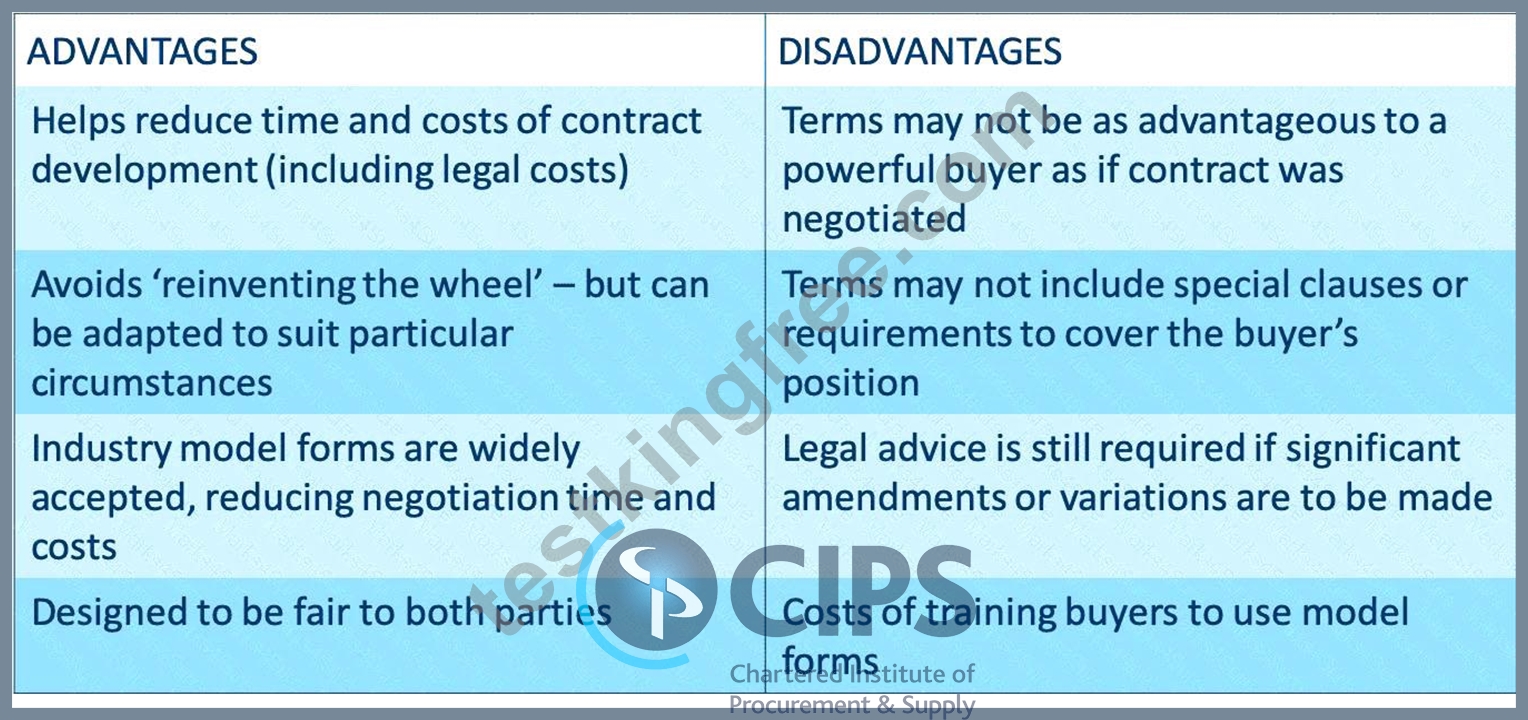
Reference:
- Procurement Study Buddy on Facebook
- CIPS study guide page 147
NEW QUESTION # 132
Maximum Score 1
The nature of the "Battle of the forms" is when both buyer and supplier are attempting to ...
- A. Secure their own terms and conditions
- B. Form a joint contract
- C. Create a performance specification
- D. Create a collaborative relationship
Answer: A
Explanation:
The "battle of the forms" arises when each party seeks to have its own terms and conditions govern the contract.
Under common law, the terms last sent and accepted (expressly or by conduct) usually apply.
Reference: CIPS L4M3 Commercial Contracting - "Battle of the forms and contract acceptance."
NEW QUESTION # 133
Which of the following are express terms?
Sale by description
Fitness for purpose
Passing of risk
Passing of title
- A. 2 and 4 only
- B. 2 and 3 only
- C. 3 and 4 only
- D. 1 and 2 only
Answer: C
Explanation:
Express terms are those specifically stated and agreed upon in the contract. "Passing of risk" and "Passing of title" are typically included explicitly in contract terms, especially in contracts involving the sale of goods. In contrast, "Sale by description" and "Fitness for purpose" are usually implied terms under the Sale of Goods Act 1979, unless expressly stated.
Reference:
CIPS L4M3 Commercial Contracting Study Guide, Chapter 3, Section 3.1.1 - Express and implied terms in contracts.
NEW QUESTION # 134
The pricing arrangement in which markup is added into cost base to calculate the final price is known as...?
- A. Market based approach
- B. Price indices
- C. Fixed Price approach
- D. Cost plus pricing
Answer: D
Explanation:
The market approach is a method of determining the value of an asset based on the selling price of similar assets.
A fixed-price strategy means you set a price and keep it constant for an extended period of time.
Cost-plus pricing is also known as markup pricing. It's a pricing method where a fixed percentage is added on top of the cost to produce A price index (PI) is a measure of how prices change over a period of time, or in other words, it is a way to measure inflation. There are multiple methods on how to calculate inflation (or deflation).
Reference:
LO 3, AC 3.3
NEW QUESTION # 135
Which of the following is always automatically considered as a contract?
- A. Framework arrangement
- B. Performance management framework
- C. Framework agreement
- D. Call-off
Answer: D
Explanation:
- A call off or a term contract is one which exists for a fixed period of time, rather than for a specific purpose
- A formal framework agreement does have some legal standing but it is not a contract, primarily because there is no consideration involved, but it is an overarching (or umbrella) agreementunder which contracts can be created (this holds true in English law but may not be right in other jurisdiction)
- A framework arrangement is a rather loose set-up, without any legal standing. It usually occurs when an organisation has decided for itself to limit the number of suppliers it is willing to work with and, through a purely internal process, sets up an approved list of such suppliers.
- A performance management framework including KPIs and targets, the assessment scheme and incentives, disincentives, bonuses and penalties. It is a schedule to a contract and only legally binding if it is referred from contract clauses.
Reference: CIPS study guide page 59-63
LO 1, AC 1.3
NEW QUESTION # 136
Which of the following statement is true about insurance?
- A. An insurance policy transfers the legal liabilities from the insured to the insurer
- B. Professional indemnity insurance provides the insured business with financial protection against the liabilities caused by or arising out of the products supplied
- C. The supplier must always pay the insurance premium for goods-in-transit
- D. An insurance policy can be mechanism of substance to back up indemnity
Answer: D
Explanation:
An insurance policy transfers a risk from one party to another in exchange for payment, it does not transfer the liabilities from the insured to insurer.
Insurance policies are taken out as a form of protection against a specific risk or unfortunate occurrence. If one party indemnifies another to protect that other party in the event of a risk occurring then the indemnity itself is merely a statement of intent. There also need to be some mechanism of substance to back up that indemnity. This BACK UP is the insurance policy which can be relied upon to meet the indemnity being given. In fact, most indemnity provisions are backed up by insurance coverage.
Professional indemnity or liability insurance offers such coverage to professional advice or service providing individuals and companies ensuring protection against any legal costs and damages awarded as a result of claims relating to negligence. Whereas more general forms of liability insurance focus on direct forms of harm such as sustaining injuries, professional indemnity insurance provides a far more detailed and comprehensive form of coverage. The cover protects a firm or individual's liability relating to any financial loss caused by errors or omissions in the service provided as well as any alleged failure to perform on behalf of a client.
Goods in transit insurance does what it says on the tin, protecting any goods your business delivers or transports from place to place. The responsibility to pay the insurance premium is negotiable, it may belong to the supplier or the buyer.
Reference:
- Is that Covered? Insurance and Indemnity Clauses
- Professional Indemnity Insurance
- Goods in transit insurance
- CIPS study guide page 150-153
LO 3, AC 3.2
NEW QUESTION # 137
What pricing arrangements or schedule would be used if the buyer is operating to an exact budget?
- A. Fixed pricing arrangement
- B. Indexation pricing arrangement
- C. Cost-plus pricing arrangement
- D. Incentivised pricing arrangement
Answer: A
Explanation:
A fixed pricing arrangement means the buyer and supplier agree on a set price that does not change regardless of market fluctuations or production costs. This gives the buyer full cost certainty, which is essential when operating to a strict or limited budget. It helps avoid financial risk over the contract duration.
Reference:CIPS L4M3 Commercial Contracting Study Guide, Chapter 4, Section 4.2.2 - Fixed pricing mechanisms and their application.
NEW QUESTION # 138
Which of the following is likely to reduce risks of different rules regarding when offers and acceptance become effective between legal systems?
- A. Letter of intent
- B. Time lapse
- C. Withdrawal protocol
- D. Deemed receipt protocol
Answer: D
Explanation:
Regarding rule of offer and acceptance, there are some differences among legal system around the world. For example, mailbox rule is generally applied in common law countries such as UK, US, Australia,.. while it is ignored in civil law countries. To clarify on rule of offer and acceptance in international trade, offerors may use expressed terms in their offers. These terms known as deemed receipt protocol.
Reference:
LO 1, AC 1.2
NEW QUESTION # 139
Which of the following are reasons why a purchaser wants to embed a subcontracting clause into the main contract? Select TWO that apply:
- A. To keep main contractor liable
- B. To improve supply chain transparency
- C. To reduce the main contract complexity
- D. To condemn whole liabilities to subcontractors
- E. To induce the conflicts between the main contractor and subcontractors
Answer: A,B
Explanation:
There are number of reasons why the purchaser will want to control the supplier's subcontracting:
- Supply chain transparency: Normally the purchaser has invested a lot of effort into selecting the right contractor. However, the main contractor's selection of subcontractor might not be in such careful manner, which may result in poor performance. Purchaser must know who subcontractors are. Controlling the subcontracting process can help the purchaser control the outcome.
- Contract terms: the purchaser's requirements must be reflected in the subcontracts. The subcontracting clauses may require the main contractor to do this.
- Liability: the main contractor may subcontract the whole or a part of its liabilities. Subcontracting clause may bind the contractor to be liable with the work, it cannot just blame the subcontractor for any faults.
Reference:
LO 3, AC 3.2
NEW QUESTION # 140
Maximum Score 1
Denny is putting together the final version of a contract to send out to a supplier. He places certain documentation into additional contract schedules at the end of the main contract.
Which of the following would be suitable inclusions to the additional schedules? Select TWO that apply.
- A. Non-disclosure agreement
- B. Health and safety commitments
- C. Financial statements
- D. Suppliers references
- E. A blank RFQ form
Answer: A,B
Explanation:
Contract schedules (or appendices) are part of the legally binding agreement and usually contain supporting or detailed information that complements the main clauses - for example, policies, commitments, and technical details.
* Health and safety commitments (B): These are operational requirements that demonstrate compliance with legislation and are typically annexed as schedules.
* Non-disclosure agreement (D): Confidentiality obligations or NDAs are often attached as schedules or referenced documents.
Financial statements, supplier references, and blank RFQ forms are pre-contract due diligence or sourcing documents and do not form part of the contract schedules.
Reference: CIPS L4M3 Commercial Contracting - "Structure and content of contracts: Schedules and supporting documents."
NEW QUESTION # 141
Which of the following are always considered as minimum preconditions for a contract? Select TWO that apply:
- A. Promise
- B. Intention to be bound
- C. Omission
- D. Consideration
- E. Specification
Answer: B,D
Explanation:
In order to form a contract to come into being, there are five conditions:
- Offer
- Acceptance
- Consideration
- Intention to be legally bound
- Capacity to contract
Reference: CIPS study guide page 28-43
LO 1, AC 1.2
NEW QUESTION # 142
Foodstuffs may arrive from an overseas supplier in a deteriorated state. Is this covered under the implied term of 'satisfactory quality'?
- A. Yes, the food is not of a reasonable standard
- B. Yes, as the title has not passed yet
- C. No, it is sale by description
- D. No, it is sale by sample
Answer: A
Explanation:
Under the Sale of Goods Act and other applicable legislation, goods must be of satisfactory quality, fit for purpose, and as described. Perishable goods arriving in a spoiled state would not meet the standard of satisfactory quality, even if sold by sample or description. This is an implied term that protects the buyer.
Reference:CIPS L4M3 Commercial Contracting Study Guide, Chapter 3, Section 3.1.1 - Implied terms and quality standards.
NEW QUESTION # 143
When writing an implementation section for an IT requirements specification, which factors would be appropriate for inclusion? Select TWO that apply.
- A. Integrations required with existing systems
- B. Required response timeframes for service requests
- C. Details of applicable legal and regulatory standards
- D. Lists of technical terms and abbreviations
- E. Mandatory training required for supplier's staff
Answer: A,B,E
Explanation:
The implementation section of a specification should include practical and operational elements essential for the deployment of the product or service. Mandatory training for the supplier's staff ensures they are adequately prepared to operate within the buyer's environment. Integrations with existing systems are crucial to ensure technical compatibility and seamless operation.
Reference:CIPS L4M3 Commercial Contracting Study Guide, Chapter 2, Section 2.1.3 - Components of effective specifications.
NEW QUESTION # 144
Which of the following is an agreement between service provider and user that quantifies the minimum quality of service?
- A. Service charter
- B. SLA
- C. Service guarantee
- D. Service standard
Answer: B
Explanation:
A service-level agreement (SLA) is a commitment between a service provider and a client. Particular aspects of the service - quality, availability, responsibilities - are agreed between the service provider and the service user. The most common component of an SLA is that the services should be provided to the customer as agreed upon in the contract.
A customer service charter is a document that outlines how an organization promises to work with its customers along with providing insights into how an organization operates.
A service guarantee is a marketing tool service firms have increasingly been using to reduce consumer risk perceptions, signal quality, differentiate a service offering, and to institutionalize and professionalize their internal management of customer complaint and service recovery.
Reference:
LO 2, AC 2.2
NEW QUESTION # 145
Which of the following is the contract provision that relieves the parties from performing their contractual obligations when certain circumstances like natural disasters, terrorist attacks, etc arise?
- A. Liquidated damage clause
- B. Exclusion clause
- C. Insurance clause
- D. Indemnity clause
Answer: B
Explanation:
The contract provision that relieves the parties from performing their contractual obligations when certain circumstances like natural disasters, terrorist attacks, etc arise is called Force majeure. Force majeure is an example of exclusion clause.
An exemption clause in a contract is a term which either limits or excludes a party's liability for a breach of contract. In order for an exclusion clause to be binding and operable upon the parties, the clause must:
1. The clause must be incorporated into the contract as a term.
2. The clause must pass the test of construction.
3. The clause must not be rendered unenforceable by the statutory provisions in the Unfair Contract Terms Act 1977 or the Consumer Rights Act 2015 (enacting the Consumer Rights Bill 2013-14).
Reference:
- Exclusion Clauses Lecture
- CIPS study guide page 149
LO 3, AC 3.2
NEW QUESTION # 146
......
CIPS L4M3 exam is a crucial milestone for procurement professionals who want to excel in the field of commercial contracting. L4M3 exam is designed to test the candidates’ knowledge and skills in drafting, negotiating and managing commercial contracts. It is a level 4 exam, which means that it is ideal for procurement professionals who have some experience in the field and are looking to advance their careers.
New L4M3 Exam Questions| Real L4M3 Dumps: https://www.testkingfree.com/CIPS/L4M3-practice-exam-dumps.html
Get New L4M3 Certification – Valid Exam Dumps Questions: https://drive.google.com/open?id=1c-ki2SJdku7jEA8WwyyK66ItzRXsx4_M