

Get Special Discount Offer of L4M7 Certification Exam Sample Questions and Answers
New L4M7 Dumps For Preparing Level 4 Diploma in Procurement and Supply Certified CIPS Exam Well
CIPS L4M7 exam is an essential qualification for procurement professionals who are looking to specialize in asset management. L4M7 exam covers a wide range of topics, including asset identification, valuation, maintenance, and disposal. It is designed to help candidates develop the skills and knowledge necessary to effectively manage assets and ensure their long-term value. Successful completion of the exam is an important step in advancing one's career in asset management.
NEW QUESTION # 39
Extra units that are held in inventory to reduce the risks of stock-out are called...?
- A. Demand variance
- B. Just-in-time
- C. Reorder point
- D. Safety stock
Answer: D
Explanation:
The safety stock (or buffer stock) is the stock level that limits stock shortages due to unforeseen events (forecasts not in line with demand, longer than expected supply time, etc...) Demand variance is the degree to which the demand in a fixed period deviates from the average demand of the same period.
A reorder point is the unit quantity on hand that triggers the purchase of a predetermined amount of replenishment inventory.
The just-in-time (JIT) inventory system is a management strategy that aligns raw-material orders from suppliers directly with production schedules.
Reference:
LO 2, AC 2.1
NEW QUESTION # 40
Inventory may be classified into direct and indirect supplies. Which of the following is a characteristic of indirect supplies?
- A. Indirect supplies are the sub-assemblies required in the final product
- B. Indirect supplies are costs that have an impact on the operating cost of the business
- C. Indirect supplies refer to stock that is partway through manufacture
- D. Indirect supplies have a significant impact on the quality of the final product
Answer: B
Explanation:
Indirect supplies support operations without becoming part of the final product. They impact operating costs (e.g., maintenance supplies), supporting the production environment but not the end product. Managing indirect supplies is crucial in whole-life asset management to control overhead costs and ensure uninterrupted operations.
NEW QUESTION # 41
ATT is a small retailer that specializes in selling 'seasonal goods' which change throughout the year. Some products need regular reordering and some only require a start-of-season single order. Sales volumes are unpredictable and variable. Ordering is from multiple suppliers with variable lead times (between two weeks and two months). ATT has no computerized stock management system but can monitor product sales through the barcode-equipped point-of-sale (POS) system.
Which of the following would be appropriate to support ATT for its stock monitoring and reorder requirements?
- A. Introduce a just-in-time system using sales information with visual checks of stock to create orders
- B. Undertake variable periodic reviews of products by classifying each product by lead times and sales volume
- C. Undertake an MRP system with a dependent demand database to allow for variances in delivery and availability
- D. Introduce a continuous stocktaking process to check all stock once per month against sales records for each product
Answer: B
Explanation:
Variable periodic reviews enable ATT to manage seasonal goods effectively by adjusting ordering based on:
* Lead times and sales volume: Classifying products by these factors helps in planning, aligning with varying supplier delivery times and unpredictable sales demand.
Implementing a JIT or MRP system would require more sophisticated management tools, making option C the most feasible. This method aligns with whole-life asset management by supporting efficient inventory planning while minimizing stockouts or overstock situations.
NEW QUESTION # 42
A group of items which are stacked together for more convenient movement is called...?
- A. Unit load
- B. Stacker
- C. Unit price
- D. Load cell
Answer: A
Explanation:
Unit load is a term used to describe grouping of different items into a convenient stack or stacks which make them easy to handle and store. Typically this involves pallets and/or the plastic wrap-ping of a load.
Stacker is designed to lift and stack pallets. This one is fully mobile so can move easily around the warehouse.
An operator would typically sit or stand while driving like a counterbalanced, reach or straddle lift truck.
A load cell is a type of transducer, specifically a force transducer. It converts a force such as ten-sion, compression, pressure, or torque into an electrical signal that can be measured and standard-ized.
Unit price is the price of a single product or service, used for example when buying several things together to refer to the price of each one.
NEW QUESTION # 43
Which of the following are advantages of a multi-story warehouse compared to a single-story warehouse?
* Heavier, frequently moved items will always be stored on the upper floor of a multi-story warehouse
* Order tracking technology is more effective and efficient in a multi-story warehouse
* There are more options for the storage of inventory by volume, weight, and frequency of movement in a multi-story warehouse
* The cost of land is likely to be less for a multi-story warehouse compared to a single-story warehouse for a similar product volume
- A. 2 and 3 only
- B. 3 and 4 only
- C. 1 and 4 only
- D. 1 and 2 only
Answer: B
NEW QUESTION # 44
A central distribution warehouse receives deliveries from several suppliers of bread and cakes on pallets in large quantities. These deliveries need to be separated into smaller individual consignments for delivery to retail stores operated by the bakery company. The division of the large quantities into smaller consignments is called:
- A. Cross-docking
- B. Small orders
- C. Retail stocking
- D. Breaking bulk
Answer: D
Explanation:
Breaking bulk is the process of dividing large shipments of goods into smaller lots for easier distribution.
This is a standard practice in warehousing and logistics to facilitate delivery to various locations or end users.
Unlike cross-docking, which involves minimal storage time, breaking bulk focuses on redistributing large shipments into smaller, manageable batches. In whole-life asset management, breaking bulk helps maintain streamlined operations and reduces holding costs by ensuring goods are moved efficiently and without prolonged storage.
NEW QUESTION # 45
What is the stock turn for a store holding products to the value of £250,000 with annual sales of these products amounting to £1,000,000?
- A. 0.25
- B. 0
- C. 1
- D. 0.4
Answer: C
Explanation:
Calculating Inventory Turnover (Stock Turn)
As with a typical turnover ratio, inventory turnover details how much inventory is sold over a period. To calculate the inventory turnover ratio, cost of goods (COGS) is divided by the average inventory for the same period.1 Cost of Goods Sold ÷ Average Inventory or Sales ÷ Inventory In this exercise, the stock turn equal to sales divided by inventory, or 1,000,000:250,000 = 4.
NEW QUESTION # 46
Which ONE of the following correctly differentiates between obsolescent and redundant stock?
- A. Obsolescent stock is in short supply; redundant stock has no current supplier with stock available
- B. Obsolescent stock has been updated by another item but can still be used; redundant stock is no longer used by an organisation
- C. Obsolescent stock has been supplied by a failed supplier; redundant stock requires quality testing before use
- D. Obsolescent stock is damaged goods that need returning to suppliers; redundant stock is no longer stocked by the organisation
Answer: B
NEW QUESTION # 47
Which of the following are holding costs of inventory in a warehouse?
* Costs related to the value of the inventory held
* Losses due to product deterioration
* Preliminary costs associated with purchase orders
* Loss of supplier discounts due to reduction in reorder quantities
- A. 2 and 3 only
- B. 1 and 3 only
- C. 2 and 4 only
- D. 1 and 2 only
Answer: D
NEW QUESTION # 48
Do all types of warehouses require access to daylight to reduce the cost of electricity?
- A. No, because only ventilation can help to reduce the humidity in the warehouse
- B. Yes, because sunlight sterilises inventories in damp conditions
- C. No, because some types of stock are sensitive to sunlight
- D. Yes, because organisation's need for artificial lighting and heating will reduce
Answer: C
Explanation:
The design of a building should consider the advantages of natural light as this can reduce the cost of artificial lighting and improve the environmental performance of the building. Daylight entering the building can also help reduce heating costs. Unfortunately some stocks react badly to direct sunlight, and some stock reacts badly to extreme of temperature or may require a specific temperature for storage. Some stock may require a warmer temperature than the ambient temperature and other stocks may require cooler temperature. For example, fabric and garment are sensitive to direct sunlight as ultraviolet light catalyses a reaction between the water present in all fabrics and atmospheric oxygen to create hydrogen peroxide. This is a bleaching agent and breaks down the chemical bonds that give dyes their colour.
Reference:
LO 1, AC 1.1
NEW QUESTION # 49
Multiple approval levels for a small purchase request is an example of which type of waste?
- A. Over-processing
- B. Over-production
- C. Not using talent
- D. Inventory
Answer: A
Explanation:
Lean thinking aims to remove wastes from work processes. Before diving into the 8 wastes, it is important to understand what waste is. Waste is any action or step in a process that does not add value to the customer. In other words, waste is any process that the customer does not want to pay for.
The original seven wastes (Muda) was developed by Taiichi Ohno, the Chief Engineer at Toyota, as part of the Toyota Production System (TPS). The seven wastes are Transportation, Inventory, Motion, Waiting, Overproduction, Overprocessing and Defects. They are often referred to by the acronym 'TIMWOOD'. The 8th waste of non-utilized talent or 'Skills' of workers was later introduced in the 1990s when the Toyota Production System was adopted in the Western world. As a result, the 8 wastes are commonly referred to as 'TIMWOODS'.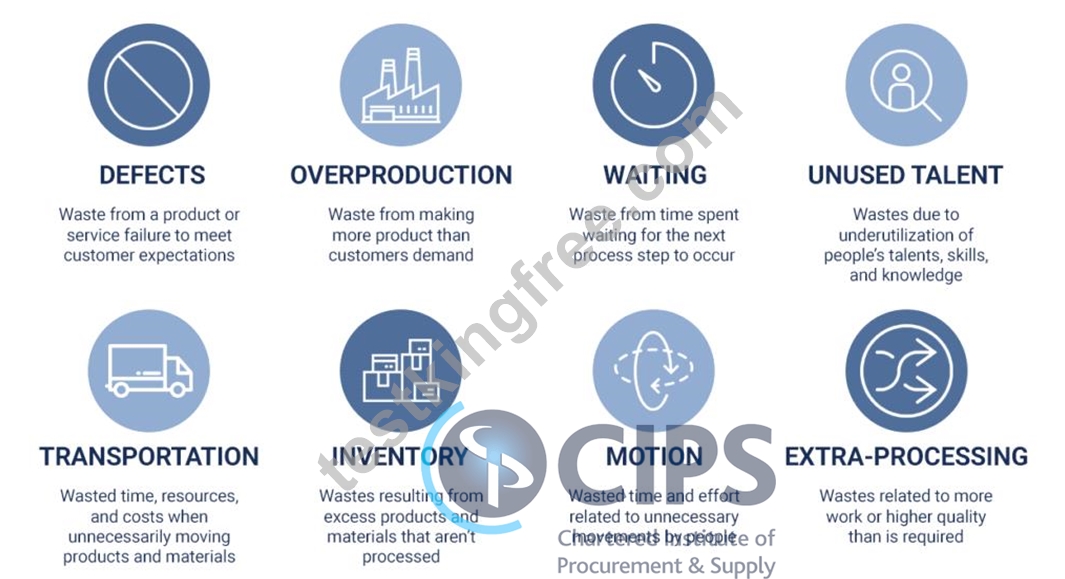
Source: The lean way
Multiple approval levels for a small purchase request is an example of over-processing since this adds more unnecessary work to users and procurement professionals.
Reference:
LO 2, AC 2.3
NEW QUESTION # 50
In just in time production system, when is an upstream production triggered?
- A. When the production workers are idle
- B. When the inventory level reaches the reorder point
- C. After the management team forecasts the future demands
- D. When downstream operations summon the upstream production
Answer: D
Explanation:
Along with Jidoka, Just-in-time (JIT) production is one of the pillars of the two Toyota Production System. It is a production method that fundamentally changed the way large-scale production oc-curred in the 20th century, and is the basis for Lean Manufacturing (Lean for short), which is the school of thought many modern companies have modeled themselves after.
JIT production is often called a pull system because instead of using traditional push production where scheduling is done based on historical data and demand forecasting, production is scheduled based on actual customer orders. Rather than predicting demands from customers, the JIT method requires that actual customer demand exists. Production doesn't begin before an order triggers it. This system not only reduces the amount of extra inventory, but also reduces the amount of work in progress at one time.
Reference:
- Just-in-Time Production
- CIPS study guide page 122-127
LO 2, AC 2.3
NEW QUESTION # 51
Which of the following best describes available inventory (also known as inventory position)?
- A. The amount of inventory on hand in excess of expected demand
- B. The amount of inventory on hand plus the amount of inventory on order
- C. The amount of inventory on hand
- D. The amount of inventory on order only
Answer: B
Explanation:
Available inventory (or Inventory position - IP) is equal to inventory on-hand plus quantity on order minus backorder (if any) Reference:
LO 2, AC 2.3
NEW QUESTION # 52
Which of the following is the minimum aisle width for using standard counterbalanced forklifts?
- A. 6.9 ft - 7.2 ft
- B. 10.5 ft - 13.1 ft
- C. 5.6 ft - 5.9 ft
- D. 4.9 ft - 5.2 ft
Answer: B
Explanation:
Minimum open aisle width for standard counterbalance forklift is 10.5-13.1 ft. You can look at the minimum aisle width for different equipment here, or calculate yourself with an instruction here.
LO 1, AC 1.3
NEW QUESTION # 53
Which component of an RFID device is responsible for sending and receiving radio waves?
- A. Antenna
- B. Laser beam
- C. Integrated circuit
- D. Network database
Answer: A
Explanation:
RFID tags are made of three different components: an RFID chip, which is an integrated circuit (IC), an antenna, and a substrate. RFID Antennas are necessary elements in an RFID system be-cause they convert the RFID reader's signal into RF waves that can be picked up by RFID tags. Without some type of RFID antenna, whether integrated or stand-alone, the RFID reader cannot properly send and receive signals to RFID tags.
NEW QUESTION # 54
Which of the following are critical factors that must be considered when evaluating warehouse or storage locations?
* The cost of the proposed location
* Who owns the storage location or warehouse
* Access to transport networks
* The number of windows in the building
- A. 2 and 3 only
- B. 1 and 4 only
- C. 2 and 4 only
- D. 1 and 3 only
Answer: D
Explanation:
When selecting a warehouse location, it's essential to consider:
* Cost: The expense of the location directly impacts the budget.
* Access to transport networks: Proximity to transportation infrastructure facilitates efficient shipping and receiving.
These factors align with whole-life asset management principles by ensuring cost-effective and accessible storage solutions, contributing to reduced transportation costs and improved logistics.
NEW QUESTION # 55
Which of the following is the material handling equipment which uses the suction force to lift an item?
- A. Vacuum lifter
- B. Dolly
- C. Pallet stacker
- D. Sack truck
Answer: A
Explanation:
VACUUM LIFTER uses the vacuum pad which attaches itself to a product. The suction force al-lows the product to be lifted (and rotated and placed). Vacuum lifters are used for moving and positioning glass sheets, but are also seen lifting boxes, plastic sacks, sheets of building materials and pipework. Some models feature hydraulic arms which allow easy movement of the lifted load. The lifting system will have a number of sucker pads and vacuum capability which determines the maximum weights and largest items that can be lifted.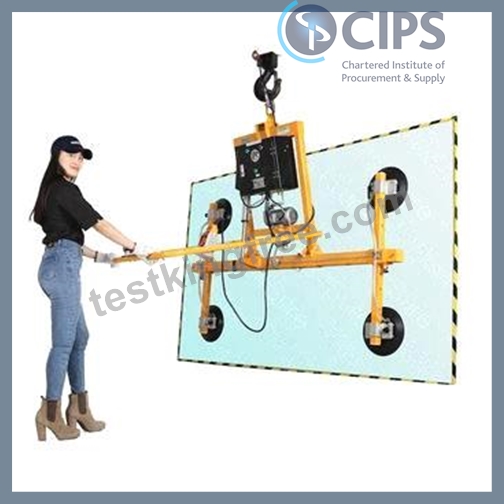
DOLLY consists of stack and sets of wheels (either casters or rollers) under the stack that allow the dolly and the heavy object on top of it to move easily and smoothly. For moving in a straight line, rollers is ideal. If you want to move manoeuvrability, dolly with sets of casters will let you swivel and turn.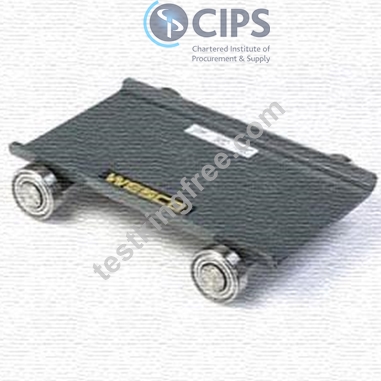
SACK TRUCK (hand truck) is an L-shaped box-moving handcart. It comprises a small base plat-form with two wheels at the base and a larger vertical structure. A small ledge to set objects on flat against the floor when the sack truck is upright. When moving, the truck and object are then tilted backward based on the vertical structure until the weight is balanced over the large wheels, making otherwise bulky and heavy objects easier to move.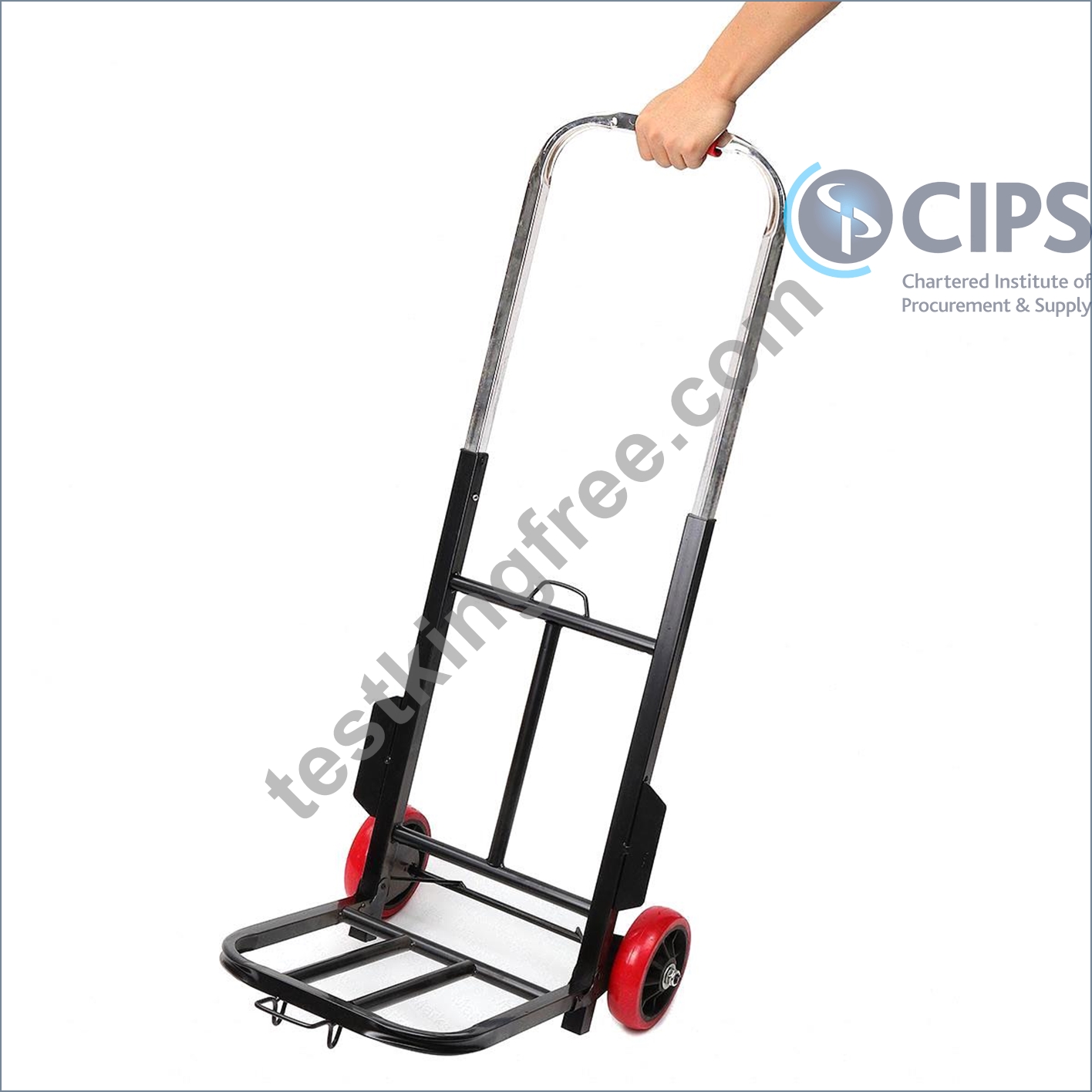
PALLET STACKER is designed to lift and stack pallets. This one is fully mobile so can move easily around the warehouse. An operator would typically sit or stand while driving like a counter-balanced, reach or straddle lift truck.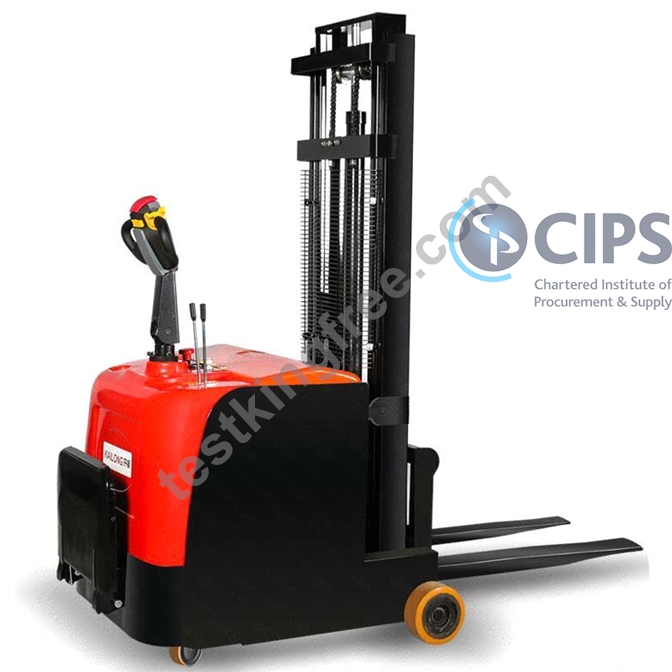
LO 1, AC 1.3
NEW QUESTION # 56
Why would an organisation need to hold safety stock?
- A. To allow for a faster and more efficient inventory turnover which will aid the cash flow of the organisation
- B. To create zero inventories and allow the development of a Just-In-Time (JIT) approach to inventory management
- C. To allow for the loss of idle time and to spread the fixed overheads across a reduced level of output
- D. To cover shortages due to agreed lead times being exceeded or the actual demand being greater than anticipated
Answer: D
NEW QUESTION # 57
......
CIPS L4M7 exam is a highly specialized qualification that focuses on Whole Life Asset Management. L4M7 exam is designed for professionals who are looking to enhance their skills in the field of asset management and develop a deep understanding of the entire lifecycle of an asset.
Updated L4M7 Dumps Questions Are Available For Passing CIPS Exam: https://www.testkingfree.com/CIPS/L4M7-practice-exam-dumps.html
Free UPDATED CIPS L4M7 Certification Exam Dumps is Online: https://drive.google.com/open?id=1FVH0DcP0sBbmL6sI29HomSVgO0mRJhft