

[Apr 22, 2026] PCCP Exam Dumps 100% Same Q&A In Your Real Exam
PCCP Test Engine Dumps Training With 227 Questions
Palo Alto Networks PCCP Exam Syllabus Topics:
| Topic | Details |
|---|---|
| Topic 1 |
|
| Topic 2 |
|
| Topic 3 |
|
NEW QUESTION # 14
Which product from Palo Alto Networks enables organizations to prevent successful cyberattacks as well as simplify and strengthen security processes?
- A. MineMeld
- B. AutoFocus
- C. Expedition
- D. Cortex XDR
Answer: D
Explanation:
From a business perspective, XDR platforms enable organizations to prevent successful cyberattacks as well as simplify and strengthen security processes.
NEW QUESTION # 15
Which component of cloud security uses automated testing with static application security testing (SAST) to identify potential threats?
- A. Virtualization
- B. API
- C. IRP
- D. Code security
Answer: D
Explanation:
Code security in cloud environments involves using tools like Static Application Security Testing (SAST) to automatically analyze source code for vulnerabilities before deployment. This helps identify and remediate potential threats early in the software development lifecycle.
NEW QUESTION # 16
Which attacker profile acts independently or as part of an unlawful organization?
- A. hacktivist
- B. cybercriminal
- C. state-affiliated group
- D. cyberterrorist
Answer: B
Explanation:
Cybercriminals are attackers who act independently or as part of an unlawful organization, such as a crime syndicate or a hacker group. Their main motivation is to make money by exploiting vulnerabilities in systems, networks, or applications. They use various methods, such as ransomware, phishing, identity theft, fraud, or botnets, to steal data, extort victims, or disrupt services. Cybercriminals often target individuals, businesses, or institutions that have valuable or sensitive information, such as financial, personal, or health data.
Cybercriminals are constantly evolving their techniques and tools to evade detection and countermeasures.
They may also collaborate with other cybercriminals or hire hackers to perform specific tasks. References:
* Cybersecurity Threats: Cybercriminals
* Attackers Profile
NEW QUESTION # 17
Which aspect of a SaaS application requires compliance with local organizational security policies?
- A. Acceptable use of the SaaS application
- B. Data-at-rest encryption standards
- C. Vulnerability scanning and management
- D. Types of physical storage media used
Answer: A
Explanation:
SaaS applications are cloud-based software that users can access from anywhere and any device. This poses a challenge for organizations to ensure that their employees are using the SaaS applications in a secure and compliant manner. Therefore, organizations need to establish and enforce acceptable use policies (AUPs) for SaaS applications that define the rules and guidelines for accessing and using the applications, such as who can use them, what data can be stored or shared, and what actions are prohibited12. AUPs help organizations to protect their data, prevent unauthorized access, and comply with local regulations and standards3. References: Using Software as a Service (SaaS) securely - NCSC, Minimum Security Standards for Software-as-a-Service (SaaS) and Platform-as-a-Service (PaaS) | University IT, How to Secure Your SaaS Applications - CyberArk
NEW QUESTION # 18
What is the function of an endpoint detection and response (EDR) tool?
- A. To provide organizations with expertise for monitoring network devices
- B. To integrate data from different products in order to provide a holistic view of security posture
- C. To monitor activities and behaviors for investigation of security incidents on user devices
- D. To ingest alert data from network devices
Answer: C
Explanation:
Endpoint Detection and Response (EDR) tools monitor, record, and analyze endpoint activity to detect suspicious behavior, investigate incidents, and respond to threats on user devices such as laptops and desktops.
NEW QUESTION # 19
Which item accurately describes a security weakness that is caused by implementing a "ports first" data security solution in a traditional data center?
- A. You may have to use port numbers greater than 1024 for your business-critical applications.
- B. You may not be able to assign the correct port to your business-critical applications.
- C. You may not be able to open up enough ports for your business-critical applications which will increase the attack surface area.
- D. You may have to open up multiple ports and these ports could also be used to gain unauthorized entry into your datacenter.
Answer: D
Explanation:
A "ports first" data security solution is a traditional approach that relies on port numbers to identify and filter network traffic. This approach has several limitations and security weaknesses, such as12:
* Port numbers are not reliable indicators of the type or content of network traffic, as they can be easily spoofed or changed by malicious actors.
* Port numbers do not provide any visibility into the application layer, where most of the attacks occur.
* Port numbers do not account for the dynamic and complex nature of modern applications, which often use multiple ports or protocols to communicate.
* Port numbers do not support granular and flexible policies based on user identity, device context, or application behavior. One of the security weaknesses that is caused by implementing a "ports first" data security solution in a traditional data center is that you may have to open up multiple ports and these ports could also be used to gain unauthorized entry into your datacenter. For example, if you have a web server that runs on port 80, you may have to open up port 80 on your firewall to allow incoming traffic. However, this also means that any other service or application that uses port 80 can also access your datacenter, potentially exposing it to attacks. Moreover, opening up multiple ports increases the attack surface area of your network, as it creates more entry points for attackers to exploit34. References: Common Open Port Vulnerabilities List - Netwrix, Optimize security with Azure Firewall solution for Azure Sentinel | Microsoft Security Blog, Which item accurately describes a security weakness that is caused by ..., Which item accurately describes a security weakness ... - Exam4Training
NEW QUESTION # 20
What is the purpose of host-based architectures?
- A. They allow a server to perform all of the work virtually.
- B. They share the work of both clients and servers.
- C. They allow client computers to perform most of the work.
- D. They divide responsibilities among clients.
Answer: A
Explanation:
In a host-based architecture, the server (host) handles all processing tasks, while the client mainly provides input/output. This centralizes control, processing, and data storage on the server, reducing the client's role to that of a terminal.
NEW QUESTION # 21
What does "forensics" refer to in a Security Operations process?
- A. Validating cyber analysts' backgrounds before hiring
- B. Analyzing new IDS/IPS platforms for an enterprise
- C. Reviewing information about a broad range of activities
- D. Collecting raw data needed to complete the detailed analysis of an investigation
Answer: D
Explanation:
Forensics in a Security Operations process refers to collecting raw data needed to complete the detailed analysis of an investigation. Forensic analysis is a crucial step in identifying, investigating, and documenting the cause, course, and consequences of a security incident or violation. Forensic analysis involves various techniques and tools to extract, preserve, analyze, and present evidence in a structured and acceptable format.
Forensic analysis can be used for legal compliance, auditing, incident response, and threat intelligence purposes. References:
* Cyber Forensics Explained: Reasons, Phases & Challenges of Cyber Forensics
* SOC Processes, Operations, Challenges, and Best Practices
* What is Digital Forensics | Phases of Digital Forensics | EC-Council
NEW QUESTION # 22
Which type of attack includes exfiltration of data as a primary objective?
- A. Denial-of-service (DoS)
- B. Watering hole attack
- C. Advanced persistent threat
- D. Cross-Site Scripting (XSS)
Answer: C
Explanation:
An Advanced Persistent Threat (APT) is a long-term, targeted cyberattack where data exfiltration is often the primary objective. Attackers maintain a covert presence in the network to steal sensitive information over time.
NEW QUESTION # 23
Which endpoint tool or agent can enact behavior-based protection?
- A. MineMeld
- B. DNS Security
- C. AutoFocus
- D. Cortex XDR
Answer: D
Explanation:
Cortex XDR is an endpoint tool or agent that can enact behavior-based protection. Behavior-based protection is a method of detecting and blocking malicious activities based on the actions or potential actions of an object, such as a file, a process, or a network connection. Behavior-based protection can identify and stop threats that are unknown or evade traditional signature-based detection, by analyzing the object's behavior for suspicious or abnormal patterns. Cortex XDR is a comprehensive solution that provides behavior-based protection for endpoints, networks, and cloud environments. Cortex XDR uses artificial intelligence and machine learning to continuously monitor and analyze data from multiple sources, such as logs, events, alerts, and telemetry. Cortex XDR can detect and prevent advanced attacks, such as ransomware, fileless malware, zero-day exploits, and lateral movement, by applying behavioral blocking and containment rules. Cortex XDR can also perform root cause analysis, threat hunting, and incident response, to help organizations reduce the impact and duration of security incidents. References:
* Cortex XDR - Palo Alto Networks
* Behavioral blocking and containment | Microsoft Learn
* Behaviour Based Endpoint Protection | Signature-Based Security - Xcitium
* The 12 Best Endpoint Security Software Solutions and Tools [2024]
NEW QUESTION # 24
Which classification of IDS/IPS uses a database of known vulnerabilities and attack profiles to identify intrusion attempts?
- A. Anomaly-based
- B. Behavior-based
- C. Knowledge-based
- D. Statistical-based
Answer: C
Explanation:
A knowledge-based system uses a database of known vulnerabilities and attack profiles to identify intrusion attempts. These types of systems have lower false-alarm rates than behavior-based systems but must be continually updated with new attack signatures to be effective.
# A behavior-based system uses a baseline of normal network activity to identify unusual patterns or levels of network activity that may be indicative of an intrusion attempt.
These types of systems are more adaptive than knowledge-based systems and therefore may be more effective in detecting previously unknown vulnerabilities and attacks, but they have a much higher false-positive rate than knowledge-based systems.
NEW QUESTION # 25
What is the key to "taking down" a botnet?
- A. prevent bots from communicating with the C2
- B. install openvas software on endpoints
- C. block Docker engine software on endpoints
- D. use LDAP as a directory service
Answer: A
Explanation:
A botnet is a network of computers or devices that are infected by malware and controlled by a malicious actor, known as the botmaster or bot-herder. The botmaster uses a command and control (C2) server or channel to send instructions to the bots and receive information from them. The C2 communication is essential for the botmaster to maintain control over the botnet and use it for various malicious purposes, such as launching distributed denial-of-service (DDoS) attacks, stealing data, sending spam, or mining cryptocurrency. Therefore, the key to "taking down" a botnet is to prevent the bots from communicating with the C2 server or channel. This can be done by disrupting, blocking, or hijacking the C2 communication, which can render the botnet ineffective, unstable, or inaccessible. For example, security researchers or law enforcement agencies can use techniques such as sinkholing, domain name system (DNS) poisoning, or domain seizure to redirect the bot traffic to a benign server or a dead end, cutting off the connection between the bots and the botmaster. Alternatively, they can use techniques such as reverse engineering, decryption, or impersonation to infiltrate the C2 server or channel and take over the botnet, either to disable it, monitor it, or use it for good purposes. References:
* What is a Botnet? - Palo Alto Networks
* Botnet Detection and Prevention Techniques | A Quick Guide - XenonStack
* Botnet Mitigation: How to Prevent Botnet Attacks in 2024 - DataDome
* What is a Botnet? Definition and Prevention | Varonis
NEW QUESTION # 26
Which two statements apply to the SSL/TLS protocol? (Choose two.)
- A. It ensures the data that is transferred between a client and a server remains private.
- B. It provides administrator privileges to manage and control the access of network resources.
- C. It is a method used to encrypt data and authenticate web-based communication.
- D. It contains password characters that users enter to access encrypted data.
Answer: A,C
Explanation:
SSL/TLS encrypts and authenticates web-based communication to ensure secure data transmission over networks. It ensures privacy by encrypting the data exchanged between a client and a server, protecting it from interception or tampering. It doesn't handle user input like passwords directly.
NEW QUESTION # 27
Match the Identity and Access Management (IAM) security control with the appropriate definition.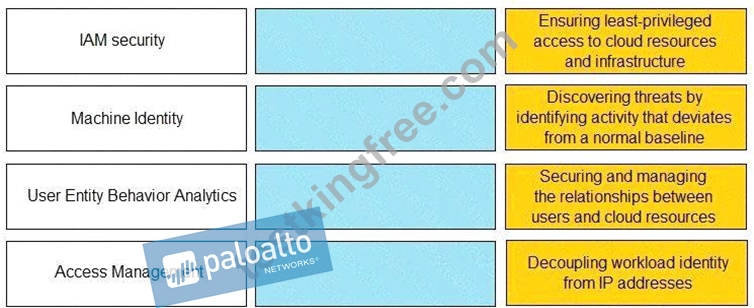
Answer:
Explanation: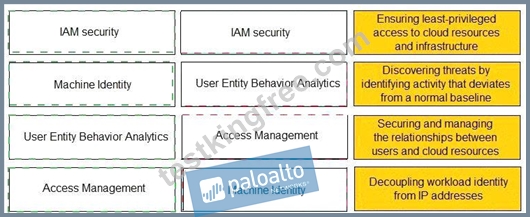
NEW QUESTION # 28
What are two capabilities of identity threat detection and response (ITDR)? (Choose two.)
- A. Matching risks to signatures
- B. Scanning for excessive logins
- C. Securing individual devices
- D. Analyzing access management logs
Answer: B,D
Explanation:
Scanning for excessive logins - ITDR identifies suspicious patterns such as unusual or excessive login attempts, which may indicate credential abuse.
Analyzing access management logs - ITDR tools analyze identity-related logs, including authentication and authorization events, to detect threats tied to user behavior and access anomalies.
Device security and signature matching are not core functions of ITDR; they fall under endpoint protection and traditional threat detection respectively.
NEW QUESTION # 29
What is required for an effective Attack Surface Management (ASM) process?
- A. Real-time data rich inventory
- B. Static inventory of assets
- C. Isolation of assets by default
- D. Periodic manual monitoring
Answer: A
Explanation:
An effective Attack Surface Management (ASM) process requires a real-time, data-rich inventory of all internet-facing assets. This enables continuous visibility, timely detection of vulnerabilities, and identification of exposures that attackers could exploit.
NEW QUESTION # 30
Which tool supercharges security operations center (SOC) efficiency with the world's most comprehensive operating platform for enterprise security?
- A. Prisma SAAS
- B. Cortex XDR
- C. WildFire
- D. Cortex XSOAR
Answer: D
Explanation:
Cortex XSOAR enhances Security Operations Center (SOC) efficiency with the world's most comprehensive operating platform for enterprise security. Cortex XSOAR unifies case management, automation, real-time collaboration, and native threat intel management in the industry's first extended security orchestration, automation, and response (SOAR) offering.
NEW QUESTION # 31
In the attached network diagram, which device is the switch?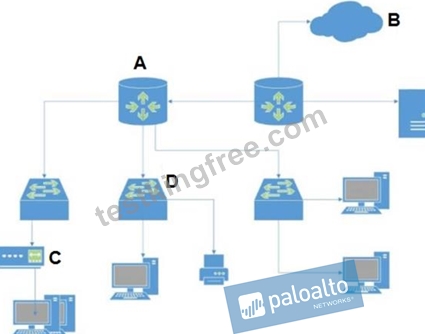
- A. Select A
- B. Select C
- C. Select D
- D. Select B
Answer: C
Explanation:
A switch is a network device that connects multiple devices on a local area network (LAN) and forwards data packets between them. A switch can be identified by its icon, which is a rectangle with four curved lines on each side. In the attached network diagram, device D is the switch, as it matches the icon and connects three computers to device A, which is another network device. References:
* [What is a Network Switch and How Does it Work?]
* [Network Diagram Symbols and Icons | Lucidchart]
NEW QUESTION # 32
Which option describes the "selective network security virtualization" phase of incrementally transforming data centers?
- A. during the selective network security virtualization phase, all intra-host traffic is encapsulated and encrypted using the IPSEC protocol
- B. during the selective network security virtualization phase, all intra-host communication paths are strictly controlled
- C. during the selective network security virtualization phase, all intra-host traffic is forwarded to a Web proxy server
- D. during the selective network security virtualization phase, all intra-host traffic is load balanced
Answer: B
Explanation:
Selective network security virtualization: Intra-host communications and live migrations are architected at this phase. All intra-host communication paths are strictly controlled to ensure that traffic between VMs at different trust levels is intermediated either by an on-box, virtual security appliance or by an off-box, physical security appliance.
NEW QUESTION # 33
A doctor receives an email about her upcoming holiday in France. When she clicks the URL website link in the email, the connection is blocked by her office firewall because it's a known malware website. Which type of attack includes a link to a malware website in an email?
- A. pharming
- B. whaling
- C. phishing
- D. spam
Answer: C
Explanation:
Phishing is a type of attack that involves sending fraudulent emails that appear to be from legitimate sources, such as banks, companies, or individuals, in order to trick recipients into clicking on malicious links, opening malicious attachments, or providing sensitive information12. The link to a malware website in the email is an example of a malicious link, which may lead to the installation of malware, ransomware, spyware, or other malicious software on the user's device, or the redirection to a fake website that mimics a legitimate one, where the user may be asked to enter their credentials, personal information, or financial details34. Phishing emails often use social engineering techniques, such as creating a sense of urgency, curiosity, or fear, to persuade the user to click on the link or attachment, or to reply to the email5. Phishing emails may also spoof the sender's address, domain, or logo, to make them look more authentic and trustworthy6.
Whaling, pharming, and spam are not the correct answers for this question. Whaling is a specific type of phishing that targets high-profile individuals, such as executives, celebrities, or politicians, with the aim of stealing their confidential information or influencing their decisions7. Pharming is a type of attack that involves redirecting the user's web browser to a fake website, even if they enter the correct URL, by modifying the DNS server or the user's hosts file. Spam is the unsolicited or unwanted electronic messages, such as emails, texts, or instant messages, that are sent in bulk to a large number of recipients, usually for advertising, marketing, or scamming purposes. References:
* What is phishing? | Malwarebytes
* Phishing - Wikipedia
* Don't Panic! Here's What To Do If You Clicked On A Phishing Link
* How can Malware spread through Email and How to Protect
* What is phishing? How this cyber attack works and how to prevent it ...
* Identifying Illegitimate Email Links | Division of Information Technology
* What is whaling? | NortonLifeLock
* [What is pharming? | NortonLifeLock]
* [What is spam? | NortonLifeLock]
NEW QUESTION # 34
......
PCCP Practice Test Pdf Exam Material: https://www.testkingfree.com/Palo-Alto-Networks/PCCP-practice-exam-dumps.html
PCCP Questions Pass on Your First Attempt Dumps for Certified Cybersecurity Associate Certified: https://drive.google.com/open?id=1mMmjntSbpkH7oYtw7d4s-aHJMG2kYTZ2