

2025 Updated SAP C-C4H56-2411 Certification Study Guide Pass C-C4H56-2411 Fast
C-C4H56-2411 Dumps PDF 2025 Program Your Preparation EXAM SUCCESS
SAP C-C4H56-2411 Exam Syllabus Topics:
| Topic | Details |
|---|---|
| Topic 1 |
|
| Topic 2 |
|
| Topic 3 |
|
| Topic 4 |
|
| Topic 5 |
|
| Topic 6 |
|
| Topic 7 |
|
| Topic 8 |
|
| Topic 9 |
|
NEW QUESTION # 15
You want to control the access of fields in SAP Service Cloud Version 2. Which element can help you implement the business need?
- A. Approval
- B. Determination rule
- C. Page layout
- D. Case routing
Answer: C
Explanation:
To control field access in SAP Service Cloud V2, Page layout is used to define which fields are visible, editable, or hidden for specific business roles or users. According to SAP documentation, "Page layouts allow administrators to control field access by configuring visibility and editability based on business requirements." Determination rule (A) is for field value calculations. Approval (B) manages case approvals, not field access. Case routing (C) assigns cases, not controls fields.
Reference:
SAP Help Portal: Page Layout Configuration in SAP Service Cloud V2
SAP Community: Field Access Control
NEW QUESTION # 16
Service agents working on a specific case type in SAP Service Cloud Version 2 need to access and perform defined actions in an external solution. What steps must an administrator perform to make this possible? Note: There are 3 correct answers to this question.
- A. Develop a custom business object.
- B. Create a mashup to embed the web page of the external solution.
- C. Define a custom screen for the mashup.
- D. Include a dedicated step pointing to the mashup in one of the phases of the case type.
- E. Use the web page URL of the external solution for extracting input parameters in the mashup.
Answer: B,D,E
NEW QUESTION # 17
Where are employee working hours maintained?
- A. Employee data
- B. Business user data
- C. Business role
- D. Holiday calendar
Answer: A
Explanation:
Employee working hours in SAP Service Cloud V2 are maintained in the Employee data. This includes details such as working hours, time zones, and availability, which are used for scheduling and case routing. According to SAP documentation, "Under the Operating Hours, you can define the working hours of the service agent" within the employee data settings.
Holiday calendar (A) defines non-working days, not individual hours. Business role (B) manages access rights, not working hours. Business user data (D) includes user credentials but not working hour details.
Reference:
SAP Community: Service Level Agreement in SAP Cloud for Customer community.sap.com SAP Help Portal: Employee Data Configuration
NEW QUESTION # 18
What functionality can be enabled to assist agents with case resolution?
- A. Create and assign surveys to the case.
- B. Integrate Microsoft Teams.
- C. Configure templates for responses.
- D. Integrate a knowledge base.
Answer: D
NEW QUESTION # 19
Which of the following account master data can be included when creating account master data objects? Note: There are 2 correct answers to this question.
- A. Account team member
- B. Role
- C. Contract data
- D. Title
Answer: A,B
Explanation:
When creating account master data objects in SAP Service Cloud V2, Role can be included to define the account's function (e.g., customer, prospect). Account team member is also included to assign employees responsible for managing the account. According to SAP documentation, "Account master data includes attributes such as Role and Account Team Members to support customer relationship management." Title (B) is typically associated with contacts, not accounts. Contract data (D) is managed separately and not part of account master data creation.
Reference:
SAP Help Portal: Account Master Data in SAP Service Cloud V2
SAP Learning: Account Management Configuration
NEW QUESTION # 20
Which elements can you use to define a service level? Note: There are 2 correct answers to this question.
- A. Priority
- B. Completion due on
- C. Day of the week
- D. Maintenance plan
Answer: A,B
Explanation:
Service levels in SAP Service Cloud V2 are defined to set timelines and priorities for case handling. Completion due on is a key element used to specify the due date for case resolution within an SLA. Priority is another critical element, as it determines the urgency of the case and influences the SLA timeline. According to SAP documentation, "Service Levels are defined in the SAP Service Cloud V2 to set the timeline for different types of Case (Ticket) based on the situation and priority." Maintenance plan (A) is related to service contracts, not SLAs. Day of the week (C) is part of operating hours configuration but not a direct element for defining service levels.
Reference:
SAP Community: Set Up Service Level In SAP Service Cloud V2 community.sap.com SAP Help Portal: SLA Setup in SAP Service Cloud V2
NEW QUESTION # 21
Which user types are available within SAP Service Cloud Version 2? Note: There are 2 correct answers to this question.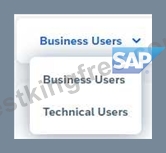
- A. Business
- B. Technical
- C. Administration
- D. Development
Answer: A,B
NEW QUESTION # 22
Which of the following objects can be replicated from SAP Service Cloud Version 2 to SAP S/4HANA? Note: There are 2 correct answers to this question.
- A. Products
- B. Service contracts
- C. Contacts
- D. Registered products
Answer: C,D
NEW QUESTION # 23
Which options can be used to control the access rights of a user? Note: There are 2 correct answers to this question.
- A. Create territory hierarchy levels
- B. Remove personal data from the business user
- C. Assign restriction rules
- D. Assign employee to organizational unit
Answer: C,D
NEW QUESTION # 24
What information can be maintained in the Related Objects facet of a case? Note: There are 3 correct answers to this question.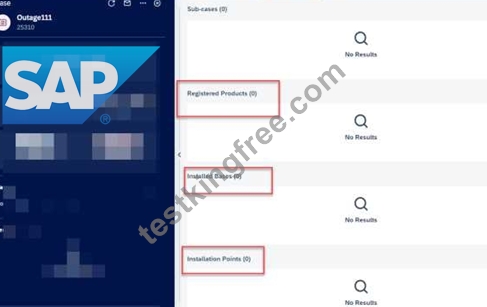
- A. Installation points
- B. Products
- C. Installed bases
- D. Registered products and installed bases related to the account only
- E. Registered products
Answer: A,C,E
NEW QUESTION # 25
Which model can be used for ABAP cloud-native development?
- A. The ABAP Cloud Development Model
- B. ABAP RESTful Application Programming Model
- C. The SAP S/4HANA Cloud Extensibility Model
Answer: B
Explanation:
For ABAP cloud-native development, SAP recommends the ABAP RESTful Application Programming Model (RAP). RAP is designed for building cloud-ready, RESTful applications and extensions in the SAP BTP ABAP environment, supporting clean core principles. According to SAP documentation, "The ABAP RESTful Application Programming Model (RAP) is the standard model for cloud-native development in ABAP." The ABAP Cloud Development Model (A) is not a specific model. The SAP S/4HANA Cloud Extensibility Model (B) refers to extensibility approaches but is not specific to ABAP cloud-native development.
Reference:
SAP Help Portal: ABAP RESTful Application Programming Model
SAP Community: ABAP Cloud Development
NEW QUESTION # 26
Which actions could you perform to control the reaction times of a case? Note: There are 3 correct answers to this question.
- A. Escalate the case.
- B. Change the priority.
- C. Assign a territory to the case.
- D. Adjust the SLA.
- E. Assign a different team to the case.
Answer: A,B,D
Explanation:
To control the reaction times of a case in SAP Service Cloud V2, you can adjust the SLA to redefine response timelines, change the priority to increase urgency and trigger faster response times, and escalate the case to prioritize it for immediate action. According to SAP documentation, "Reaction times can be managed by adjusting SLAs, changing case priority, or escalating cases to ensure timely responses." Assigning a territory (D) affects routing but not reaction times directly. Assigning a different team (E) may influence handling but does not inherently control reaction times.
Reference:
SAP Help Portal: Case Management and SLA Configuration
SAP Community: Managing Case Reaction Times
NEW QUESTION # 27
Which of the following account types can be used in SAP Service Cloud Version 2? Note: There are 2 correct answers to this question.
- A. Individual customers
- B. Groups
- C. Contacts
- D. Channel partners
Answer: A,C
NEW QUESTION # 28
How can you trigger an event notification based on a specific condition?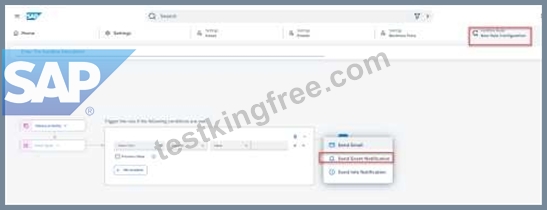
- A. Configure event management
- B. Configure autoflow
- C. Implement SDK logic
- D. Configure integration setting
Answer: B
NEW QUESTION # 29
Which screenshots show the correct configuration activities to meet the requirements for incoming service issues? Note: There are 2 correct answers to this question, scroll down to view all possible answer options.
- A.
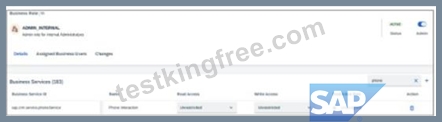
- B.
- C.
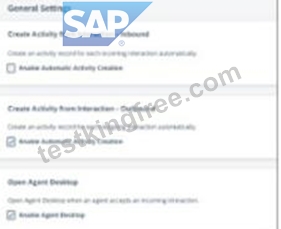
- D.
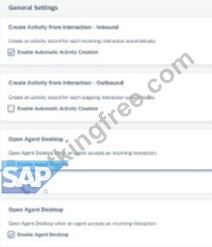
Answer: B,C
NEW QUESTION # 30
You are setting up an organizational structure for a new implementation. Which of the following is possible while performing this task?
- A. Assign an employee to several organizational units.
- B. Make sure an organizational node can only be set up with a replication process from the back end.
- C. Make sure that each organizational unit can have only one function at a time.
- D. Use the Reporting Line function for selection.
Answer: D
NEW QUESTION # 31
Which of the following services can be activated in SAP Service Cloud Version 2? Note: There are 2 correct answers to this question.
- A. Templates
- B. Maintenance plans
- C. Live activity configuration
- D. Agent Desktop
Answer: C,D
Explanation:
In SAP Service Cloud V2, Live activity configuration can be activated to enable real-time interaction features like phone or chat channels. The Agent Desktop is also a service that can be activated to provide agents with a centralized interface for case management. According to SAP documentation, "Services such as Live Activity Configuration and Agent Desktop can be activated to enhance service delivery in SAP Service Cloud V2." Maintenance plans (A) are managed in SAP S/4HANA, not Service Cloud V2. Templates (B) are configured but not activated as a service.
Reference:
SAP Help Portal: Service Activation in SAP Service Cloud V2
SAP Learning: Agent Desktop and Live Activity Setup
NEW QUESTION # 32
Which of the following activities are necessary for using cases in SAP Service Cloud Version 2? Note: There are 2 correct answers to this question.
- A. Set Up Business Roles
- B. Set Up Product Lists
- C. Activate Scoping Items
- D. Maintain Business Users
Answer: A,C
NEW QUESTION # 33
Which of the following services can be activated in SAP Service Cloud Version 2? Note: There are 2 correct answers to this question.
- A. Live activity configuration
- B. Initial user
- C. Agent Desktop
- D. Templates
Answer: C,D
NEW QUESTION # 34
What steps must an administrator perform to enable the phone channel in the Agent Desktop? Note: There are 2 correct answers to this question.
- A. Integrate with a third-party CTI provider.
- B. Add the phone channel to the live interaction widget.
- C. Obtain API token credentials from the CTI provider.
- D. Add a mashup service in the Agent Desktop.
Answer: A,C
NEW QUESTION # 35
What options are available to automatically assign an employee or team to a case? Note: There are 2 correct answers to this question.
- A. Set up rules with BRF+.
- B. Set up rule(s) for case routing to teams.
- C. Set up rule(s) for case routing to employees.
- D. Define case types and assign responsible teams and employees.
Answer: B,C
NEW QUESTION # 36
Which of the following features are available in the adaptation tool? Note: There are 2 correct answers to this question.
- A. Change the field label
- B. Create a new URL mashup
- C. Add a new button
- D. Add a new field
Answer: A,C
NEW QUESTION # 37
What steps are required to enable an extension field for cases that allow users to select more than one option? Note: There are 2 correct answers to this question.
- A. Create an extension field with data type Object and data format Code.
- B. Activate the Multi Value flag in the adaptation mode.
- C. Create an extension field with data type String and data format Code.
- D. Maintain the list of values and activate the Multi Value flag.
Answer: C,D
Explanation:
To enable an extension field for cases that allows multiple selections, administrators must create an extension field with data type String and data format Code to define a field that supports a code list (dropdown with multiple values). Additionally, they need to maintain the list of values and activate the Multi Value flag to allow users to select multiple options from the code list. According to SAP documentation, "For multi-select extension fields, create a field with data type String and format Code, then maintain the code list and enable the Multi Value flag." Activating the Multi Value flag in adaptation mode (B) is not a standard step, as it's done during field configuration. Data type Object (C) is used for relationships, not multi-select fields.
Reference:
SAP Help Portal: Extension Fields in SAP Service Cloud V2
SAP Community: Multi-Select Field Configuration
NEW QUESTION # 38
......
Get Perfect Results with Premium C-C4H56-2411 Dumps Updated 82 Questions: https://www.testkingfree.com/SAP/C-C4H56-2411-practice-exam-dumps.html
Free C-C4H56-2411 Exam Study Guide for the NEW Dumps Test Engine: https://drive.google.com/open?id=1ObDG_KCGboaWFFj9rU2iEh8e7jz2BSyk