
Exam Name: Strategic Ethical Leadership
Certification Provider: CIPS
Corresponding Certification: CIPS Level 6 Professional Diploma

Over 52825+ Satisfied Customers
Instant Download CIPS : L6M1 Questions & Answers as PDF & Test Engine

Updated: Nov 16, 2026
No. of Questions: 44 Questions & Answers with Testing Engine
Download Limit: Unlimited
Instant Download: Upon successful payment, Our systems will automatically send the product you have purchased to your mailbox by email. (If not received within 12 hours, please contact us. Note: don't forget to check your spam.)
100% Money Back Guarantee
TestKingFree has an unprecedented 99.6% first time pass rate among our customers.  We're so confident of our products that we provide no hassle product exchange.
- Best exam practice material
- Three formats are optional
- 10 years of excellence
- 365 Days Free Updates
- Learn anywhere, anytime
- 100% Safe shopping experience
L6M1 Online Test Engine
- Online Tool, Convenient, easy to study.
- Instant Online Access L6M1 Dumps
- Supports All Web Browsers
- L6M1 Practice Online Anytime
- Test History and Performance Review
- Supports Windows / Mac / Android / iOS, etc.
- Try Online Engine Demo
- Total Questions: 44
- Updated on: Nov 16, 2026
- Price: $69.00
L6M1 Desktop Test Engine
- Installable Software Application
- Simulates Real L6M1 Exam Environment
- Builds L6M1 Exam Confidence
- Supports MS Operating System
- Two Modes For L6M1 Practice
- Practice Offline Anytime
- Software Screenshots
- Total Questions: 44
- Updated on: Nov 16, 2026
- Price: $69.00
L6M1 PDF Practice Q&A's
- Printable L6M1 PDF Format
- Prepared by CIPS Experts
- Instant Access to Download L6M1 PDF
- Study Anywhere, Anytime
- 365 Days Free Updates
- Free L6M1 PDF Demo Available
- Download Q&A's Demo
- Total Questions: 44
- Updated on: Nov 16, 2026
- Price: $69.00
The fastest study plan is the one that starts today. Buy the CIPS Strategic Ethical Leadership material from TestKingFree, pay securely by credit card, and your L6M1 files are downloading within about a minute — install them anywhere you like.
CIPS L6M1 Exam Overview:
| Certification Vendor: | CIPS |
|---|---|
| Exam Name: | Strategic Ethical Leadership |
| Exam Number: | L6M1 |
| Certificate Validity Period: | Certification valid indefinitely (subject to continuing professional development) |
| Exam Duration: | 150 minutes |
| Real Exam Qty: | 4 written tasks |
| Exam Price: | GBP 265 |
| Passing Score: | 50% |
| Exam Format: | Written examination, Open-book (allowed: core textbook only), Scenario-based questions |
| Related Certifications: | CIPS Level 6 Diploma in Procurement and Supply MCIPS (Chartered Member) |
| Available Languages: | English |
| Sample Questions: | DOWNLOAD DEMO |
| Exam Way: | Paper-based or on-screen exam at approved test centres |
| Pre Condition: | Recommended: CIPS Level 4 or equivalent procurement experience; L6M0 (Applied Leadership and Management) is the recommended prerequisite |
| Official Syllabus URL: | https://www.cips.org/qualifications |
CIPS L6M1 Exam Syllabus Topics:
| Section | Weight | Objectives |
|---|---|---|
| Topic 1: Governance and Accountability | 15-20% | - Whistleblowing policies and procedures - Transparency and anti-corruption frameworks - Corporate governance principles - Fiduciary duties and conflict of interest management |
| Topic 2: Sustainable Supply Chain Management | 15-20% | - Human rights due diligence - Environmental sustainability in supply chains - Supplier code of conduct development - Modern Slavery Act compliance |
| Topic 3: Leadership in Procurement and Supply | 20-25% | - Ethical leadership models (Bass & Steidlmeier) - Creating an ethical culture and climate - Board-level and strategic leadership responsibilities - Transformational vs transactional leadership styles |
| Topic 4: Corporate Social Responsibility (CSR) | 15-20% | - Triple bottom line (People, Planet, Profit) - Integration of CSR into procurement strategy - UN Sustainable Development Goals alignment - CSR reporting frameworks and standards |
| Topic 5: Strategic Decision-Making Ethics | 10-15% | - Risk assessment of ethical decisions - Ethical decision-making models (Kidder, Rest) - Impact analysis on stakeholders - Managing ethical dilemmas in practice |
| Topic 6: Ethical Theories and Frameworks | 15-20% | - Stakeholder theory and social contract theory - Deontological ethics (Kantian duties, rights) - Virtue ethics (Aristotle's framework) - Teleological/utilitarian approaches |
CIPS L6M1 Exam — Frequently Asked Questions
The L6M1 exam is CIPS's official route to the CIPS Level 6 Professional Diploma certification (Level 6 (Advanced Diploma) level). For IT professionals building a career, it signals verified skill — the kind of advantage that tips better opportunities your way. It also sits in a family of related credentials: CIPS Level 6 Diploma in Procurement and Supply, MCIPS (Chartered Member).
Delivery is instant — files unlock at payment and a copy lands in your email within a minute; our 24/7 online service team responds within 2 hours if anything goes missing, and there are no installation limits. On refunds, our guarantee is real but conditional: take the corresponding L6M1 exam within 60 days of purchase, and if you fail, send a scanned enrollment slip plus the official Score Report PDF within 2 days of the exam — we process the full refund within 7 days. Exams taken within 3 days of purchase, name mismatches between candidate and payer, and free or expired products are excluded. Rather have a replacement? Exchange for two equal-value exam products free and keep your original updates.
Recommended: CIPS Level 4 or equivalent procurement experience; L6M0 (Applied Leadership and Management) is the recommended prerequisite Requirements like these do get updated, so confirm the details on the official exam page — official L6M1 exam information — before you spend anything on registration.
Registration runs GBP 265, and the pass mark is 50%. Paying by credit card is the standard route — safe and stable for both buyer and seller. And remember the fee is per attempt: a retake costs the same again, which is why candidates drill with the 44 practice questions from TestKingFree until their margin is comfortable.
The exam sets 4 written tasks questions against 150 minutes on the clock. That pairing punishes hesitation, so train it out: set a per-question budget, flag-and-return instead of freezing, and rehearse full timed sessions in the TestKingFree engine until pacing is automatic.
Yes — a free PDF demo lets you examine the question quality first. If you buy, 365 days of free updates are included, with new versions sent to you as they're released; an expired update period can be renewed later at 50% off.
Expect 6 domains in the CIPS Strategic Ethical Leadership blueprint, headlined by Strategic Decision-Making Ethics (10-15%), Governance and Accountability (15-20%), Corporate Social Responsibility (CSR) (15-20%). Use the weights as your study budget — high-percentage domains earn the most points per hour. The complete outline above has the full breakdown.
CIPS Strategic Ethical Leadership Sample Questions:
SIMULATION
Explain and evaluate how a Leader can use Management by Objectives (10 points). Discuss THREE ways to measure the effectiveness of leadership (15 points)
Correct Answer:
See the Answer is the explanation
Explanation:
Management by Objectives (MBO) and Measuring Leadership Effectiveness
Part 1: How a Leader Can Use Management by Objectives (MBO) (10 Points) Definition of Management by Objectives (MBO) Management by Objectives (MBO) is a leadership approach where leaders and employees set specific, measurable goals that align with the organization's strategic objectives. Developed by Peter Drucker, MBO emphasizes clear goal setting, performance tracking, and employee involvement.
How a Leader Can Use MBO Effectively
Setting Clear Objectives
Leaders work with employees to establish SMART goals (Specific, Measurable, Achievable, Relevant, Time-bound).
Example: A procurement leader may set an objective to reduce supplier costs by 10% within six months.
Aligning Individual and Organizational Goals
Ensures employees understand how their goals contribute to the company's success.
Example: A CPO (Chief Procurement Officer) aligns procurement cost-saving goals with the finance department's budget objectives.
Regular Performance Monitoring
Leaders conduct periodic reviews to track progress and provide feedback.
Example: Monthly progress check-ins ensure employees stay on track toward procurement efficiency goals.
Providing Support and Resources
Leaders remove obstacles and provide training or tools to help employees achieve their objectives.
Example: Implementing new procurement software to improve efficiency.
Performance Evaluation and Rewards
Employees are evaluated based on objective achievements, and success is rewarded (e.g., bonuses, promotions).
Example: Procurement staff meeting targets could receive performance-based incentives.
Evaluation of MBO's Effectiveness
✔ Pros: Improves goal clarity, accountability, and motivation.
✘ Cons: Can be rigid if objectives are too fixed, ignoring external changes.
Part 2: Three Ways to Measure Leadership Effectiveness (15 Points)
A leader's effectiveness is crucial for team performance, motivation, and achieving strategic objectives. Below are three key ways to measure leadership effectiveness.
1. Employee Engagement and Satisfaction
Definition: The level of motivation, commitment, and job satisfaction employees have under a leader.
How to Measure:
Conduct employee engagement surveys (e.g., using Likert scale questions).
Measure retention rates-low turnover indicates effective leadership.
Track employee feedback in performance reviews.
Why It's Important:
✔ A highly engaged workforce is more productive and innovative.
✔ Employees who trust leadership stay longer and contribute more.
2. Achievement of Organizational and Team Goals
Definition: The ability of a leader to drive the team toward achieving company objectives.
How to Measure:
Compare actual vs. target performance metrics (e.g., cost savings in procurement).
Analyze key performance indicators (KPIs) like project completion rates.
Track efficiency improvements in processes under the leader's direction.
Why It's Important:
✔ Demonstrates how well a leader can set, communicate, and execute strategic goals.
✔ Ensures leadership is focused on tangible results, not just employee relationships.
3. Adaptability and Problem-Solving Ability
Definition: A leader's ability to navigate challenges, handle change, and innovate under pressure.
How to Measure:
Assess how a leader handles crises or disruptions (e.g., supply chain breakdowns).
Review decision-making effectiveness during uncertain situations.
Gather 360-degree feedback from peers, subordinates, and senior leaders.
Why It's Important:
✔ Business environments change-leaders must adapt quickly to remain effective.
✔ Ensures that leadership is proactive rather than reactive in problem-solving.
Conclusion
A leader can use Management by Objectives (MBO) to drive performance through goal-setting, alignment, monitoring, and evaluation. Leadership effectiveness can be measured through employee engagement, goal achievement, and adaptability, ensuring that leaders not only set objectives but also inspire teams, navigate challenges, and deliver measurable success.
SIMULATION
Tom is a Supply Chain manager working in the automobile manufacturing industry in the UK. He has recently completed an analysis of his supply chain and is considering implementing strategies to encourage supply chain diversity, particularly around inclusivity of SMEs (small to medium sized enterprises).
Discuss a variety of strategies that Tom could employ to achieve supply chain diversity. (25 points)
Correct Answer:
See the Answer is the explanation
Explanation:
Overall explanation
Below you will find how you can plan and draft the essay. Remember this is an example of one way you could approach the question. At Level 6 the questions are much more open so your response may be completely different and that's okay.
Essay Plan
Intro - what is supply chain diversity?
1. Supplier diversity program and targets
2. Help SMEs build capacity to work with Tom
3. Collaboration and networking
4. Provide financial help
5. Uncomplicate procurement processes to allow SMEs to bid easier
Conclusion - supply chain diversity benefits the industry as a whole
Example Essay
Supply chain diversity refers to the practice of intentionally including a variety of suppliers from different backgrounds, ownership structures, and demographics in a company's supply chain. It is a win-win approach to supply chain management. The primary goal of supply chain diversity is to promote fairness, equality, and inclusivity within the supply chain, while also reaping the benefits of a diverse supplier base. Tom, as a Supply Chain manager, can employ several strategies to encourage supply chain diversity, with a specific focus on inclusivity for SMEs:
Supplier Diversity Programmes and Targets: Implementing a supplier diversity program is a proactive step to encourage SME participation in the supply chain. Tom can establish clear goals and guidelines for procurement such as encouraging bids from diverse suppliers, including SMEs, minority-owned, women-owned, and disabled-owned businesses. These programs can set targets and track progress to ensure inclusivity. One example would be to set a target of X number of suppliers being SMEs.
Capacity Building and Training: Tom can work with SMEs to build their capacity and capabilities to meet the requirements of the automobile manufacturing industry. This could involve providing training, mentorship, and resources to help SMEs meet quality, safety, and compliance standards. By investing in their development, SMEs can become more competitive suppliers.
Supplier Collaboration and Networking: Encouraging collaboration and networking among suppliers can create a supportive ecosystem for SMEs. Tom can organize events, workshops, and forums where SMEs can connect with larger suppliers and industry experts. Building these relationships can lead to partnerships and subcontracting opportunities, enabling SMEs to enter the supply chain.
Supplier Development Funds: Allocating funds specifically for supplier development can be a powerful incentive. Tom can establish a fund to help SMEs invest in equipment, technology, and process improvements necessary to meet the manufacturing industry's demands. These funds can be offered as grants, low-interest loans, or equity investments.
Streamlined Procurement Processes: Simplifying and streamlining the procurement process can make it easier for SMEs to participate in tendering opportunities. Tom can reduce bureaucratic hurdles and provide clear guidelines for SMEs to bid for contracts. In the automotive industry, suppliers are often required to have a certain cash flow and metrics such as gearing ratios. By reducing the financial requirements to bid for a contract, this would allow more SMEs to apply to work with Tom's company. Moreover digitizing procurement processes can also enhance accessibility and transparency, making it more SME-friendly.
In addition to these strategies, Tom should ensure that diversity and inclusivity considerations are integrated into the organization's overall supply chain strategy and corporate culture. This includes regular monitoring and reporting on diversity metrics, encouraging supplier diversity as a key performance indicator, and promoting awareness and education on diversity and inclusivity among employees and suppliers. By implementing supplier diversity strategies, Tom can foster a more inclusive and diverse supply chain in the UK's automobile manufacturing industry, benefiting not only SMEs but also the industry as a whole through enhanced innovation, competitiveness, and sustainability.
Tutor Notes
- I don't think the study guide covers supply chain diversity as well as it could. This question is taken from p. 204. Other options they mention in the book include; changing the organisational culture, getting commitment from senior leaders, integrating diversity into the corporate vision and joint ventures with SMEs.
- However there are a lot of really interesting online resources about supply chain diversity and the benefits. And some really good case stories about it. I'd recommend reading: Increasing SME Participation in Supply Chains - Deecon Consulting and looking at the Federation of Small Businesses FSB The Federation of Small Businesses | FSB, The Federation of Small Businesses also this initiative is really innovative: Support your SME supply chain - Heart of the City (theheartofthecity.com)
SIMULATION
Evaluate the 'Traits' approach to leadership (25 points)
Correct Answer:
See the Answer is the explanation
Explanation:
Introduction
Leadership plays a pivotal role in organizational success, influencing decision-making, team performance, and strategic direction. One of the earliest and most enduring leadership theories is the "Traits Approach to Leadership." This theory suggests that certain inherent traits make an individual an effective leader. Unlike other leadership theories that focus on behaviors or situational factors, the traits approach assumes that leaders are born, not made.
This essay will critically evaluate the traits approach to leadership, discussing its key characteristics, advantages, limitations, and relevance in modern organizational contexts, particularly in procurement and supply chain management.
Understanding the Traits Approach to Leadership
Definition
The Traits Approach to Leadership is based on the idea that effective leaders possess inherent personality traits that differentiate them from non-leaders. These traits are considered stable over time and consistent across different situations.
Early leadership research focused on identifying the common traits found in successful leaders across industries, military settings, and politics.
Key Characteristics of the Traits Approach
Innate Leadership Qualities - Leadership is seen as something a person is born with, rather than developed.
Focus on Personality Traits - Effective leaders exhibit specific personality traits such as intelligence, confidence, and emotional stability.
Universal Application - The theory assumes that leadership traits apply across all industries and organizational settings.
Predictability of Leadership Success - If someone possesses the right traits, they are more likely to become a successful leader.
Common Leadership Traits Identified in Research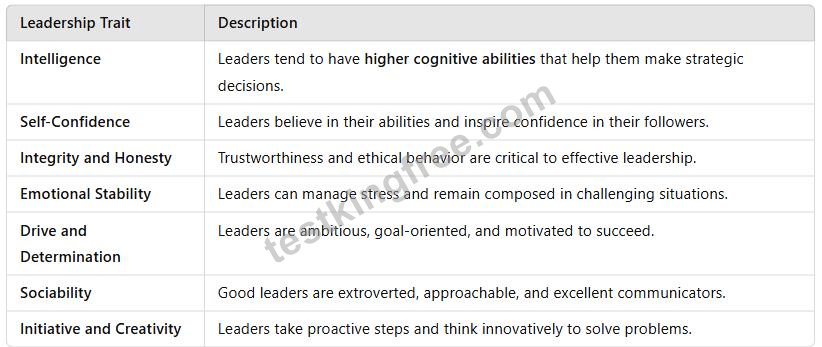
These traits suggest that leaders are naturally equipped with qualities that allow them to excel in their roles.
Advantages of the Traits Approach to Leadership (10 Points)
1. Identifies Key Leadership Qualities
The traits approach helps organizations identify individuals with leadership potential by assessing personality traits.
Example: In procurement, a leader with high intelligence and problem-solving skills can effectively negotiate supplier contracts and manage risks.
2. Provides a Foundation for Leadership Selection
Organizations can use personality assessments to select and promote leaders based on their inherent characteristics.
Example: A company hiring a Chief Procurement Officer (CPO) may look for candidates who exhibit confidence, strong decision-making skills, and integrity.
3. Universally Recognized and Researched
This approach has been extensively studied for decades, making it one of the most well-documented leadership theories.
Example: Many successful world leaders, such as Steve Jobs and Nelson Mandela, exhibited self-confidence, resilience, and intelligence-key traits identified in the model.
4. Helps Develop Leadership Training Programs
Although traits are largely inborn, some leadership traits can be developed through training and experience.
Example: An employee with high intelligence but low sociability can undergo communication and emotional intelligence training to become a more effective leader.
5. Supports Leadership Continuity and Succession Planning
Organizations can identify and groom future leaders by assessing leadership traits early in their careers.
Example: A procurement manager with initiative, strong ethics, and analytical skills can be promoted to a strategic leadership role.
Limitations of the Traits Approach to Leadership (10 Points)
1. Ignores the Influence of Situations and Context
Leadership effectiveness depends on the situation rather than just traits.
Example: A leader with strong confidence and intelligence may struggle in a highly bureaucratic organization where decision-making is slow.
2. Fails to Explain Leadership Development
This theory assumes that leaders are born, not made, which contradicts modern research showing that leadership can be learned and developed.
Example: Many successful CEOs started as entry-level employees and developed their leadership skills over time.
3. Overlooks the Importance of Leadership Behaviors
Having the right traits does not automatically make someone an effective leader-their actions, decision-making style, and adaptability matter more.
Example: A procurement leader with high intelligence but poor communication skills may fail to build strong supplier relationships.
4. No Clear Agreement on Essential Traits
Different studies identify different sets of leadership traits, making it difficult to define a universal leadership profile.
Example: Some researchers emphasize charisma and extroversion, while others focus on humility and adaptability.
5. Does Not Account for Cultural Differences
Leadership traits may not be universal across cultures-a trait that is valuable in one culture may not be as important in another.
Example: In Western cultures, assertiveness is valued, while in Asian cultures, humility and collective decision-making are preferred leadership traits.
Relevance of the Traits Approach in Modern Organizations
Despite its limitations, the traits approach remains relevant in leadership selection and development. Modern organizations integrate it with other leadership theories to create a holistic leadership model.
1. Integration with Behavioral Leadership Models
Instead of assuming that traits alone determine leadership success, organizations combine it with behavioral approaches that emphasize leadership actions.
Example: Transformational leadership combines traits (e.g., charisma, confidence) with inspiring behaviors to create an effective leadership model.
2. Use in Leadership Assessments and Hiring
Organizations use psychometric assessments to evaluate potential leaders based on personality traits.
Example: The Big Five Personality Model (openness, conscientiousness, extraversion, agreeableness, neuroticism) is commonly used in executive hiring.
3. Helps in Leadership Development Programs
While some leadership traits are inborn, others can be developed through mentorship, training, and experience.
Example: Procurement professionals can enhance their decision-making skills, emotional intelligence, and adaptability through leadership development programs.
Conclusion
The traits approach to leadership has been a foundational theory in leadership studies, helping organizations understand the qualities that define effective leaders. It provides valuable insights into leadership selection, succession planning, and training.
However, the approach has several limitations, particularly its lack of situational awareness and failure to explain leadership development. Modern organizations recognize that while leadership traits are important, behaviors, experience, and adaptability play an equally critical role.
The most effective approach to leadership combines trait theory with behavioral and situational leadership models to create a well-rounded leadership development framework. This ensures that leadership is not just about natural talent but also about continuous learning, adaptability, and strategic execution.
SIMULATION
Discuss the 5 approaches to management of the Blake Mouton Managerial Grid. How can this be applied to the role of a procurement manager? (25 points)
Correct Answer:
See the Answer is the explanation
Explanation:
Introduction
Management effectiveness is critical for organizational success, particularly in functions like procurement, where balancing cost efficiency, supplier relationships, and operational effectiveness is key. The Blake Mouton Managerial Grid provides a framework for evaluating leadership styles based on a manager's concern for people (team members, stakeholders, suppliers) versus concern for production (task completion, efficiency, and profitability).
This essay will discuss the five approaches to management outlined in the Blake Mouton Managerial Grid and explore how procurement managers can apply them to enhance procurement performance.
Understanding the Blake Mouton Managerial Grid
The Blake Mouton Managerial Grid (1964) classifies management styles based on two axes:
Concern for People - The degree to which a leader considers employee motivation, satisfaction, and well-being.
Concern for Production (or Task) - The extent to which a leader focuses on achieving organizational goals, efficiency, and productivity.
This results in five distinct leadership styles, each with its strengths and weaknesses.
The Five Approaches to Management in the Blake Mouton Grid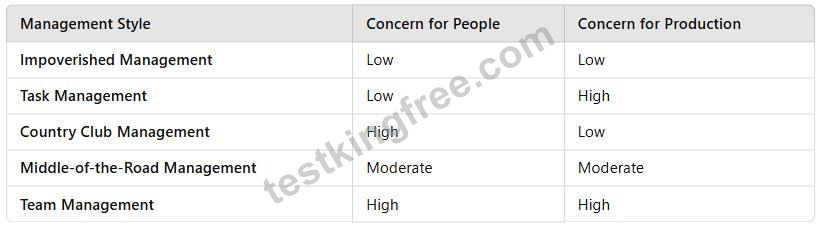
1. Impoverished Management (Low Concern for People, Low Concern for Production) Description:
Leaders with an impoverished management style exert minimal effort to manage people or production.
They often avoid decision-making, fail to motivate employees, and show little interest in organizational goals.
This approach leads to low productivity, disengaged employees, and poor procurement outcomes.
Impact on Procurement Management:
❌ Weak supplier management - Poor relationships with suppliers may lead to delivery delays and contract failures.
❌ No cost control - Procurement teams may fail to negotiate favorable pricing due to lack of leadership.
❌ Lack of strategic alignment - Procurement fails to support organizational goals, resulting in inefficiencies.
Example:
A procurement manager who ignores supplier performance reviews, does not enforce contract terms, and fails to manage procurement risks would be practicing an impoverished management style.
2. Task Management (High Concern for Production, Low Concern for People) Description:
Task-oriented managers focus solely on efficiency, cost-cutting, and productivity, while neglecting employee well-being and engagement.
This style is highly authoritative and focuses on strict rules, efficiency, and results-driven processes.
Impact on Procurement Management:
✅ Strict cost control - The procurement team will focus on cutting costs and maximizing efficiency.
✅ Strong compliance enforcement - Ensures strict adherence to procurement policies and regulations.
❌ Supplier dissatisfaction - Overly aggressive cost-cutting and negotiation tactics may harm supplier relationships.
❌ Low employee morale - Procurement assistants may feel undervalued, leading to high staff turnover.
Example:
A procurement manager who focuses only on cost reduction and efficiency, without considering supplier relationships or team well-being, would fit this style.
3. Country Club Management (High Concern for People, Low Concern for Production) Description:
A country club manager prioritizes employee satisfaction and relationships but neglects productivity and performance.
This results in a friendly, low-pressure environment, but with low accountability and inefficiency.
Impact on Procurement Management:
✅ Strong supplier and stakeholder relationships - Procurement teams collaborate well with suppliers but may overpay due to a lack of tough negotiations.
✅ High team morale - Employees feel valued and motivated.
❌ Lack of cost efficiency - Over-prioritizing relationships may result in weak cost controls.
❌ Ineffective risk management - Procurement managers may fail to enforce strict supplier performance criteria.
Example:
A procurement manager who develops strong relationships with suppliers but fails to hold them accountable for poor performance is practicing country club management.
4. Middle-of-the-Road Management (Moderate Concern for People, Moderate Concern for Production) Description:
Balances both people and task concerns, but does not excel in either.
Ensures some level of efficiency and employee satisfaction, but lacks a strong strategic direction.
Impact on Procurement Management:
✅ Balanced supplier relationships - Ensures cost efficiency while maintaining supplier goodwill.
✅ Moderate employee engagement - The team feels reasonably motivated, but lacks innovation and strong leadership.
❌ Missed cost-saving opportunities - Procurement might fail to maximize value due to a lack of strategic focus.
❌ Lack of strong risk mitigation - The procurement manager may not aggressively manage risks, leading to supply chain disruptions.
Example:
A procurement manager who performs adequately but does not drive significant improvements or cost savings fits this style.
5. Team Management (High Concern for People, High Concern for Production) Description:
The most effective leadership style, where the manager prioritizes both team well-being and achieving high performance.
Encourages collaboration, innovation, and accountability.
Focuses on both supplier relationships and cost efficiency.
Impact on Procurement Management:
✅ Optimized supplier performance - Ensures strong contract management, strategic sourcing, and supplier collaboration.
✅ High employee morale and performance - Employees are engaged, trained, and motivated to drive procurement success.
✅ Balanced cost and quality approach - Focuses on achieving cost efficiency while maintaining quality standards.
✅ Encourages innovation in procurement - Uses data analytics, AI, and technology to improve procurement processes.
Example:
A procurement manager who mentors their team, fosters supplier partnerships, and ensures cost savings while maintaining ethical procurement practices follows a team management approach.
Application of the Blake Mouton Grid to Procurement Management
The Blake Mouton Grid helps procurement managers identify their leadership style and improve team performance and supplier management. Here's how:
Developing High-Performance Procurement Teams - Procurement managers should strive for a team management approach, ensuring both efficiency and employee engagement.
Enhancing Supplier Relationship Management - A balanced approach ensures fair negotiations, long-term partnerships, and cost efficiency.
Strategic Cost Management - Managers should avoid being overly task-focused (cost-cutting) or too lenient on supplier pricing.
Improving Risk Management - Ensuring strong governance and compliance while maintaining good supplier relationships.
Continuous Improvement - Encouraging innovation, sustainability, and procurement technology adoption.
Conclusion
The Blake Mouton Managerial Grid provides valuable insights into leadership effectiveness in procurement management. Among the five approaches:
Team Management is the most effective style for procurement managers, balancing supplier relationships, cost efficiency, and employee engagement.
Task Management may be useful in cost-control situations, but must be balanced with ethical supplier management.
Country Club, Middle-of-the-Road, and Impoverished Management styles are less effective, as they fail to balance procurement efficiency and supplier relationships.
By adopting a "Team Management" approach, procurement managers can drive strategic value, optimize supplier performance, and enhance procurement team capabilities, ultimately contributing to long-term business success
SIMULATION
What is meant by ethical supply chain management? (5 points). Discuss how the following can impact upon a supply chain and ways a supply chain manager can mitigate the risks: corporate governance, bribery and corruption, insider trading and discrimination (20 points)
Correct Answer:
See the Answer is the explanation
Explanation:
Overall explanation
Below you will find how you can plan and draft the essay. Remember this is an example of one way you could approach the question. At Level 6 the questions are much more open so your response may be completely different and that's okay.
Essay Plan
Intro - ethical supply chain management = environment, society and wellbeing of stakeholders P1 - corporate governance P2 - bribery and corruption P3 - insider trading P4 - discrimination Conclusion - Upholding these ethical principles not only benefits the organization but also contributes to a more just and responsible global business environment.
Example Essay
Ethical supply chain management involves the integration of ethical principles and practices into every aspect of a supply chain's operations. It focuses on ensuring that the supply chain not only meets its goals of efficiency, cost-effectiveness, and profitability but also operates in a manner that is socially responsible and aligned with moral values. Ethical supply chain management aims to create value while considering the impact on the environment, society, and the well-being of all stakeholders involved, particularly those that have traditionally been exploited or marginalised. Supply chain managers play a pivotal role in establishing and upholding ethical standards within the supply chain.
Corporate Governance:
Corporate governance refers to the framework of rules, practices, and processes by which a company is directed and controlled. It encompasses the relationships among the company's management, its board of directors, shareholders, and other stakeholders. Supply chain managers should ensure that their organization's corporate governance practices are transparent, accountable, and aligned with ethical standards.
For example, the Enron scandal in the early 2000s serves as a stark reminder of the consequences of poor corporate governance. Enron's executives engaged in unethical and fraudulent practices, leading to the company's collapse. This scandal highlighted the importance of transparent corporate governance to prevent such lapses.
Supply chain managers can contribute to ethical corporate governance by establishing mechanisms for transparency, accountability, legal compliance, and ethical oversight within the supply chain.
Bribery and Corruption:
Bribery involves the offering, giving, receiving, or soliciting of something of value with the aim of influencing the actions of an official or other person in a position of authority. Corruption, on the other hand, encompasses a broader range of dishonest or unethical behaviour, including bribery, embezzlement, and abuse of power. Supply chain managers must actively combat bribery and corruption within the supply chain.
One prominent example of bribery and corruption in the supply chain is the case of the Brazilian construction giant Odebrecht. The company was involved in a vast bribery scheme across Latin America, implicating high-ranking politicians and business leaders. This case underscores the far-reaching consequences of unethical practices within the supply chain.
To mitigate the risk of bribery and corruption, supply chain managers should implement anti-bribery policies, conduct due diligence on suppliers, establish reporting mechanisms, and regularly audit and monitor the supply chain for compliance.
Insider Trading:
Insider trading involves trading securities based on non-public, material information. It is a form of market abuse that undermines fairness and transparency in financial markets. Supply chain managers should address insider trading risks within the organization.
A well-known example of insider trading is the case of Martha Stewart, the American businesswoman and television personality. Stewart sold her shares in a pharmaceutical company, ImClone Systems, based on non-public information about the FDA's impending rejection of the company's drug application. She was later convicted of insider trading.
To prevent insider trading, supply chain managers can limit access to sensitive information, educate employees about insider trading laws, establish monitoring and reporting mechanisms, and ensure legal compliance.
Discrimination:
Discrimination involves treating individuals unfairly or unequally based on their characteristics, such as race, gender, age, or disability. Discrimination within the supply chain can have detrimental social and legal consequences.
To combat discrimination, supply chain managers should promote equal opportunity, implement diversity initiatives, conduct training and awareness programs, and enforce non-discrimination policies throughout the supply chain.
In conclusion, ethical supply chain management is integral to an organization's overall sustainability and reputation. Supply chain managers should actively manage ethics in areas such as corporate governance, bribery, corruption, insider trading, and discrimination to ensure that the supply chain operates ethically, complies with legal standards, and aligns with moral values. Upholding these ethical principles not only benefits the organization but also contributes to a more just and responsible global business environment.
Tutor Notes
- For a higher score you should mention some of the legislation surrounding these areas:
- Corporate Governance = Companies Act 2006: This legislation lays out the statutory duties of company directors and officers, addresses corporate governance issues, and provides requirements for financial reporting, disclosure, and shareholder rights.
- Corporate Governance = UK Corporate Governance Code: Although not a law, this code issued by the Financial Reporting Council (FRC) sets out principles of good corporate governance that UK-listed companies are encouraged to follow. It provides guidelines on board composition, transparency, accountability, and more.
- Bribery and Corruption: Bribery Act 2010: This act is the primary legislation governing bribery and corruption in the UK. It introduced strict anti-bribery provisions, including criminal offenses related to bribery, both domestically and internationally.
- Insider Trading: Criminal Justice Act 1993: Part V of this act includes provisions related to insider dealing (insider trading) offenses. It criminalizes the misuse of insider information in relation to securities and other financial instruments.
- Discrimination: Equality Act 2010: This comprehensive legislation addresses discrimination on various grounds, including age, disability, gender, race, religion or belief, sexual orientation, and gender reassignment. It provides protection against discrimination in employment, education, housing, and other areas of public life.
Viewing page 1 out of 9 pages.
Viewing questions 1-5 out of 44 questions.
 868 Customer ReviewsCustomers Feedback (* Some similar or old comments have been hidden.)
I am a staff of the company, and my boss wanted us to obtain the certificate for L6M1 exam, then I chose the materials online, and I bought L6M1 exam braindumps from you, and I had obtained the certification successfully!
Afra

I just received my certification. Thanks to TestKingFree for helping me pass my L6M1 exam.
Kenneth

If you want to pass the L6M1 exam, buy this L6M1 preparation questions, and you will feel greatful for your wise choice as me!
Richard
I have a lot of work to do, but i still want to have a L6M1 certification. Your L6M1 exam braindumps helped me achieve it today. Big thanks!
Samuel
I passed L6M1 this time.
Robin
A good day I passed L6M1 exam, thank you TestKingFree, no your help, no my success.
Natividad
Some of your answers of L6M1 are perfect.
Eden
This dump is valid. I passed L6M1. The materials can help you prepared for the exam well. I will also use TestKingFree study guide next time.
Steward
All my questions are from your materials.
L6M1 passed
Everley
Some new questions and some of your answers are incorrect.Perfect materials guys.
Nick
I'd say if you want to pass the exam with ease, these L6M1 practice briandumps are required as the most important factor. I have cleared my exam and tested its high-effective!
Primo
Using this I got hired at a great tech company of the city. Thanks a lot for high quality L6M1 dump.
Howar
I have failed once, this time I decide to choose the L6M1 dumps for help, lucky I passed it,you gays can rely on the TestKingFree.
Hubery
Instant Download L6M1
After Payment, our system will send you the products you purchase in mailbox in a minute after payment. If not received within 2 hours, please contact us.
365 Days Free Updates
Free update is available within 365 days after your purchase. After 365 days, you will get 50% discounts for updating.

Money Back Guarantee
Full refund if you fail the corresponding exam in 60 days after purchasing. And Free get any another product.
Security & Privacy
We respect customer privacy. We use McAfee's security service to provide you with utmost security for your personal information & peace of mind.
